How to Get Mobile Internet in Japan in 2026
A travel eSIM is the easiest way for most tourists to get mobile internet in Japan, while local SIMs suit longer stays, roaming suits short trips, and pocket Wi-Fi works for groups. Compare costs, data needs, network coverage, and setup tips to stay connected across Japan.

The easiest way to get "mobile internet in Japan" in 2026 is with a travel eSIM installed before departure. A local SIM works for longer stays, home-carrier roaming can suit short trips, and pocket WiFi is useful for families or groups.
Japan has strong 4G and growing 5G coverage across major cities and popular tourist routes. However, rural areas and remote islands can have weaker signals, while public Wi-Fi isn't always available when you need it. Choosing a connection before arrival makes travelling easier.
This blog explains "how to get internet in Japan", compares the costs and benefits of each option, and helps you choose the right data allowance. You can also explore our Japan Travel Guide and Will My Phone Work in Japan guide before departure.
Quick Answer: What Is the Best Way to Get Internet in Japan?
For most tourists, a travel eSIM offers the easiest setup and flexible data options without changing physical SIM cards. However, the best choice depends on your trip length, budget, phone compatibility, and whether you need a Japanese phone number.
What Is Mobile Internet in Japan Like?
Japan has four major mobile network operators: NTT Docomo, au (KDDI), SoftBank, and Rakuten Mobile.
According to Opensignal's April 2026 mobile network report, each has different strengths:
- NTT Docomo: Widest overall and 5G coverage footprint in populated areas.
- au (KDDI): Strong performance for reliability and video experience.
- SoftBank: Fastest average download speed at 65.1 Mbps in the report.
- Rakuten Mobile: Strong upload speeds, with an expanding 5G network.
Japan's major 3G networks have also shut down, with NTT Docomo ending its service on March 31, 2026. Travellers now need a phone compatible with supported 4G or 5G networks.
For everyday travel, the "mobile internet Japan" offers is generally dependable. However, network performance can change in mountains, national parks, and remote islands.
How Can Tourists Get Internet in Japan?
There are five main ways to access the internet in Japan that travellers need: a travel eSIM, local SIM, international roaming, pocket WiFi, or public Wi-Fi. Each suits different travel needs.

#1. Travel eSIM
A travel eSIM is a digital SIM that connects your phone to a Japanese mobile network without inserting a physical card.
You buy a plan online, install it through an app or QR code, and connect to a supported network when you arrive. Installation can usually be completed over Wi-Fi before departure, although activation rules vary by provider.
Most travel eSIMs are data-only, so they don't include a Japanese phone number. However, compatible dual-SIM phones can keep your home line available while using the eSIM for data.
If you're wondering, "how can I use my phone in Japan" without replacing your regular SIM, this is often the most convenient solution.
Internet-based calls through LINE or WhatsApp work over mobile data. Some providers, including Jetpac, also offer optional in-app calling to regular phone numbers.
Advantages: Simple setup, no physical SIM swap, flexible data packages, and convenient top-ups.
Limitations: Requires an unlocked, eSIM-compatible phone. Hotspot rules, data limits, and coverage depend on the provider.
Read How Does eSIM Work in Japan for more details.
#2. Local SIM Card
A physical "SIM Card for Japan" is useful for travellers who prefer traditional SIM cards or need a Japanese phone number.
Tourist SIMs are available at major airports such as Narita, Haneda, and Kansai, as well as electronics stores including BIC Camera and Yodobashi Camera. Providers such as Mobal and Sakura Mobile also offer advance ordering and collection options.
Most prepaid tourist SIMs provide mobile data only. If you need to make regular calls or receive Japanese SMS messages, look for a voice-enabled SIM with a local number.
Before buying, check that your phone is unlocked, confirm any passport or identity requirements, and ask whether manual APN settings are needed.
Advantages: Flexible data options and access to Japanese phone numbers through eligible voice plans.
Limitations: Physical setup, potential identity verification, and plans that generally cover Japan rather than multiple countries.
#3. International Roaming
Roaming lets you connect to a Japanese mobile network through your existing home carrier. It requires little setup, but charges depend on your plan.
For travellers researching "Data Roaming in Japan", here are some common US carrier options:
Note: T-Mobile's eligible plans may already include international data, although high-speed allowances differ. Check your specific benefits before buying another pass.
Our guide on Does T-Mobile Work in Japan explains the available options.
Best practice: Check your carrier's Japan rates, daily charging rules, and data limits before travelling. Without an included allowance or suitable pass, roaming can lead to unexpected charges.
#4. Pocket WiFi
If you're wondering "how to get WiFi in Japan" for several devices, pocket WiFi is another option.
A pocket WiFi in Japan is a portable router that connects to a Japanese mobile network and shares its connection with nearby phones, tablets, or laptops.
Providers such as Japan Wireless and Sakura Mobile offer rental services with airport collection or delivery options. Rental prices often range from approximately ¥500 to ¥1,500 per day, depending on the package and duration.
Advantages: Convenient for groups, families, and travellers carrying several devices.
Limitations: Requires regular charging, adds another device to carry, and must be returned at the end of the rental.

#5. Public Wi-Fi
If you're searching for "how to get WiFi in Japan" without paying, free networks are available at many airports, hotels, cafés, convenience stores, and railway stations.
Some Shinkansen services also offer complimentary connectivity. For example, the Tokaido, Sanyo, and Kyushu Shinkansen provide Shinkansen_Free_Wi-Fi, which requires registration and may ask users to reconnect every 30 minutes.
However, free internet in Japan is provided through public hotspots and isn't always reliable when you're moving between attractions.
Use public Wi-Fi for occasional browsing and downloads, but avoid sensitive activity on unsecured networks. A trusted VPN can provide additional protection.
eSIM vs SIM vs Roaming vs Pocket WiFi
Here's how the four paid options for "mobile internet in Japan" compare.
Does Japan Have Good Mobile Coverage?
Yes. Japan offers generally strong mobile coverage in cities and along major transport routes, although reception varies in remote areas.
Coverage in Major Cities
Tokyo, Osaka, Kyoto, Nagoya, Fukuoka, and Sapporo generally have reliable 4G and growing 5G availability across the main operators.
However, reception can weaken inside underground stations, tunnels, and buildings with thick walls.
Coverage Outside Cities
If you're researching "how to get cell service in Japan" for a rural itinerary, checking your provider's coverage is particularly important.
Mountainous areas such as the Japanese Alps, national parks, remote islands, and smaller villages may have weaker or inconsistent signals.
Mobile connectivity on trains can also vary, particularly through tunnels and mountainous stretches. Downloading offline maps before travelling outside major cities is a useful precaution.
4G vs 5G
Both 4G and 5G are available in Japan, but 5G coverage is not universal.
For most travellers, 4G is sufficient for navigation, messaging, bookings, browsing, and video calls. 5G may provide faster speeds where available, although performance depends on network conditions and your device.
How Much Mobile Data Do You Need in Japan?
Your "data plan for Japan trip" should match your trip length and everyday usage rather than price alone.
These are estimates, not fixed requirements. Maps and messaging use relatively little data, while streaming, video calls, and laptop hotspots can consume much more.
Travel tip: Download offline maps and Japanese translation packs before departure. Use hotel Wi-Fi for large downloads to reduce mobile data usage.
How Much Does Mobile Internet in Japan Cost?
The cost of "mobile internet Japan" travellers buy varies by provider, data allowance, and validity period. Here are indicative prices for 2026.
For reference, Jetpac's listed 30-day Japan packages include 30 GB for $29.99, 40 GB for $34.99, and an unlimited option for $65.99, based on its October 2026 product listing.
When choosing a "data plan for Japan trip", compare validity and high-speed allowances alongside price. An eSIM may cost less than daily roaming, but travellers with included international data might not need a separate plan.
What Is the Best Internet Option for Your Trip?
The answer to "how to get internet in Japan" depends on your itinerary and connectivity needs.
How to Choose an eSIM for Japan
Finding the "best eSIM for Japan" means comparing the features that matter for your trip, not simply choosing the cheapest plan.
Our Best eSIM for Japan guide compares providers in more detail.
Check Country Coverage
A Japan-only plan works for a single-country trip. If you're also visiting South Korea, Taiwan, or another destination, compare regional and global coverage options.
Check How Much Data You Need
Avoid paying for unlimited data if you mainly use maps, messaging, and browsing. Match the allowance to your trip and check whether top-ups are available.
Check Network Partners
The coverage of an "eSIM Japan" plan depends on the local networks it uses.
Compare providers that connect through NTT Docomo, au, SoftBank, or Rakuten Mobile, especially when your itinerary includes remote destinations. Some eSIMs support more than one partner network.
Check Hotspot Rules
If you're travelling with a laptop or sharing data, confirm whether the plan allows tethering and whether any data or speed restrictions apply.
Check Speed and Fair-Use Limits
Unlimited data doesn't always mean unlimited high-speed data. Some plans reduce speeds after a daily allowance.
For example, Jetpac's unlimited Japan plan provides 3 GB every 24 hours at standard network speeds, followed by speeds of up to 1 Mbps until the next cycle.

Check Activation Rules
Some eSIM plans start when installed, while others begin when first connected to a supported network. Confirm the provider's validity rules before departure.
Make Sure Your Phone Is Compatible and Unlocked
Your device must support eSIM and be carrier-unlocked. Read Will My Phone Work in Japan to check your phone's compatibility.
How to Set Up Mobile Internet Before Your Trip
Setting up "mobile internet in Japan" before departure helps you access maps and bookings as soon as you arrive.
If Using an eSIM
Our How to Get an eSIM for Japan guide explains the full process.
- Check that your phone supports eSIM and is unlocked.
- Buy a suitable plan and install it over Wi-Fi.
- Keep your regular SIM active if needed.
- Set the travel eSIM as your mobile data line.
- Enable data roaming on the travel eSIM if required.
- Disable roaming on your home SIM if you want to avoid accidental charges.
- Test your connection after arriving in Japan.
If Using a Physical SIM
Before departure, check that your phone is unlocked.
After arriving, purchase a tourist SIM from an authorized retailer, complete any required identity verification, and follow the installation instructions. Some SIMs require manual APN configuration.
Before Leaving Home
- Download offline maps and Japanese translation packs.
- Save your hotel address and booking details.
- Install useful transport and navigation apps.
- Save emergency contacts and important numbers.
- Keep train tickets and reservations available offline.
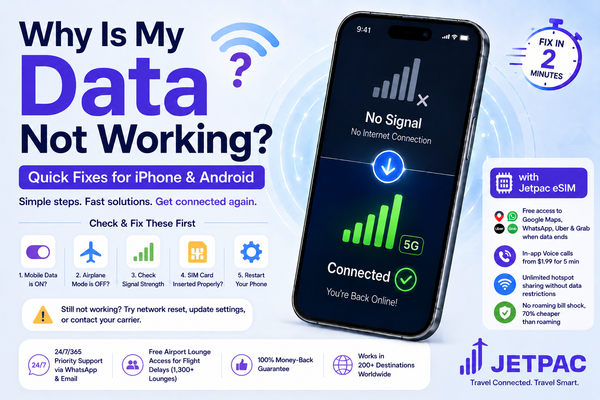
What to Do If Your Mobile Internet Is Not Working
If your connection stops working in Japan, try these quick fixes.
If none of these steps work, contact your provider to check activation, account status, and available network coverage.
Stay Connected in Japan With Jetpac
Japan eSIM from Jetpac offers a convenient way to stay connected without purchasing a physical SIM card. You can install it before travelling and connect to a supported Japanese network when you arrive.
Jetpac works with KDDI (au) and Rakuten Mobile in Japan, with automatic switching between supported networks to help maintain a stronger available connection.
Why Consider Jetpac for Japan?
- Flexible data options: Choose fixed-data plans up to 40 GB or an unlimited package, with different validity periods.
- Unlimited hotspot sharing: Connect a laptop or other devices without a separate tethering cap, while your plan's data and speed conditions still apply.
- Essential app access: Continued access to WhatsApp chat, Google Maps navigation, Uber, and Grab when regular data runs out.
- In-app calling: Optional voice packs start at $1.99 for 5 minutes to make supported outgoing calls.
- Reusable eSIM: Keep one installed eSIM profile and purchase compatible plans across 200+ destinations.
- SmartDelay: Eligible travellers can register flights for complimentary airport lounge access if qualifying delays occur, subject to terms.
Is Jetpac Right for Your Trip?
Jetpac is worth considering if you want digital setup, flexible data allowances, and hotspot sharing without carrying another device.
It can suit city breaks, multi-stop itineraries, and travellers who want to keep their regular SIM available. However, your phone must be unlocked and eSIM-compatible.
Jetpac's standard Japan data eSIM doesn't provide a Japanese mobile number or regular SMS. If those are essential, a voice-enabled local SIM may be more suitable.
For trips to remote mountains or islands, check the coverage of Jetpac's partner networks before purchasing.
FAQs
What is the best way to get mobile internet in Japan?
For most tourists, a travel eSIM is the easiest option. Local SIMs suit longer stays, roaming may work for short trips, and pocket WiFi is useful for groups.
Can I use my phone in Japan without paying roaming charges?
Yes. Use a travel eSIM or local SIM for data and disable roaming on your home SIM. Some carriers also include international data on eligible plans.
Is eSIM or a local SIM better for Japan?
A travel eSIM is more convenient for most tourists. A local voice SIM may be better if you need a Japanese phone number or specific long-stay services.
Does my phone need to be unlocked to use an eSIM in Japan?
Yes. Your phone must be carrier-unlocked and eSIM-compatible to use an eSIM from a different provider.
Can I keep my regular phone number while using a travel eSIM?
Yes, on compatible dual-SIM phones. Your home SIM can remain active for calls and texts while the travel eSIM handles mobile data. Home-carrier charges may still apply.
Is mobile internet reliable in rural areas of Japan?
Coverage varies in mountains, national parks, and remote islands. Check your provider's partner network and download offline maps before travelling.
Do I need a passport to buy a SIM card in Japan?
Bring your passport. Voice-enabled SIMs generally require identity verification, while data-only SIM requirements vary by provider and applicable regulations.
Does Japan have free Wi-Fi for tourists?
Yes. Free Wi-Fi is available at many airports, hotels, cafés, railway stations, and some trains. It's useful as a backup, but coverage and reliability vary.
Disclaimer
This blog is for educational and general travel-planning purposes only. Information is based on publicly available sources reviewed in October 2026. Mobile coverage, SIM registration requirements, roaming rates, pricing, eSIM features, and service availability may change without notice. Always verify current details with official operators and service providers before travelling. Jetpac is not responsible for inaccuracies, subsequent changes, or losses resulting from reliance on this information.
Get connected as soon as you land with a Jetpac travel eSIM.