20 Best Places to Visit in Canada by Season
Canada offers 20 world-class destinations across four seasons, from Banff's turquoise lakes in summer to Quebec City's Winter Carnival and Churchill's polar bears. US citizens need only a valid passport. The CAD exchange rate gives Americans strong spending power in 2026.
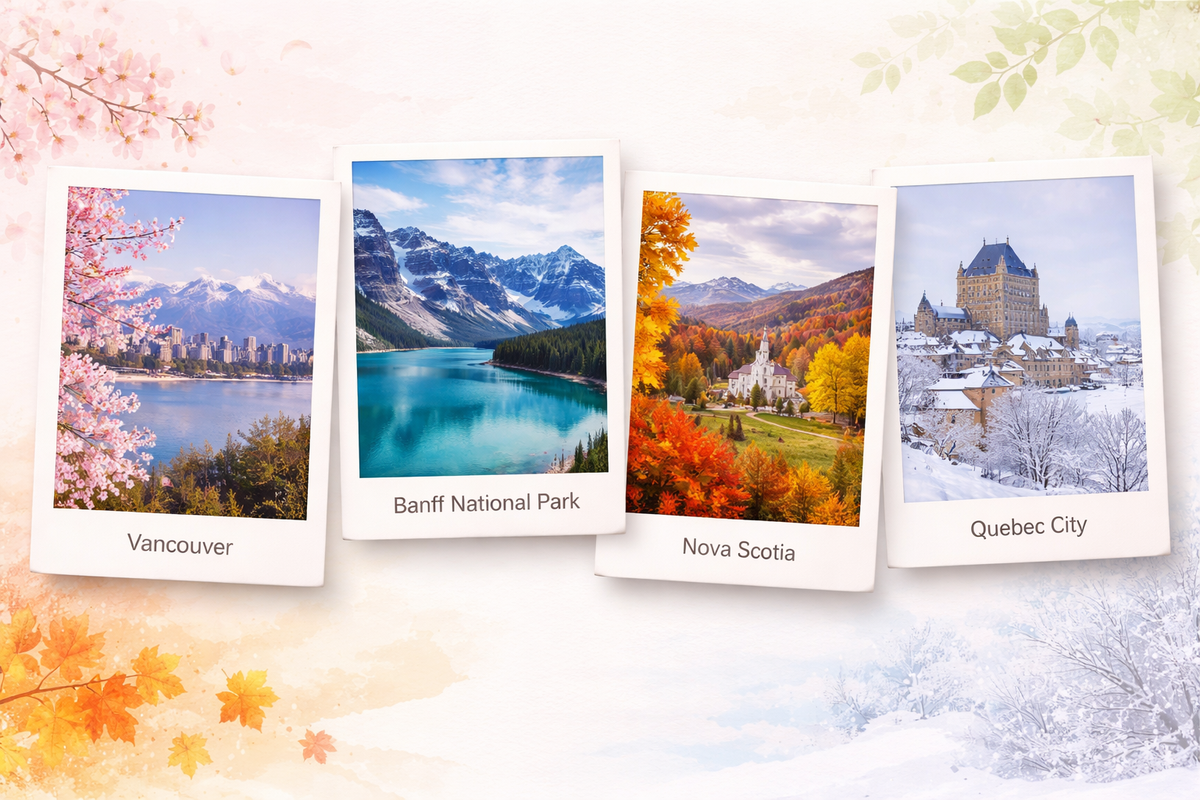
Canada is the second-largest country on Earth and one of the most geographically diverse destinations for US travelers. The Canadian dollar running at approximately USD 0.72 in 2026 means American spending power is strong. The border crossing is the simplest international trip from the USA. And the range of landscapes, cities, and experiences on offer makes it one of the best places to travel in Canada year-round, regardless of when you go.
This blog covers 20 destinations organised by the season that make each one unmissable, with travel tips, practical notes, and everything Americans traveling to Canada need to know before departure.
Quick Reference: 20 Best Places by Season
The best Canadian destination changes dramatically with the season. Here is where to go and when.
🌸 Spring: March to May
Spring is the cheapest time to visit Canada and one of the most underrated. Crowds are thin, prices are lower, and the landscapes are coming alive. For US travelers crossing the border in spring, these five destinations are at their most rewarding.
#1. Vancouver, British Columbia
Vancouver is consistently ranked among the best places to visit in Canada for its extraordinary setting between the Pacific Ocean and the snow-capped Coast Mountains. Stanley Park (405 hectares of old-growth forest within the city limits), Granville Island Public Market, and the North Shore mountains are all accessible within a single day. Spring brings cherry blossom season (mid-March to mid-April) when over 40,000 trees across the city bloom simultaneously. Temperatures average 10-14°C (50-57°F) and hotel rates are 20-30% lower than peak summer.
#2. Victoria, British Columbia (⭐ Hidden Gem)
Victoria sits on the southern tip of Vancouver Island and is one of the prettiest places in Canada that most Americans traveling to Canada skip in favour of Vancouver. The flower baskets that line the Inner Harbour, the afternoon tea tradition at the Fairmont Empress Hotel (from CAD 115 / USD 83 per person), the British Columbia Parliament Buildings lit up at night, and whale watching tours from the waterfront make Victoria one of the most distinct experiences in the country. Spring brings Victoria's flower count to a peak. The Butchart Gardens (40+ acres of formal gardens) are magnificent from April onward.
Travel tip: BC Ferries from Tsawwassen (south of Vancouver) to Swartz Bay (near Victoria) takes 1hr 35min. From USD 18 (CAD 25) per person.
#3. Montreal, Quebec
Montreal is one of Canada's most culturally rich and consistently underrated cities among US travelers. French is the primary language, but English is widely spoken. The Old Port (Vieux-Port), the Notre-Dame Basilica, the Mile End neighbourhood, and the underground city (the largest underground pedestrian network in the world at 33km) are the anchors. Spring brings the Jazz Festival pre-season warmup and the city's famous terrasse culture back to life. Things to do in Canada do not get more cosmopolitan.
#4. Ottawa, Ontario
Canada's capital comes into its own in spring when Dow's Lake erupts into the world's largest tulip display (Canadian Tulip Festival, mid-May, 1 million+ tulips). The National Gallery of Canada, Parliament Hill, the Rideau Canal UNESCO World Heritage Site, and the ByWard Market make Ottawa one of the most complete city breaks in the country. Ottawa is also one of the most bilingual, safest, and most walkable cities in Canada.
#5. Whistler, British Columbia (⭐ Hidden Gem)
Most US travelers know Whistler as a ski destination, but spring skiing here (March to May) is one of the coolest places to visit in Canada that genuinely surprises visitors. Longer days, softer snow, fewer crowds, and après-ski culture at its most relaxed make it exceptional. Whistler Mountain and Blackcomb Mountain offer the largest ski area in North America (8,171 acres). By late May, the mountain village transitions to hiking season with wildflower meadows and mountain biking trails.
Also Read
How to Save Money While Traveling?
Want to travel more without overspending? Learn how to save money while traveling with smart tips on flights, stays, daily expenses, and hidden costs that most travelers miss.
Read More ↗Fun Facts About Canada
Planning a trip or just curious? Discover fun facts about Canada, from unique traditions and culture to surprising things you probably didn’t know.
Read More ↗Will My Phone Work in Canada
Traveling to Canada soon? Check if your phone will work, understand network compatibility, and avoid expensive roaming charges with the right setup.
Read More ↗☀️ Summer: June to August
Summer is Canada's peak season. National parks fill, coastal towns buzz, and festivals run every weekend. These five destinations are the best places to visit in Canada when the weather is at its best.
#6. Banff National Park, Alberta
Banff is Canada's most visited national park and one of the most breathtaking places in Canada by any measure. Lake Louise and Moraine Lake (their turquoise colour comes from glacial rock flour suspended in the water) are among the most photographed places on earth. The Icefields Parkway connecting Banff to Jasper is consistently ranked among the most scenic drives in the world. Over 4 million people visit Banff annually. Book accommodation months in advance for July and August.
Travel tip: Fly into Calgary (90 minutes away). Parks Canada day pass required: USD 17 (CAD 24) per adult. Moraine Lake road access is timed-entry only in summer — book via reservation.parks.canada.ca.
#7. Jasper National Park, Alberta ⭐ Hidden Gem
Jasper is the quieter, wilder alternative to Banff and one of the best places to travel in Canada for those who want the Rocky Mountain experience without the peak-season crowds. Maligne Lake and the boat tour to Spirit Island, the Athabasca Glacier (walkable with a guided tour), and the Jasper SkyTram are the highlights. Jasper National Park is also one of the world's largest dark sky preserves, making summer nights extraordinary for stargazing.
Travel tip: 3.5 hours from Banff along the Icefields Parkway. Drive every single kilometre of it. Stop at the Columbia Icefield. It is the most spectacular road in the country.
#8. Quebec City, Quebec
Quebec City is the most European city in North America and one of the best places to visit in Canada for first-timers who want history, architecture, and culture in one compact destination. Old Quebec (Vieux-Québec) is a UNESCO World Heritage Site, the only walled city north of Mexico in North America. The Château Frontenac, the Quartier Petit-Champlain, and the Plains of Abraham are the essential sights. Summer brings the Festival d'été de Québec (July), one of the largest outdoor music festivals in the world, with 300+ shows across 10 stages.
#9. Prince Edward Island
PEI is one of the most relaxing places to vacation in Canada. The island's red sandstone cliffs, wide sandy beaches, seafood so fresh it barely needs cooking, and the Green Gables literary heritage make it unlike anywhere else in the country. PEI lobster season peaks in summer. The Green Gables Heritage Place (from Anne of Green Gables) and the Cavendish Beach area of PEI National Park are the standout things to do in Canada's smallest province.
#10. Tofino, British Columbia ⭐ Hidden Gem
Tofino is Canada's surf capital and one of the most visually dramatic cool places to visit in Canada. Located on the wild west coast of Vancouver Island, it sits at the edge of the temperate rainforest where old-growth trees meet the Pacific Ocean. Cox Bay and Chesterman Beach are the surf breaks. Pacific Rim National Park Reserve (which Tofino borders) attracts over 1 million visitors annually. In summer, whale watching tours leave daily from the harbour. Brown bears are regularly spotted on the beach.
🍂 Fall: September to November
Fall is the most underrated season for the best places to travel in Canada. Foliage turns across eastern Canada, wine harvest season begins in British Columbia, crowds thin, and prices drop. These five destinations hit their peak.
#11. Toronto, Ontario
Canada's largest city and busiest international gateway is the most logistically convenient starting point for Americans from the eastern USA. The CN Tower (USD 40 / CAD 55), the Distillery District, Kensington Market, the Royal Ontario Museum, and the Art Gallery of Ontario anchor a city that rewards walkers. Fall brings TIFF (Toronto International Film Festival, September), one of the world's most important film events, which transforms the city's entertainment district for 10 days.
Travel tip: Direct flights from every major US East Coast city. 90 minutes from Buffalo by car across the Peace Bridge. No eTA or visa required for US citizens with a valid passport.
#12. Nova Scotia and Cape Breton (⭐ Hidden Gem)
Nova Scotia is one of the best places to visit in Canada for fall foliage, and one that most US travelers have never considered. The Cabot Trail (300km loop around Cape Breton Highlands National Park) is one of the most spectacular coastal drives in the world. Celtic music culture, lobster suppers at church halls, dramatic cliff-top views, and the fishing villages of Lunenburg (UNESCO World Heritage Site) and Peggy's Cove make this Atlantic Canada's most rewarding road trip.
#13. Niagara Falls, Ontario
Niagara Falls receives approximately 13 million visitors annually, making it one of the most visited natural attractions in North America. The Horseshoe Falls on the Canadian side (the larger of the two falls) is significantly more impressive than the American side. The Maid of the Mist boat tour takes you to the base of the falls. The Journey Behind the Falls experience accesses tunnels directly behind the curtain of water. Fall crowds are smaller, and the mist-filled light in October creates extraordinary photography conditions.
#14. Algonquin Provincial Park, Ontario ⭐ Hidden Gem
Algonquin is one of the best places to travel in Canada for wilderness immersion without the Rocky Mountain logistics. Ontario's oldest provincial park covers 7,653 km² of boreal forest, lakes, and rivers, 2.5 hours north of Toronto. Fall canoe trips through an orange and red maple canopy are among the defining Canadian experiences. Moose are commonly spotted from the highway in October. Wolf howling programs run on August weekends. The park has over 2,000km of canoe routes.
Best accessed by car from Toronto via Highway 60. Canoe and camping gear rental are available in the park. Reserve campsites at ontario.ca/parks well in advance.
Reserve a Campsite ↗#15. Kelowna and the Okanagan Valley, British Columbia
The Okanagan Valley is British Columbia's wine country and one of the coolest places to visit in Canada for food and wine travelers. Over 200 wineries operate in the valley, most within 30 minutes of Kelowna. Harvest season (September to October) brings the best wine tasting experiences when grapes are being picked, and wineries run special events. Okanagan Lake provides warm-water swimming in summer and scenic walking in fall. The region averages 2,000 hours of sunshine annually.
Fly into Kelowna from Vancouver (1 hr), Calgary (1 hr 10 min), or Toronto (4 hr). The Kelowna area wine map is available at tourismkelowna.com.
View Kelowna Wine Map ↗❄️ Winter: December to February
Canada in winter is magical for travelers who embrace the cold. Skiing, northern lights, ice festivals, and a side of Canada that genuinely feels different from any other season make these five destinations some of the best places to visit in Canada for a winter trip.
#16. Quebec City Winter Carnival
Quebec City transforms completely in winter into one of the most atmospheric cold-weather destinations in the world. The Québec Winter Carnival (late January to mid-February) is the world's largest winter carnival, featuring the ice palace, snow sculptures, the iconic Bonhomme mascot, night parades, and ice canoe racing across the frozen St. Lawrence River. Château Frontenac, overlooking the frozen river, is one of the most striking winter images in Canada.
#17. Whistler Ski Season, British Columbia
Whistler Blackcomb is North America's largest ski resort by skiable terrain (8,171 acres across two mountains) and one of the best places to vacation in Canada for winter sports. The village at the base is walkable, vibrant, and well-equipped for families and solo travelers. Peak Chairlift connects the two mountain summits at 2,182 metres. The 2010 Winter Olympics ski events were held here.
#18. Yukon and Whitehorse (⭐ Hidden Gem)
The Yukon is one of the most breathtaking places in Canada and one of the best places on earth to see the northern lights. Whitehorse, the Yukon's capital, is the practical base with hotels, tours, and the Miles Canyon hiking trail. Aurora season runs from October through March, with January and February offering the most consistent viewing. Dog sledding, snowshoeing, ice fishing, and hot springs at Takhini Hot Springs (winter temperature drop makes the steam visually spectacular) complete the experience.
#19. Banff in Winter (⭐ Hidden Gem)
Banff in winter is a completely different experience from the summer crowds. Lake Louise and Johnston Canyon freeze into extraordinary ice formations. Ski resorts at Ski Banff (Lake Louise, Sunshine Village, Mount Norquay) offer 7,700 acres of skiing. Hot springs at Banff Upper Hot Springs run year-round and are exceptional after a day on the slopes. Wildlife is more visible against the snow, and elk are frequently spotted in the townsite itself.
Travel tip: Banff Avenue has excellent restaurants and shops even in deep winter. January is the coldest and quietest month. Temperatures average -15°C (5°F), but the air is dry, and sunny days are frequent.,
#20. Churchill, Manitoba (⭐ Hidden Gem)
Churchill is one of the most extraordinary things to do in Canada and one of the few places on earth where you can see polar bears in the wild. Located on the shore of Hudson Bay, Churchill is the polar bear capital of the world. The bears gather here in October and November, waiting for the bay to freeze. Beluga whale watching runs in July. Northern lights viewing runs from November through March. Churchill is remote (no road access, fly or train only) and genuinely wild.
Practical Tips for Americans Traveling to Canada
Entry requirements
US citizens do not need a visa or an eTA to enter Canada. A valid US passport is all that is required.
Canada allows US citizens to stay for up to 6 months (180 days). No pre-registration or advance application is needed.
Currency
Canada uses the Canadian Dollar (CAD). As of March 2026, 1 CAD = approximately USD 0.72, meaning US dollars go approximately 38% further in Canada than at home.
USD 100 buys approximately CAD 139.
Most places accept US credit cards. Visa and Mastercard are widely accepted across all provinces.
Cross-border travel by car
Driving from the USA to Canada is straightforward. You need your valid US passport.
Customs officers typically ask the purpose of your visit, how long you intend to stay, and whether you are carrying goods to declare.
Flying from the USA
Direct flights operate from major US cities to Toronto, Vancouver, Montreal, Calgary, and Ottawa, making Canada easily accessible with short travel times.
- New York to Toronto: 1 hr 25 min
- New York to Vancouver: 5 hr 30 min
- Los Angeles to Vancouver: 2 hr 45 min
- Chicago to Toronto: 1 hr 20 min
Canadian Time Zones
Canada spans 6 time zones. Here's how each region compares to Eastern Time (New York).
| Province / Territory | Time Zone | vs. ET (New York) | Key Destinations |
|---|---|---|---|
|
British Columbia
BC
|
Pacific Time
PT (UTC −8 / −7)
|
ET − 3 hrs |
Vancouver
Victoria
Whistler
|
|
Alberta
AB
|
Mountain Time
MT (UTC −7 / −6)
|
ET − 2 hrs |
Banff
Jasper
Calgary
|
|
Ontario & Quebec
ON / QC
|
Eastern Time
ET (UTC −5 / −4)
|
Same as NY |
Toronto
Montreal
Ottawa
Quebec City
|
|
Atlantic Canada
NS / PEI / NB
|
Atlantic Time
AT (UTC −4 / −3)
|
ET + 1 hr |
Nova Scotia
PEI
|
|
Yukon
YT
|
Pacific Time*
Year-round (UTC −7)
|
ET − 3 hrs |
Whitehorse
|
* Yukon observes Pacific Time year-round and does not follow daylight saving time.
🏥 Health Insurance in Canada
What US travelers need to know before crossing the border.
| Coverage Type | Valid in Canada? | What You Need to Know |
|---|---|---|
|
US Health Insurance
Private / Employer plans
|
✕ Generally No | Most US private and employer health plans do not cover treatment received outside the United States. |
|
Medicare
US federal program
|
✕ Not Covered | Medicare does not cover medical services in Canada. |
|
Travel Insurance
With medical coverage
|
✓ Recommended | Strongly recommended for all US travelers. |
|
Emergency Medical
Without any coverage
|
⚠️ High Cost | Out-of-pocket emergency costs can be very significant. |
💡 Tip: Purchase travel insurance with medical coverage before departure.
Staying Connected: eSIM for Canada
Canada is a vast country. Traveling across multiple provinces means different networks and coverage zones, and relying on your US carrier's international roaming across thousands of kilometres of varied terrain gets expensive fast.
An Jetpac eSIM for Canada installed before departure means working data before you clear customs, no hunting for a Canadian SIM card, no roaming charges from your US plan.
FAQs
What is the best time of year to visit Canada?
It depends on what you want. Summer (June to August) is peak season and best for national parks, hiking, and outdoor adventure. Fall (September to October) is best for foliage, wine harvest, and fewer crowds. Winter (December to February) is best for skiing, northern lights, and festivals. Spring (March to May) is the cheapest and best time for cities and early outdoor activities. For first-timers from the USA, July is the most consistently rewarding month across most of the best places to visit in Canada.
Where to go in Canada for first-time visitors?
For a first trip from the USA, most experienced travelers recommend the Canadian Rockies (Banff and Jasper) for scenery, Vancouver for city plus nature, and either Quebec City or Toronto for culture and history. These four destinations cover the full range of what makes Canada exceptional and are all accessible by direct flight from most US cities. The Banff-Vancouver-Quebec City triangle is the most common first-timer itinerary.
What is the number 1 tourist spot in Canada?
Banff National Park consistently ranks as the most visited and most celebrated single destination in Canada, receiving over 4 million visitors annually. Niagara Falls draws the highest raw visitor numbers (approximately 13 million annually) but is often counted as a day trip destination. For overall destination experience, Banff is Canada's undisputed top attraction and one of the most breathtaking places in Canada by any measure.
What is the safest part of Canada to visit?
Canada is one of the safest countries in the world for tourists, and all regions covered in this guide are considered very safe for American visitors. For pure urban safety, Ottawa, Quebec City, and Victoria consistently rank among the safest cities in the country. Rural and national park areas require awareness of wildlife (bears in Banff and Jasper, polar bears in Churchill), but standard safety protocols make encounters rare. Overall, safety concerns are minimal for US travelers across all 20 destinations mentioned in this blog.
Disclaimer
This blog is based on verified travel sources, official Canadian government entry requirements (canada.ca), and publicly available tourism data as of March 2026. Entry requirements, stay limits, and border crossing rules are subject to change. Always verify the latest requirements at canada.ca before travel. All Canadian Dollar amounts have been converted to US Dollars at an approximate rate of 1 CAD = USD 0.72 based on the CAD/USD exchange rate as of March 2026. Currency conversion amounts are indicative only and will vary at the time of travel. Always check the latest exchange rate before departure. Jetpac is not responsible for network variations or outcomes related to travel decisions made based on this content.