
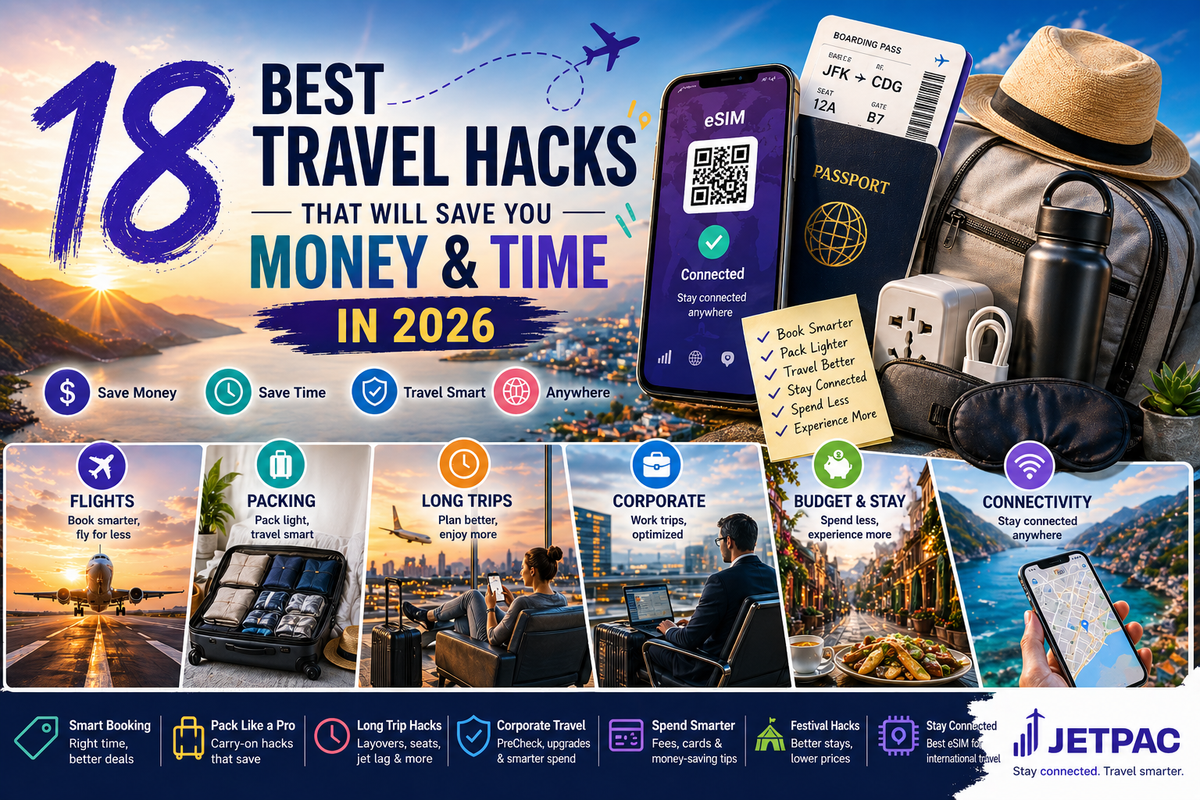
18 Best Travel Hacks That Will Save You Money & Time in 2026
The best travel hacks in 2026 are the ones that save money and reduce stress every single trip. Smarter flight timing, carry-on packing, better long-trip prep, and avoiding roaming charges with a travel eSIM all save real money, time, and stress.
Travel costs in 2026 are higher than they have been in recent years. Airfares in March 2026 came in 14.9% higher year-over-year, according to NerdWallet's analysis of Bureau of Labor Statistics Consumer Price Index data. The best travel hacks are not tricks or loopholes.
They are practical habits that consistently save real money and real time across every kind of trip. These 15 are the travel hacks people actually use, plus 3 bonus Jetpac exclusive hacks drawn from data-backed research, frequent flyer communities, and the decisions that move the needle most.
5 Travel Hacks for Flights
Flight cost is the single largest variable in most travel budgets. These travel hacks for flights are backed by real booking data from Expedia's 2026 Air Hacks Report, the most comprehensive analysis of U.S. flight pricing patterns published this year.
Hack 1: Know which day is cheapest for domestic versus international travel.
The rules differ depending on where you are flying. For domestic flights, Tuesday is the cheapest day to depart, averaging 14% below Sunday fares according to Expedia's 2026 data.
For international flights, Friday is now the cheapest day to fly, saving up to 8% compared to Sunday. Sunday is the most expensive day for both. The practical application: for a domestic round trip, fly out and return on Tuesday or Wednesday. For international travel, depart on Friday when possible.
Hack 2: Book at the right window, not the earliest one.
Most travelers assume booking months ahead always saves money. The data says otherwise. For domestic flights, the optimal booking window is 15-30 days before departure, saving an average of $130 compared to booking six or more months out, according to Expedia's 2026 report.
For international flights, 31-45 days ahead saves an average of $190 versus early booking. Set a Google Flights price alert for your target route and wait for the window rather than booking the first price you see.
One additional note: when booking, going directly through the airline's own website rather than a third-party platform gives you significantly better options for changes, refunds, and credits if your flight is disrupted. The slightly higher price is often worth it.
Hack 3: Use Google Flights price tracking and error fare alerts instead of incognito mode.
The widespread belief that searching in incognito mode lowers flight prices is a myth. Airlines use demand-based dynamic pricing, not browser cookies. Prices rise because demand rises, not because your browser remembered your search.
What actually works is setting a Google Flights price alert for your specific route and letting it notify you when prices drop. For larger savings, subscribe to Going (formerly Scott's Cheap Flights), which tracks error fares, pricing mistakes, and flash sales.
Going subscribers save an average of $550 per ticket on error fares, according to the platform's own published data. Error fares disappear within hours; having the alert already set is the only way to catch them.
Hack 4: Go carry-on only and eliminate baggage fees entirely.
Checked bag fees now run $30-$70 each way on most major U.S. carriers. A family of four on a round trip can pay over $500 in baggage fees on a single trip. Forty-eight percent of U.S. travelers now fly with carry-on luggage only, according to Expedia's 2026 data.
Every airline that charges for carry-ons still allows one free personal item. A well-packed personal item bag, a backpack that opens flat like a suitcase, functions as a second piece of luggage and flies free on virtually every airline.
Hack 5: Book seats strategically for groups and pairs.
Two specific tactics used by frequent travelers that most casual travelers miss. For groups of two or more: search and book one seat at a time rather than the full group in a single transaction.
Airlines sometimes register high demand when they detect a multi-seat search and adjust prices accordingly. Splitting the search into individual bookings consistently surfaces the base rate. For pairs traveling together: book the window seat and the aisle seat in the same row rather than two adjacent seats.
The middle seat between them is the last to fill on any flight. If it stays empty, both travelers gain extra space. If someone books it, they will almost always accept a swap to get out of the middle seat.
3 Super Easy Packing Hacks for Travel
Packing smart removes two of the biggest friction points in travel: overpacking and not being able to find anything. These packing hacks for travel address both directly.
Hack 6: Use packing cubes with a rolling system.
Packing cubes are one of the few must-have travel items that pay for themselves on the first trip. Assign one cube per category: tops, bottoms, underwear and socks, cables and tech.
Roll clothes tightly inside each cube rather than folding; rolling consistently fits more into a bag than flat folding and reduces creasing in transit. The real value of the system is that everything has a fixed location, which means repacking at each stop takes minutes. The best packing hacks for travel are the ones that create a system, not just a slightly smaller pile.
Hack 7: Wear your bulkiest items as airplane travel outfits.
Airplane travel outfits are one of the most underused packing hacks for travel available. Wear your heaviest shoes, thickest jacket, and bulkiest mid-layer on the plane rather than packing them.
Design your airplane travel outfits to layer: a base layer, a packable mid-layer, and an outer jacket you can remove once seated. Slip-on shoes speed up security screening, and compression socks on flights over four hours reduce leg swelling and lower the risk of deep vein thrombosis, which medical professionals note increases on long-haul flights. What you wear on the plane does not count toward your luggage weight or bag allowance.
Hack 8: Build a permanent must-have travel items kit and never unpack it.
The must-have travel items that most travelers forget cost the most to replace at airports: a portable charger, a universal plug adapter, a reusable water bottle, a travel-size pain reliever, and a sleep mask.
Pack these must-have travel items in a single small zip pouch that lives permanently in your carry-on. Replenish after every trip rather than packing from scratch. The time saved hunting for a charger the night before a trip, and the money saved not paying airport retail prices, add up across a year of travel.
3 Not to Miss Travel Hacks for Long Trips
Long trips carry specific costs in time, comfort, and wasted first days. These three travel hacks for long trips address each.
Hack 9: Use long layovers as free city stops.
More than a quarter of U.S. travelers now plan long layovers specifically to explore an additional city, according to Expedia's 2026 travel data.
A six to ten-hour layover in a well-connected hub like Doha, Singapore, or Dubai can give you enough time to leave the airport, reach a central landmark, eat a local meal, and return comfortably.
Store your carry-on at the airport's left luggage service, use downloaded offline maps, and treat the layover as a bonus destination rather than a waiting room.
Before planning any layover city stop, check your nationality's transit visa requirements for the specific country; rules vary significantly by passport, and some nationalities require a transit visa even for short stops.
Hack 10: Check your seat before you book it.
Most travelers pick seats based on the row number shown on a booking screen. Frequent flyers use SeatGuru or AeroLopa before confirming any seat. Both tools show the exact aircraft configuration on your specific flight: which aisle seats have a hidden armrest release button that gives extra room, which window seats have a misaligned window, which rows have reduced recline near an exit door, and which economy seats are nearest to lavatories.
The hidden aisle armrest release is one of the most widely shared insider hacks in frequent flyer communities; the button is typically located in the hinge of the armrest and allows you to lift it during the flight for significantly more room.
Knowing your aircraft before you book takes two minutes and makes a measurable difference on any flight over three hours.
Hack 11: Beat jet lag before it starts and download everything before leaving home.
Two practical habits are bundled here because both happen before you board. For jet lag: begin shifting your sleep schedule three days before departure. For eastward travel, go to bed one hour earlier each of the three nights prior.
For westward travel, stay up one hour later. On the plane, set your watch to the destination time zone when you board, eat and sleep on the destination schedule rather than home time, and avoid alcohol, which dehydrates and disrupts sleep quality at altitude.
For connectivity: before leaving your home Wi-Fi, download Google Maps offline for every city on your itinerary, save boarding passes to your phone wallet, and screenshot hotel addresses, confirmation numbers, and local emergency contacts. A phone with no signal but fully preloaded content is more useful at a foreign arrival hall than a phone with a strong signal and nothing saved.
Also Read
Best eSIM for International Travel
Traveling across countries? Discover the best eSIM for international travel with insights on coverage, pricing, and how to stay connected without roaming hassles.
Best Travel Apps
Want smoother trips? Explore the best travel apps for navigation, bookings, communication, and managing your travel plans on the go.
Best eSIM App Guide
Not sure which eSIM app to choose? Follow this guide to compare features, coverage, and usability to find the best eSIM app for your travel needs.
Best Travel Apps for Planning
Planning a trip soon? Discover the best travel apps for planning itineraries, booking stays, and organizing your journey efficiently.
2 Travel Hacks Every Corporate Traveler Should Know
Frequent business travelers fly on tighter schedules than leisure travelers, which means every inefficiency compounds. These two Travel Hacks Every Corporate Traveler implements consistently deliver the highest return per minute of setup time.
Hack 12: Get TSA PreCheck or Global Entry and know when to volunteer to be bumped.
TSA PreCheck fees start at $78 for five years, depending on your enrollment provider; verify current pricing for each provider at tsa.gov/precheck before applying. PreCheck gives expedited security screening at over 200 U.S. airports with no removing shoes, laptops, or liquids.
Global Entry costs $100 for five years, includes all TSA PreCheck benefits, and adds expedited U.S. customs clearance on return from international travel. Verify current Global Entry pricing and eligibility at cbp.gov.
Many premium travel credit cards, including the Amex Platinum, Chase Sapphire Reserve, and Capital One Venture X, reimburse the application fee entirely; check your card benefits before paying out of pocket.
The second corporate hack most travelers miss: when a flight is overbooked, and the gate agent asks for volunteers to take a later flight, raise your hand.
Compensation for volunteering typically runs $200-$1,300 in travel vouchers, depending on the route and airline, plus a confirmed seat on the next available flight, often a meal voucher, and a hotel if the delay runs overnight.
For a frequent traveler with schedule flexibility on one leg of a trip, volunteering to be bumped is one of the highest per-hour-value actions available at an airport.
Hack 13: Use a no-foreign-transaction-fee card for all spending and always book directly with the airline.
Foreign transaction fees run 1-3% on every purchase made abroad. On a $5,000 business trip, that is $50-$150 in fees for nothing. A no-foreign-transaction-fee card eliminates this entirely while earning points on every dollar.
Always decline the offer to pay in U.S. dollars at foreign point-of-sale terminals; Dynamic Currency Conversion rates are consistently worse than your card's own exchange rate, sometimes by 3-7%. Pay in local currency every time.
On booking: always purchase flights directly through the airline's website rather than a third-party platform when travel disruptions are possible. Airlines prioritize their own direct customers for rebooking, credits, and refunds.
A third-party booking adds a layer of friction that can cost hours when a flight is cancelled or significantly delayed.
Accommodation and Destination Spending Hacks
Hack 14: Ask for a corner room and eat prix fixe at lunch, not dinner.
Two hacks that operate completely differently but both deliver outsized value with zero extra cost. On accommodation: when checking in, ask the front desk for a corner room.
Because of the way most hotels are built, corner rooms are structurally larger than standard rooms due to their position at the building's edge, but are rarely categorized as upgrades or charged at a higher rate.
This is a widely used insider hack in frequent traveler communities that works at properties of every tier. Ask quietly at check-in rather than at booking.
On food: the same restaurant that charges $35-50 for dinner serves identical food at lunch for $12-20 in most European, Latin American, and Southeast Asian cities. Prix fixe lunch menus and set lunch specials are how locals eat at the restaurants tourists only visit at dinner.
Eating your main meal at lunch rather than dinner is one of the most effective destination spending hacks available and requires no compromise on quality. One block off the main tourist square reduces the price of the same meal by another 20-30% in the most popular destinations.
Summer Festival Travel Hacks
Hack 15: Book accommodation in an adjacent town before you buy the tickets.
Hotels and rentals within walking distance of major festival sites charge the highest accommodation premiums of any travel category: typically 3-5x standard rates for the same property during event days.
A stay 20-40 minutes away by public transit or rideshare consistently costs 40-70% less for equivalent accommodation. Many festival organizers add dedicated shuttle services between hub towns and venues that reduce the distance to irrelevant.
The critical sequence: research accommodation in adjacent towns first, before purchasing festival tickets. If accommodation is unavailable at a reasonable price in the surrounding area, the tickets are not a good deal regardless of the experience. Summer Festival Travel Hacks that work are not about the event itself; they are about the logistics that surround it.
Top 3 Travel Hacks with Jetpac
Connectivity is one of the easiest travel costs to control and one of the most common things people leave too late. These are the three Jetpac travel hacks that make the biggest difference first.
Hack 1: Avoid roaming charges before you even leave home
One of the simplest answers to How to Avoid Roaming Charges is to stop relying on your U.S. carrier’s international day pass. Those daily fees usually run $10 to $15 per day, which can quietly turn into $140 to $210 across a two-week trip.
A Jetpac eSIM for international travel activates before departure through a QR code, so your connection is live as soon as you land. No local SIM hunt, no airport kiosk queue, and no roaming bill waiting when you get back.
Hack 2: Keep essential apps working even after your data runs out
Most travel eSIMs stop being useful the second your main data allowance is finished. That is usually the exact moment travelers still need maps, messages, or a ride booking.
Jetpac keeps WhatsApp, Google Maps, Uber, and Grab active even after your main data runs out. That means you can still navigate, message, and get around when plans change unexpectedly.
Hack 3: Use one plan across all your devices and multiple countries
Many travelers still think mobile data should sit on one phone in one country. That makes no sense on longer or multi-stop trips.
Jetpac supports unlimited hotspot sharing, so one plan can cover your phone, laptop, and tablet at the same time. It also works across 200+ destinations and switches automatically to the strongest local carrier in each country.

Which Hacks Deliver the Most Value in 2026?
The best travel hacks are not the cleverest ones. They are the ones with the lowest setup cost and the highest consistent return.
Flying on the right day of the week, booking at the 15-45 day window rather than six months ahead, setting a Going error fare alert, going carry-on only, getting Global Entry before your first international trip of the year, using a no-foreign-transaction-fee card on every purchase, and activating a travel eSIM before you board are all one-time or low-effort habits that pay back on every single trip.
These are the best travel hacks that experienced travelers build into their default routine rather than remembering to apply one trip at a time.
FAQs
What are the best travel hacks for saving money on flights in 2026?
For domestic flights, fly on Tuesday and book 15-30 days ahead to save an average of $130 versus booking early. For international flights, Friday is the cheapest day to fly, and the optimal booking window is 31-45 days out. Use Google Flights price alerts and Going error fare alerts rather than incognito mode, which has no effect on pricing. Go carry-on only to eliminate baggage fees of $30-$70 each way.
What are the best packing hacks for travel?
Use packing cubes with a rolling system so every item has a fixed location. Design your airplane travel outfits to include your bulkiest items so they do not count toward your bag allowance. Keep a permanent kit of must-have travel items, including a portable charger, universal adapter, and reusable bottle, in a dedicated pouch that never leaves your carry-on.
What are the best travel hacks for long trips?
Check your specific seat on SeatGuru or AeroLopa before booking to avoid poor seats and find hidden comfort features. Use long layovers as free city stops in hub cities. Adjust your sleep schedule three days before departure to reduce jet lag. Download offline maps, boarding passes, and translation packs over home Wi-Fi before you leave.
What are the Travel Hacks Every Corporate Traveler should prioritize?
Get TSA PreCheck or Global Entry before the year starts; verify current fees at tsa.gov/precheck. Volunteer to be bumped on overbooked flights for $200-$1,300 in travel vouchers when your schedule allows. Use a no-foreign-transaction-fee card for all spending and always book flights directly with the airline rather than through third-party platforms for easier changes and refunds.
What are the best Summer Festival Travel Hacks?
Book accommodation in a town 20-40 minutes from the festival before purchasing tickets. Prices run 40-70% lower than at-venue accommodation. Research the shuttle or transit options between your base and the venue before committing. If affordable accommodation is unavailable nearby, the tickets are not a good deal at any price.
How to Avoid Roaming Charges when traveling internationally?
Activate a travel eSIM before departure rather than using your U.S. carrier's daily international pass at $10-$15 per day. An international eSIM from a provider like Jetpac costs a fraction of carrier roaming fees, activates via QR code before you leave home, and keeps essential apps running even after your data allowance is used. The best eSIM for international travel activates before you board and works across multiple countries without a SIM swap at each border.
Disclaimer
This blog is for informational and educational purposes only. Flight pricing data, booking windows, and savings estimates are based on publicly available reports, including Expedia's 2026 Air Hacks Report and NerdWallet's Consumer Price Index analysis at the time of writing; figures are subject to change. Baggage fee ranges are estimates based on current major U.S. carrier policies and may vary by airline and route. TSA PreCheck and Global Entry fees vary by enrollment provider and are subject to change; always verify current pricing at tsa.gov/precheck and cbp.gov before applying. Going error fare savings figures are based on Going's own published platform data. Travel credit card benefits vary by issuer; verify foreign transaction fee policies and fee reimbursement eligibility directly with your card provider. Transit visa requirements vary by nationality and destination; check requirements with the relevant embassy or consulate before planning any layover city stop. Jetpac is not responsible for network variations, third-party data accuracy, or decisions made based on this content. No endorsement of any airline, card issuer, booking platform, or third-party service is implied.