
Do You Need a Visa to Go to Italy in 2026? Complete Entry Requirements Guide
US, UK, Canadian, and Australian travellers can visit Italy visa-free for up to 90 days in any 180-day Schengen period. From Q4 2026, ETIAS will add an online authorisation step, while long stays, work, study, or non-exempt passports may need an Italy visa.
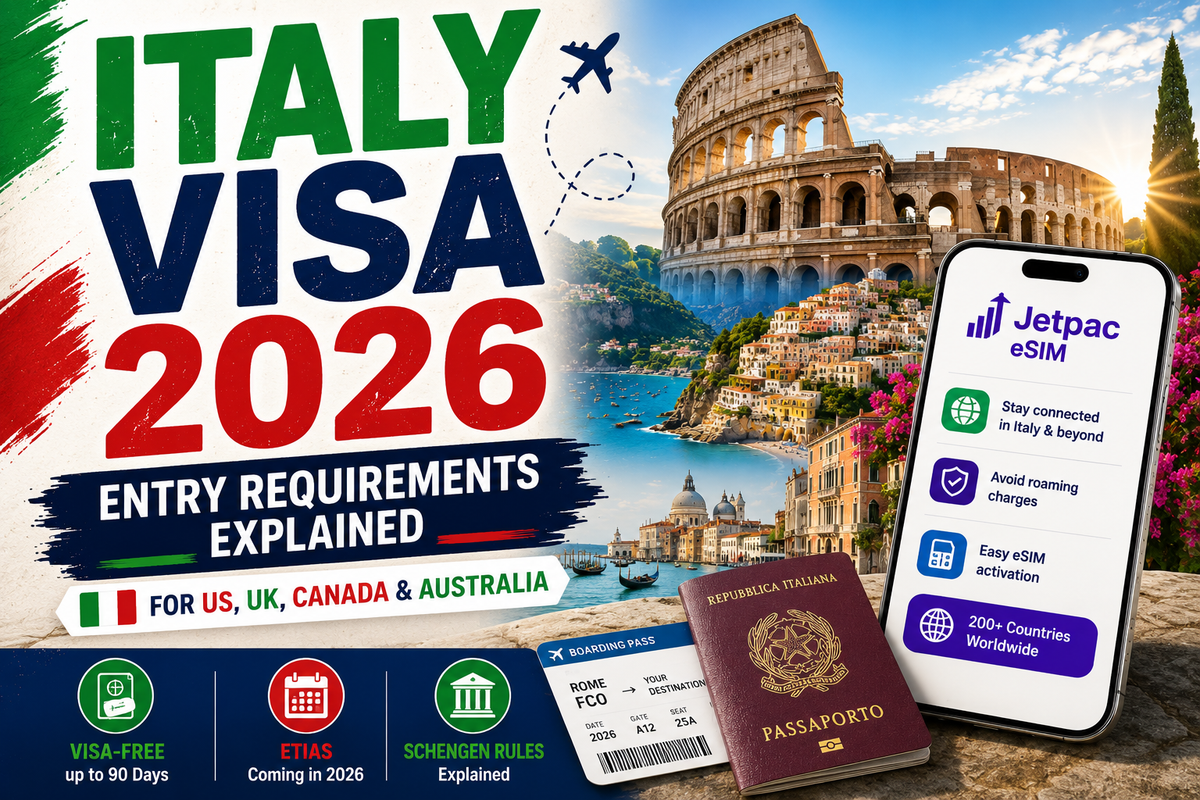
One of the most common questions travelers ask before planning a trip to Italy is whether they need a visa to enter the country. Do you need a visa to go to Italy? For most Americans, British, Canadians, and Australians, the answer is no. Understanding Italy entry requirements, Italy visa requirements, and Italy travel requirements before you book will save time and prevent surprises at the border.
Italy is a member of the Schengen Area, a zone of 29 European countries with standardized visa and entry policies. Italy visa requirements are set at the Schengen level, meaning they apply equally across all member countries. Many travelers, including citizens of the United States, the United Kingdom, Canada, and Australia, can visit Italy visa-free for short stays. Others may need a Schengen visa for Italy before traveling.
There is also a significant new development every traveler should know about for 2026: the European Travel Information and Authorisation System (ETIAS). ETIAS Italy is a pre-travel authorization expected to launch in the final quarter of 2026. It is not a visa, but it will add one brief online step for most visa-free travelers once it goes live. As of June 2026, ETIAS has not been launched, and the official European Union (EU) website confirms no action is currently required.
This blog covers everything travelers need to know before visiting Italy in 2026.
Quick Answer: Do You Need a Visa to Visit Italy?
EU Citizens
No visaVisa required? No
US Citizens
Under 90 daysVisa required? No
UK Citizens
Under 90 daysVisa required? No
Canadian Citizens
Under 90 daysVisa required? No
Australian Citizens
Under 90 daysVisa required? No
Long-Term Visitors
Over 90 daysVisa required? Usually Yes
Do You Need a Visa to Visit Italy?
Italy is part of the Schengen Area. For most short-stay visitors, Italy follows Schengen visa rules, meaning citizens of many countries can enter for tourism or business for up to 90 days within any 180 days without applying for a visa in advance. Whether you need a visa to go to Italy depends primarily on your passport and the length and purpose of your stay.
Citizens of approximately 60 countries can travel to Italy visa-free for short stays. Those visiting as tourists can enter without an Italy tourist visa for stays under 90 days. Citizens of countries not on the Schengen visa-exempt list must apply for a Schengen visa for Italy before traveling. Those who require a Schengen visa for Italy should apply well in advance of their departure date. Whether you need a visa is determined by the passport you hold, not where you currently live. An Indian citizen residing in the United States still needs a Schengen visa to visit Italy. This guide also covers all Italy travel requirements for travelers who are visa-exempt.
Who Needs a Visa for Italy?
#1. Citizens Who Can Travel Visa-Free
Most visitors asking "Do you need a visa to go to Italy?" will find that the answer depends entirely on passport nationality.
The following nationalities can enter Italy for tourism or business for up to 90 days within 180 days without a visa for Italy: the United States, Canada, the United Kingdom, Australia, New Zealand, Singapore, Japan, South Korea, and approximately 60 other countries.
Visa-free access covers tourism, business meetings, family visits, and short educational courses. It does not cover working or studying for extended periods. These travelers do not need an Italy tourist visa for stays under 90 days.
#2. Citizens Who Usually Need a Visa
Citizens of countries not on the Schengen visa-exempt list, including India, China, and many others, must apply for a Schengen visa for Italy before traveling. Use the Italian Ministry of Foreign Affairs visa discovery tool at esteri.it to confirm whether your nationality requires a visa. Note that visa eligibility is based on passport nationality, not country of residence.
Do US Citizens Need a Visa for Italy?
No. US citizens do not need a visa to go to Italy for tourist or business stays of up to 90 days within a 180-day period. This is confirmed by the US State Department: US citizens may enter Italy for up to 90 days for tourist or business purposes without a visa.
For US travelers, Italy entry requirements for a short stay are straightforward. Your passport must be valid for at least 3 months beyond your planned departure from the Schengen Area. Six months' validity is recommended. The passport must have been issued within the last 10 years and have at least 2 blank pages for border stamps. You should also carry proof of onward or return travel, proof of accommodation for the duration of your stay, and proof of sufficient funds. Approximately €70 to €100 per person per day is the commonly cited guideline. Travel insurance is strongly recommended, though not legally mandatory for visa-free travelers.
The US State Department notes that if your passport has ever been reported lost or stolen, or has expired, Italian authorities could deny entry and return you to the United States immediately. Carry only a valid, unreported passport. For travelers from the USA planning extended stays, review the visa types section below.
Note on ETIAS for US travelers: Starting in Q4 2026, US citizens will also need an approved ETIAS authorization before traveling to Italy. ETIAS is not a visa. It is a quick online pre-travel screening, similar to the US Electronic System for Travel Authorization (ESTA). As of June 2026, ETIAS has not launched. No action is required now.
Do UK Citizens Need a Visa for Italy?
No. UK citizens do not need a visa for Italy for visits of up to 90 days within 180 days. Since Brexit, the UK is no longer part of the EU, which means UK travelers are subject to the same Schengen 90/180-day rule as US and Canadian travelers. Days spent in other Schengen countries, including France, Spain, and Germany, count toward the same 90-day limit as days in Italy. UK citizens will need ETIAS authorization once the system launches in Q4 2026. No action is currently required.
Do Canadian Citizens Need a Visa for Italy?
No. Canadian citizens do not need a visa for Italy for visits of up to 90 days within 180 days. Canada is on the Schengen visa-exempt list, and Canadian travelers have the same short-stay rights as US travelers. The same passport requirements apply: valid for at least 3 months beyond the planned Schengen departure date and issued within the last 10 years. Canadian citizens will also need ETIAS once it launches in Q4 2026.
Do Australian Citizens Need a Visa for Italy?
No. Australian citizens do not need a visa for Italy for visits of up to 90 days within 180 days. Australia is on the Schengen visa-exempt list. The same Italy visa requirements apply as for US and Canadian travelers: a valid passport with at least 3 months' validity beyond departure, issued within the last 10 years, proof of funds, onward travel, and accommodation available on request at the border. Australian citizens will also need ETIAS once it launches in Q4 2026.
What Is the 90/180-Day Schengen Rule?
The 90/180-day rule is the most important rule visa-free travelers need to understand before visiting Italy. Italy is one of 29 Schengen countries that share one travel clock. You can spend a maximum of 90 days in the entire Schengen Area in any rolling 180-day period. Days in France, Spain, Germany, and any other Schengen country all count toward the same 90-day total as days in Italy.
Examples using timeline:
- 14 days in France followed by 14 days in Italy: 28 days used, 62 remaining.
- 30 days in Spain, then 30 days in Italy, then 30 days in Germany: 90 days used, none remaining.
- 30 days in France, return home, return 2 months later for 60 days in Italy: 90 days used, limit reached.
3 Common mistakes:
- Assuming the 90 days applies only to Italy. It applies to the entire Schengen Area.
- Assuming the 180-day clock resets after leaving Europe. It is a rolling window, not a fixed calendar period.
- Assuming entry and exit days do not count. Both count.
Overstaying the 90-day limit can result in fines, detention, deportation, and future entry bans across the entire Schengen Area.
As of April 2026, the Entry/Exit System (EES) is fully operational. When you arrive at any Schengen border, including Italy, your fingerprints, facial image, and passport details are collected at automated e-gates or staffed booths. This process takes a few minutes, replaces the traditional passport stamp, and automatically tracks your Schengen days. Use the EU Schengen calculator at ec.europa.eu to check your remaining days before traveling.
ETIAS for Italy Explained
What Is ETIAS?
ETIAS is a pre-travel authorization system being introduced by the EU for travelers who do not need a visa to visit Schengen countries. ETIAS Italy means that visitors from the US, UK, Canada, Australia, and approximately 60 other visa-exempt countries will need to complete a quick online application and receive approval before boarding a flight to Italy. This requirement applies once the system launches. ETIAS is designed to screen travelers for security risks before arrival, similar to the US ESTA.
Who Needs ETIAS?
Citizens of all visa-exempt countries, including the US, UK, Canada, Australia, New Zealand, Japan, and South Korea, will need ETIAS once it launches. Citizens of countries that already require a Schengen visa do not need ETIAS. EU citizens and Schengen Area residents are also exempt.
When Will ETIAS Start?
As of June 2026, ETIAS Italy has not launched. The official EU website (travel-europe.europa.eu) states: "ETIAS will start operations in the last quarter of 2026. No action is required from travellers at this point." The exact launch date will be announced at least six months before the system goes live. Some reports suggest mandatory enforcement could extend into early 2027 during a transitional period. During that phase, travelers will not be refused entry solely for not having an ETIAS.
Is ETIAS a Visa?
No. ETIAS Italy is not a visa. It is a travel authorization and pre-screening system, similar to the US ESTA. The application is entirely online, takes a few minutes to complete, and once approved, the authorization is electronically linked to your passport. You do not visit a consulate or submit physical documents. ETIAS is valid for three years, or until your passport expires, whichever comes first. One ETIAS covers all Schengen member countries, so a single approval allows travel to Italy, France, Spain, Germany, and all other participating countries without reapplying.
The fee is a small amount, exempt for travelers under 18 and over 70 under EU regulation. Check the current official fee at travel-europe.europa.eu when ETIAS launches. Only apply through official EU domains ending in europa.eu. Fraudulent third-party sites will charge significantly more.
Also Read
Do I Need a Visa to Travel to Spain?
Learn Spain’s entry requirements, including visa rules, passport validity requirements, ETIAS updates, and what travellers from different countries need before visiting.
Do Americans Need a Visa for Europe?
Understand current entry requirements for Americans visiting Europe, including visa-free stays, ETIAS requirements, passport rules, and travel limits within the Schengen Area.
Do I Need a Visa for France?
Check France visa requirements, passport validity rules, ETIAS information, and what travellers from different countries need before entering France.
Do You Need a Visa to Go to Italy?
Find out who needs a visa for Italy, how long visa-free visits are allowed, passport requirements, and important entry rules for international travellers.
Can Americans Travel to Russia?
Learn the latest travel requirements, visa rules, safety considerations, and practical information Americans should review before planning a trip to Russia.
What are the Documents Required to Enter Italy?
Even if you do not need a visa, Italian border officials can ask to see the following travel documents for Italy at any point of entry. Have all of these ready, even if not formally requested. Understanding Italy entry requirements before departure is the simplest way to ensure a smooth arrival.
#1. Valid Passport
Must be valid for at least 3 months beyond your planned departure from the Schengen Area, issued within the last 10 years, and have at least 2 blank pages. A passport previously reported lost or stolen can result in immediate denial of entry. Renew your passport well in advance if it expires within six months of your planned travel. San Marino and Vatican City are sovereign states surrounded by Italian territory. Both have open border arrangements with Italy, and no passport control applies when crossing into either during an Italian trip.
#2. Return or Onward Ticket
Proof that you plan to leave before your 90-day limit expires. A printed or digital return flight confirmation is the simplest proof.
#3. Proof of Accommodation
Hotel booking confirmations, vacation rental receipts, or a letter from a host confirming your stay details. If staying in a private rental such as an Airbnb, confirm with your host before arrival that they will register you with local Italian authorities as required by Italian law. Hotels handle this automatically.
#4. Travel Insurance
Not legally required for visa-free travelers, but strongly recommended by the US State Department. Medical care in Italian private hospitals typically requires advance payment or proof of insurance. If applying for a Schengen visa, comprehensive travel insurance with a minimum coverage of €30,000 is mandatory.
#5. Proof of Funds
Evidence that you can financially support your stay. Bank statements, credit card confirmation, or cash. The guideline is approximately €70 to €100 per person per day.
What are the Types of Italy Visa?
For travelers who need a visa for Italy, or who plan to stay longer than 90 days, here are the main Italy visa requirements by category.
#1. Italy Tourist Visa (Schengen Type C Visa)
The Italy tourist visa is for citizens of countries not on the visa-exempt list visiting for tourism for up to 90 days. Applied for through the Italian consulate or visa application center. Italy visa requirements for a Type C visa include a completed application form, passport photos, a valid passport, travel insurance (minimum €30,000 coverage), a return ticket, accommodation proof, financial means, and payment of the €80 application fee.
#2. Student Visa
For full-time study at an accredited Italian institution for longer than 90 days. Requires university acceptance documentation, proof of accommodation, and financial support.
#3. Work Visa
For employment with an Italian employer, subject to Italian immigration quotas. Requires a job offer letter and employer sponsorship.
#4. Digital Nomad Visa
Italy's dedicated visa for remote workers and freelancers. Requirements include a minimum annual income threshold, proof of remote work arrangements, health insurance, and accommodation. Valid for one year and renewable. Verify current income requirements at esteri.it before applying, as thresholds may be updated.
#5. Long-Stay National Visa (Type D)
For stays of more than 90 days for any purpose, including work, study, family reunification, or retirement. Requirements vary by category and are detailed at esteri.it.
For travelers from the USA, the most relevant categories are the standard visa-free entry under 90 days and the Digital Nomad Visa for longer remote work stays.
How to Apply for an Italy Visa?
These steps apply to travelers who require a Schengen visa for Italy.
Required Documents
Your Italy visa application requires a completed application form, two recent passport-sized photos, a valid passport with at least 3 months' validity beyond departure, return tickets, proof of accommodation, travel insurance with a minimum coverage of €30,000, and bank statements or proof of financial means.
Processing Times
Standard processing takes approximately 15 calendar days from submission. In peak season or complex cases, processing can take up to 45 calendar days. Apply well ahead of your travel dates. A minimum of four to six weeks before departure is strongly recommended.
Application Costs
The standard Schengen visa fee for Italy is €80 for adults. Additional service fees may apply at visa application centers. Fees are non-refundable regardless of the outcome.
Where to Apply?
Submit your Italy visa application in person at the nearest Italian embassy, consulate, or authorized visa application center. Book your appointment online in advance as slots fill quickly during peak travel periods. Biometric data, including fingerprints and a digital photo, will be collected at your appointment.
4 Common Reasons Italy Visa Applications Get Rejected
#1. Incomplete or Missing Documents
An incomplete Italy visa application is the most common cause of rejection. Italy visa requirements must be met in full. Check every document against the official Italian consulate checklist before submission. Missing even one item can result in an outright refusal.
#2. Insufficient Funds
Bank statements that do not demonstrate enough funds, approximately €70 to €100 per person per day, may result in denial. Statements should clearly show your name, account details, and sufficient balance.
#3. Invalid or Inadequate Travel Insurance
Your insurance must meet Schengen minimum standards: at least €30,000 coverage, valid across the entire Schengen Area, covering medical emergencies and repatriation. Policies that cover only your home country or a single destination are not accepted.
#4. Passport Issues
A passport close to expiry, previously reported lost or stolen, or lacking sufficient blank pages, can cause rejection.
Travel Checklist Before Flying to Italy
Use this list in the weeks before departure to confirm all Italy travel requirements are in order.
#1. Passport
Valid for at least 3 months beyond Schengen exit date, issued within the last 10 years, 2 blank pages, not previously reported lost or stolen. Renew well in advance if the expiry falls within six months of travel.
#2. Visa or ETIAS
Apply for a Schengen visa 4 to 6 weeks before departure if your nationality requires one. ETIAS is not yet required as of June 2026. When launched, apply at travel-europe.europa.eu only. Do not use third-party sites.
#3. Accommodation
Book and save all confirmations. If using a private rental, confirm your host will register you with Italian authorities.
#4. Insurance
Purchase a comprehensive travel insurance policy before departure. Mandatory for Schengen visa applicants (minimum €30,000 coverage). Strongly recommended for all travelers.
#5. Mobile Connectivity
Install a Jetpac Italy embedded SIM (eSIM) at home before departure. Data connects from the moment you land with no store visits and no roaming charges.
Staying Connected in Italy
Why Mobile Data Matters When Traveling in Italy
From the moment you land at Rome Fiumicino, Naples, or Milan Malpensa, reliable data is essential. Digital boarding passes need to be accessible throughout arrival. Border and immigration updates can affect which terminal or exit to use. Google Maps and offline navigation apps are critical in Italian cities where streets are complex, and English signage is limited. Train schedules and bookings via Trenitalia or Italo require internet access. Translation apps for menus, signs, and conversations depend on a live connection.
Hotel Wi-Fi is unreliable, and public Wi-Fi in Italian cities is inconsistent. An eSIM Italy plan installed before departure means data is live the moment your flight lands, without needing to find a Subscriber Identity Module (SIM) card store, queue at a counter, or hand over your passport in an unfamiliar airport.
Italy eSIM vs Physical SIM Card
A physical SIM requires finding a TIM, Vodafone, or WindTre store after arrival, queuing, presenting your passport, and waiting for activation. An Italy eSIM activates via QR code at home before you fly, with no store visits, no queuing, and no risk of being disconnected during the critical first hours of your trip. For travelers visiting multiple European countries beyond Italy, an eSIM for Europe covers the full itinerary on a single plan without switching cards at each border.
Compararing eSIM Options? Read our blog on the best eSIM for Italy and Pocket WiFi Italy for a full breakdown.
Why Travelers Use a Jetpac Italy eSIM?
Jetpac is the best eSIM for Italy for US travelers, covering Italy and 200+ destinations worldwide on prepaid 5G with multi-network switching. Unlimited hotspot sharing covers every device in your group. Voice calls start at $1.99 for 5 minutes, and 24/7 WhatsApp and email support is included throughout your trip. To confirm your device supports eSIM before purchasing, dial *#06# from your keypad. If an EID number (a unique identifier for your device's eSIM chip) appears on screen, your device is eSIM compatible. Activate your Italy eSIM before departure, and data connects the moment you land.

FAQs
Do Americans Need a Visa for Italy?
No. US citizens do not need a visa to go to Italy for stays of up to 90 days within any 180-day period. Your passport must be valid for at least 3 months beyond your planned Schengen departure and issued within the last 10 years. Proof of funds, accommodation, and a return ticket may be requested at the border. From Q4 2026, Americans will also need an ETIAS authorization before traveling to Italy. As of June 2026, ETIAS has not been launched, and no action is required.
How Long Can You Stay in Italy Without a Visa?
Travelers from visa-free countries, including the US, UK, Canada, and Australia, can stay in Italy for up to 90 days within any rolling 180-day period. This limit covers the entire Schengen Area, not just Italy. Days in France, Spain, Germany, or any other Schengen country all count toward the same total. Stays longer than 90 days require a long-stay national visa (Type D).
Is ETIAS the Same as a Visa?
No. ETIAS Italy is a travel authorization, not a visa. It is an online pre-screening system similar to the US ESTA. Travelers from visa-free countries, including US, UK, and Australian citizens, will need ETIAS once it launches in Q4 2026, but they will remain visa-free. The application is entirely online, and once approved is electronically linked to your passport. As of June 2026, ETIAS has not launched. No action is required at this time.
Do You Need Travel Insurance for Italy?
Travel insurance is not legally mandatory for visa-free travelers visiting Italy. However, the US State Department strongly recommends purchasing it before departure. Medical care in Italian private hospitals typically requires advance payment or proof of insurance, and costs can be high. If you are applying for a Schengen visa for Italy, comprehensive travel insurance with a minimum coverage of €30,000 is a mandatory document requirement.
What Documents Are Required to Enter Italy?
The essential travel documents for Italy for visa-free travelers are: a valid passport (3 months validity beyond Schengen departure, issued within the last 10 years, 2 blank pages), a return or onward ticket, proof of accommodation, and proof of sufficient funds. Travel insurance is strongly recommended. Border officers can request any of these, and entry can be denied even to visa-free travelers if documents are not in order.
Can You Work in Italy on a Tourist Visa?
No. The Italian tourist visa and visa-free entry both permit tourism, business meetings, and short educational courses only. Working in Italy without the correct authorization is illegal and can result in deportation and future entry bans. Remote workers planning to work from Italy for an extended period should investigate the Italy Digital Nomad Visa at esteri.it.
Do You Need an eSIM for Italy Travel?
Not required, but practical from the moment you land. A Jetpac Italy eSIM activates at home before departure, giving you 5G data on arrival without roaming charges or the need to find a SIM card store in Italy. For US travelers, where Google Maps, translation apps, and digital boarding passes are essential from arrival, a Jetpac Italy eSIM is the simplest connectivity solution.
Disclaimer
This blog is for educational purposes only. All the information mentioned in this blog is sourced from publicly available, reliable sources and data. Italy entry requirements, Schengen visa rules, ETIAS timelines, passport validity requirements, and visa fees are subject to change. As of June 2026, ETIAS has not yet launched. The official EU website (travel-europe.europa.eu) confirms the target is Q4 2026, with the exact launch date to be announced at least six months in advance. Always verify current Italy visa requirements at the Italian Ministry of Foreign Affairs (esteri.it), the US State Department Italy travel advisory (travel.state.gov), or your country's official government travel guidance before booking. The €80 Schengen visa fee and proof of funds guidelines are standard figures at the time of writing and may be updated. This blog does not constitute immigration or legal advice. Jetpac is not responsible for network variations or connectivity issues in any destination. No product endorsement of any third-party service is implied or intended.