17 Best European Beach Vacations for 2026 for USA Travelers
Europe’s beaches are not interchangeable, and that’s the point. From the Algarve’s cliff-lined coves to Crete’s pale lagoons and Sardinia’s turquoise shallows, these coasts move between old towns, dunes, seafood, and long salt-air evenings, rewarding travelers who match shore to season and budget.
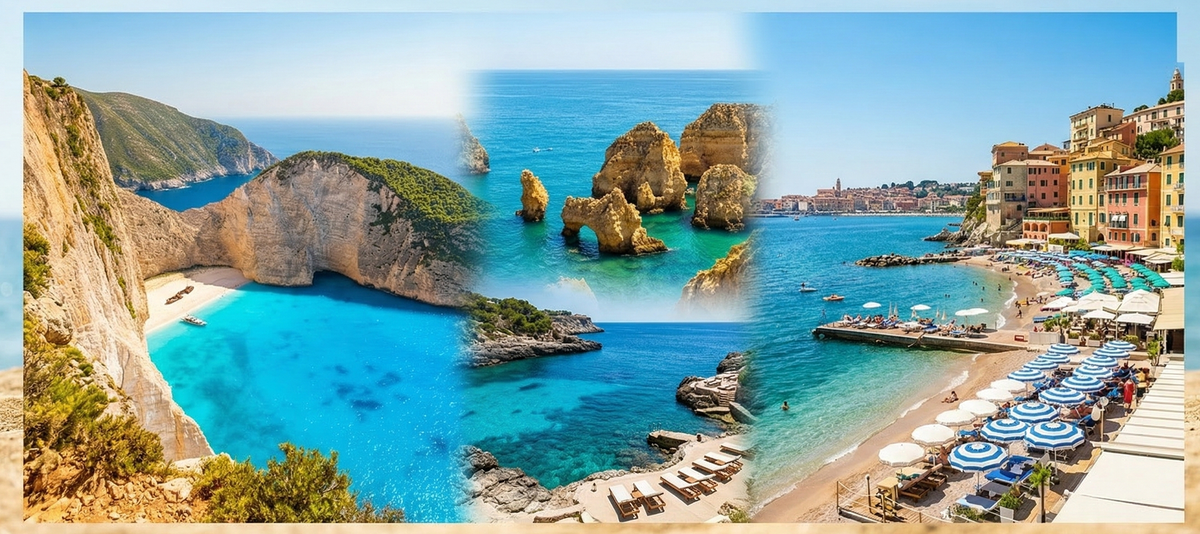
Planning beach vacations in Europe opens up one of the world's most varied coastlines for American travelers. The range is extraordinary: powder-white coves in Sardinia, turquoise lagoons in Crete, volcanic dunes in the Canary Islands, hidden cliff coves on the Costa Brava, and Atlantic surf breaks in the Basque Country. Americans traveling to Europe for a beach holiday often assume the experience is interchangeable across the Mediterranean, but it is not. Greece is not Spain. Croatia is not Portugal.
Each country's coast has its own character, its own season, and its own price point. Before you go, install a Jetpac eSIM before departure and stay connected from the moment you land, whether you are navigating cliff roads in the Algarve or catching a boat to a remote cove in Sardinia. More on that later.
Beaches in Europe suit every budget. The cheapest European countries to visit for a beach holiday in 2026 include Montenegro, southern Italy, and Crete, all offering coastlines that rival those of Western Europe at significantly lower daily costs. At the other end, Mykonos and the French Riviera remain among the top beach destinations in the world for travelers who want luxury alongside the water.
For Americans traveling to Europe in 2026, most of these destinations sit within the Schengen Zone, meaning a single ETIAS authorization covers entry across multiple countries.
Verify current ETIAS requirements at the official EU portal before booking, as this is expected to be fully operational for US passport holders by 2026.

Below are the best European beach vacations for 2026:
1. Algarve, Portugal
Best for: Dramatic coastal scenery, hidden cove beaches, and a first European beach trip.
Peak Water Temp: 22°C / 72°F (August)
Est. Daily Cost: USD 80-130
The Algarve stretches 100 miles along Portugal's southern coast, and the beaches in Europe do not get more cinematic than this.
Golden limestone cliffs frame hidden coves like Praia da Marinha and Praia de Benagil, the latter accessible only by kayak through a cathedral sea cave opening.
For travelers who want scenery as much as sun, this is among the most beautiful beaches in Europe on any honest list.
Consistently ranking among the top beach destinations for American visitors, the Algarve is a 3-hour drive south from Lisbon, with English widely spoken throughout.
2. Mallorca, Spain
Best for: White sand beach quality, resort infrastructure, families.
Peak Water Temp: 26°C / 79°F (August)
Est. Daily Cost: USD 90-150
Mallorca has some of the best white sand beaches in Europe, with Es Trenc on the south coast standing out as a 3 km stretch of naturally protected white sand and turquoise water with no commercial development.
Playa de Muro is calmer and suits families, while Cala Mondragó sits inside a natural park with short forest trails leading to a sheltered swimming cove.
Palma, the capital, adds a Gothic cathedral, excellent restaurants, and strong flight connections through Madrid or Barcelona, making Mallorca one of the most complete Mediterranean beach destinations for American travelers.
3. Hvar, Croatia
Best for: Adriatic character, boutique beaches, long summer evenings.
Peak Water Temp: 26°C / 79°F (August)
Est. Daily Cost: USD 90-140
Hvar sits in the Adriatic with cobalt water, white stone towns, lavender fields inland, and the Pakleni Islands just offshore, reachable by water taxi for quiet anchorage beaches.
Dubovica beach, a short ride south of Hvar Town, offers a sheltered cove with consistently clear water away from the main harbor crowds.
June and September deliver the same Adriatic quality at 20 to 30% lower accommodation rates than July and August.
For US travelers building an Adriatic itinerary, Hvar is the strongest single-island choice on this coastline.
4. Mykonos, Greece
Best for: High-end beach experience, Cycladic scenery, nightlife.
Peak Water Temp: 26°C / 79°F (August)
Est. Daily Cost: USD 130-220
Mykonos has some of the most famous beaches in Europe, with Super Paradise, Psarou, and Elia each offering a distinct experience from party beach to private resort cove to quiet swimming bay.
The whitewashed Cycladic backdrop makes every photograph effortless, and a short ferry connects to the uninhabited UNESCO island of Delos, one of the ancient Mediterranean's most important sanctuary sites.
Mykonos is the most expensive Greek island on this list; travelers watching their budget should consider staying in the inland village of Ano Mera to cut accommodation costs by 30 to 40%.
5. Crete (Chania), Greece
Best for: White sand beaches, variety, and history alongside the coast.
Peak Water Temp: 26°C / 79°F (August)
Est. Daily Cost: USD 75-125
Crete contains some of the best white sand beaches in Europe, with Balos Lagoon offering a shallow turquoise lagoon with pink-white sand accessible by boat from Kissamos, and Elafonisi delivering pale sand and crystal-clear water across a wading sandbar on the island's southwestern tip.
Chania on the northwest coast is one of the finest small cities in the Mediterranean, with a Venetian harbor and Ottoman architecture within walking distance of excellent tavernas.
Crete is one of the most cost-effective islands in Greece, and its combination of coastline variety, cultural depth, and accessibility makes it an outstanding European beach base.
6. Zakynthos, Greece
Best for: Iconic cliff beach scenery, sea turtles, and dramatic landscapes.
Peak Water Temp: 25°C / 77°F (August)
Est. Daily Cost: USD 70-115
Zakynthos is home to Navagio Beach, the Shipwreck Beach, which is one of the most beautiful beaches in Europe by any visual standard: a rusted freighter stranded on powder-white sand inside a sheer limestone cliff cove, accessible only by boat.
The Blue Caves on the northern coastline produce a vivid blue glow as light refracts through the water, best seen by a small boat in morning light. Laganas Bay in the south is a loggerhead sea turtle nesting ground from June through August, and day boat tours combining all three are among the best-value maritime experiences in the eastern Mediterranean.
7. Sardinia, Italy
Best for: Stunning coastline, wild interior, Italian culture.
Peak Water Temp: 26°C / 79°F (August)
Est. Daily Cost: USD 90-160
Sardinia contains what many experienced beach travelers consider the most beautiful beaches in Europe, including La Pelosa in the northwest, a shallow turquoise cove with white sand and a medieval watchtower, and Cala Goloritzé on the Orosei coast, a UNESCO-protected cove accessible only by hiking trail or boat.
The Costa Smeralda concentrates luxury infrastructure in the northeast, while the island's interior adds prehistoric nuraghi stone towers and mountain gorges to the coastal experience.
Sardinia rewards at least a week and is best explored with a rental car, which opens dozens of small coves that bus routes never reach.
8. Malta
Best for: English-speaking beach destination, snorkeling, and UNESCO history.
Peak Water Temp: 27°C / 81°F (August)
Est. Daily Cost: USD 70-120
Malta's Blue Lagoon on the island of Comino offers water clarity up to 30 meters in calm conditions, making it one of the top snorkeling destinations in the Mediterranean.
St. Peter's Pool on the southern coast is a natural rock swimming pool carved by the sea, rarely crowded outside peak summer.
English is an official language in Malta, making it the most friction-free beach destination in the Mediterranean for American visitors who want no language barrier.
Valletta, a UNESCO World Heritage capital, is fully walkable in a half-day and sits just 20 minutes from the Blue Lagoon ferry.
9. Budva, Montenegro
Best for: Budget Adriatic, dramatic scenery, off the beaten track.
Peak Water Temp: 26°C / 79°F (August)
Est. Daily Cost: USD 50-85
Montenegro's Budva Riviera delivers Adriatic coastline at a fraction of Croatian prices, with Sveti Stefan, a walled medieval village on an island connected to the mainland by a sand causeway, as the most iconic view on this coast. Jaz Beach, 15 minutes north of Budva, is a wide open bay that stays uncrowded even in peak July.
Food, accommodation, and boat trips run 30 to 50% below equivalent Croatian options, making Budva the strongest budget value on this list.
10. French Riviera (Nice), France
Best for: Mediterranean glamour, day trip network, city-beach combination.
Peak Water Temp: 25°C / 77°F (August)
Est. Daily Cost: USD 110-180
Nice's Promenade des Anglais runs 4 km along a pebble beach above the azure Mediterranean, and while the pebble format differs from sandy beaches in Europe elsewhere on this list, the water color and Belle Époque boulevard backdrop are among the most iconic coastal views in Europe.
The old town, Vieux-Nice, is a 10-minute walk from the beach and offers excellent market food, traditional Niçoise restaurants, and colorful Baroque architecture.
Day trips from Nice reach Monaco in 30 minutes by train, Cannes in 40, and Èze cliff village in 20, making it the most connected coastal hub in Western Europe.
11. Corsica, France
Best for: Wild beaches, unspoiled Mediterranean scenery, hiking alongside the coast.
Peak Water Temp: 25°C / 77°F (August)
Est. Daily Cost: USD 85-140
Corsica's Palombaggia beach near Porto-Vecchio clusters some of the finest beaches in Europe within a short stretch of the island's south: fine white sand, clear water in three shades of blue, and Aleppo pines providing natural shade, with Santa Giulia 5 km north adding a sheltered lagoon-style swimming alternative.
Scandola Nature Reserve, a UNESCO site of volcanic coastline and sea caves, is accessible by boat from Porto.
The GR20 hiking trail runs the full mountain spine of the island, giving travelers who want more than sun and sea a serious alternative within the same trip.
12. Tenerife, Canary Islands, Spain
Best for: Year-round sun guarantee, volcanic scenery, families.
Peak Water Temp: 23°C / 73°F (August)
Est. Daily Cost: USD 75-120
Tenerife's Playa de las Teresitas is a 1.5 km white sand beach sitting in a sheltered bay below the Anaga mountain range, 20 minutes from the island's capital, Santa Cruz.
Tenerife averages between 20°C and 28°C every month of the year, making it the most reliable sun guarantee on this list and suitable for January travel as much as July.
El Teide, Spain's highest peak at 3,718 meters, is accessible by cable car from the island's center and makes for a full-day excursion from any beach base on the island.
13. Fuerteventura, Spain
Best for: White sand dunes, windsurfing, beach scale.
Peak Water Temp: 23°C / 73°F (August)
Est. Daily Cost: USD 70-115
Fuerteventura has the best white sand beaches in Europe in terms of sheer scale, with Corralejo Natural Park in the north covering 10 km of Saharan-style dunes meeting the Atlantic in a landscape that resembles the Caribbean more than the Mediterranean.
Sotavento Beach on the south coast is a world-class windsurfing and kitesurfing venue, hosting professional competitions in summer behind a flat-water lagoon.
The island receives approximately 3,000 hours of sun per year and has less cloud cover than any other Canary Island, making it the strongest choice on this list for guaranteed beach weather.
14. Costa Brava, Spain
Best for: Hidden coves, medieval villages, and coastal culture.
Peak Water Temp: 25°C / 77°F (August)
Est. Daily Cost: USD 80-130
The Costa Brava runs 200 km of rugged Catalan coastline north of Barcelona, with small cove villages like Calella de Palafrugell, Tamariu, and Aiguablava offering clear water, good seafood, and no large resort infrastructure.
Sa Tuna and Fornells are small enough that limited parking keeps the beaches manageable even in peak summer.
This is one of the best places to travel in Europe for travelers who want scenery, food culture, and genuine beach quality, and Dalí's house in Cadaqués sits within the same coastal stretch for an easy cultural add-on.
15. Rhodes, Greece
Best for: History alongside beaches, long season, and extended swim season.
Peak Water Temp: 27°C / 81°F (August)
Est. Daily Cost: USD 80-130
Rhodes has one of the longest beach seasons in Greece, with warm swimming weather running from May through October, and Lindos Bay sits below the ancient Acropolis of Lindos, combining genuine archaeological weight with excellent swimming in a single half-day.
Anthony Quinn Bay, named for the actor who fell in love with it while filming nearby, is a sheltered cove on the northeastern coast with clear water and minimal development.
The medieval walled Old Town of Rhodes is a UNESCO World Heritage site and one of the best-preserved medieval cities in Europe, making it one of the strongest history-alongside-beach combinations in the Mediterranean.
16. Puglia, Italy
Best for: Budget Italy, undiscovered white sand coast, and authenticity.
Peak Water Temp: 27°C / 81°F (August)
Est. Daily Cost: USD 70-110
Puglia's coast is among the least-known beaches in Europe relative to its quality, with Punta Prosciutto on the Ionian coast offering a long white sand beach with shallow turquoise water and almost no foreign tourist infrastructure.
Torre dell'Orso on the Adriatic side features limestone stacks rising from the water and a sea cave, while Polignano a Mare is a cliff town built directly above the Adriatic with a small beach at the base of its walls.
Puglia remains largely off the path that most American travelers follow through Italy, and the trulli of Alberobello, the Baroque city of Lecce, and the Valle d'Itria all sit within driving range of the coast.
17. Biarritz, France
Best for: Atlantic surf, Basque culture, dramatic Atlantic coast.
Peak Water Temp: 20°C / 68°F (August)
Est. Daily Cost: USD 90-150
Biarritz is the best example of cool beaches in Europe on this list, with Atlantic swell, a dramatic coastal profile unlike the Mediterranean, and a Basque cultural identity that makes the town feel entirely unlike anywhere else in France.
Grande Plage is a long urban beach backed by a Belle Époque casino, and the surfing infrastructure is serious since this is where European surfing originated in the 1950s.
A day trip to San Sebastián, roughly 45 minutes east, adds one of the world's great food cities to the beach itinerary, and Biarritz works best in June or September when crowds and prices are most manageable.
Europe's most iconic beaches: Quick view
For travelers specifically researching the most beautiful beaches in Europe, these stand out across the 17 destinations above:
- Balos Lagoon, Crete: Pink-white sand, shallow turquoise lagoon, accessible by boat
- Navagio (Shipwreck Beach), Zakynthos: Cliff-framed cove, rusted wreck, electric-blue water
- La Pelosa, Sardinia: Turquoise shallows, white sand, medieval watchtower backdrop
- Palombaggia, Corsica: Fine white sand, pine shade, three shades of blue water
- Corralejo, Fuerteventura: 10 km of Saharan-scale dunes meeting the Atlantic
Each is a public beach with no entry fee. Each looks better in person than in photographs.
Planning your European beach trip
Europe packing list essentials differ from a city itinerary. Reef-safe sunscreen is required at several protected coves in Sardinia and Crete, where conventional sunscreen is restricted to protect marine environments. A dry bag handles boat trips to remote beaches without stress, and comfortable sandals that manage both cobblestones and beach access eliminate the need for separate footwear.
Europe souvenirs worth picking up at beach destinations include hand-painted ceramics from Puglia and Rhodes, Maltese lace, Corsican honey and cured meats, and local olive oils from Portugal and Croatia. Most beach destinations have a weekly market where locally made items sell at lower prices than in tourist shops near the waterfront.
For travelers planning a first beach vacation in Europe, June is the most practical month: warm enough for comfortable swimming at all Mediterranean destinations, meaningfully cheaper than July, and less crowded at every popular site on this list.
Read More: Ready to go beyond the coast? Europe's best summer experience combines beach bases with inland cities, mountain regions, and festival calendars. Read our blog 👉 best summer destinations in Europe covers where to go, when to go, and how to build a complete European summer itinerary.
Staying connected across Europe's Beach destinations
Beach destinations in Europe create a connectivity challenge that city travel does not. Resort Wi-Fi is unreliable, boat trips to remote coves take you outside mobile coverage for hours at a stretch, and buying a local SIM at a small Greek island, a Montenegrin resort town, or a Corsican coastal village is often impractical due to limited phone shops, language barriers, and no guarantee the SIM covers the next country on your itinerary.
For travelers crossing multiple beach destinations and multiple countries, the answer is a Jetpac eSIM for Europe installed before departure.
Here is what makes beach travel connectivity genuinely different from city travel:
🗺️ Coastal navigation depends on mobile data: Cliff roads in the Algarve, dirt tracks to Corsican coves, and remote Puglia beaches all require live navigation that resort Wi-Fi cannot support.
This is where a Jetpac eSIM keeps you connected with its multi-network connectivity.
🚤 Boat trip coordination: Jetpac’s unrestricted hotspot sharing keeps communication with friends and family always smooth.
🌍 One plan, all 200+ countries covered: Portugal, Spain, France, Italy, Greece, Croatia, Montenegro, Malta, and more are covered under a single eSIM plan, no SIM swaps at borders
💰 Up to 70% cheaper than US carrier roaming: At USD 10 to 15 per device per day for standard roaming, two weeks and two phones cost USD 280 to 420 in roaming fees before a single beach towel is hired.
Jetpac offers plans that are up to 70% cheaper than traditional roaming plans.
📱 Essential apps stay on even after data runs out: Apps like Google Maps, WhatsApp, Uber and Grab remain functional, even if your data runs out, so you are never stranded on a coastal road without directions. And stay connected with boat operators, villa hosts, and ferry service providers.
📞 In-app international calls from the USA starting at USD 1.99 for 5 minutes.
✅ 100% money-back guarantee with 24/7 support via WhatsApp and email
If you are comparing options before departure, the best eSIM for Europe for multi-country beach travel is the one that covers the widest range of countries under a single plan and handles the patchwork of signal coverage across Mediterranean resort areas and remote coastal routes.
Jetpac's automatic 4G/5G network-switching manages that coverage gap better than any single-country SIM.
FAQs
What are the best European beach vacations for Americans in 2026?
The 17 destinations on this list cover every style, budget, and country. For a first European beach trip, the Algarve (Portugal), Crete (Greece), and Malta are the most accessible and consistently high-quality options, with English widely spoken, direct connections from major US entry airports, and coastlines that justify the flight.
For luxury, Mykonos and Nice lead. For budget, Montenegro and Puglia deliver the best value-to-quality ratio on the Adriatic and Mediterranean, respectively.
Which European beaches have the whitest sand?
The best white sand beaches in Europe include Balos Lagoon and Elafonisi in Crete, La Pelosa in Sardinia, Palombaggia in Corsica, and the Corralejo Natural Park dunes in Fuerteventura. All four are public beaches with no entry fee. Balos and La Pelosa have introduced timed visitor limits in peak season, so book the boat tour in advance for both.
Which European beach destinations offer the best value?
Montenegro, Puglia in southern Italy, Crete, and Zakynthos offer the best cost-to-quality ratio on this list. Montenegro, in particular, runs 30 to 50% below Croatian prices for equivalent Adriatic coastline and scenery. The Canary Islands (Tenerife and Fuerteventura) are also strong budget options given their year-round sun reliability and good flight connections from major European hubs.
What is the best time for a beach trip to Europe?
June and September offer the best combination of warm beaches in Europe, lower prices, and manageable crowds at most Mediterranean destinations. July and August are peak season: the highest prices and most crowded, but also the warmest water and longest daylight hours. The Canary Islands and Malta are warm enough year-round for comfortable beach swimming in any month.
What should I pack for a European beach trip?
Your beach packing essentials for Europe include reef-safe sunscreen (required at protected coves in Sardinia and Crete), a dry bag for boat trips to remote beaches, comfortable sandals that handle both beach and cobblestones, a light linen cover-up for restaurants, and any prescription medication in carry-on luggage when crossing multiple countries.
Pack light, as most beach destinations have laundry facilities, and checked baggage fees on European budget airlines add up quickly.
Do I need an eSIM for beach travel across multiple European countries?
For multi-country beach travel, yes. Purchasing local SIMs at beach destinations is unreliable since small islands and resort towns often lack phone shops, and a SIM bought in Greece does not cover Croatia or Montenegro. A Jetpac eSIM installed before departure covers all destinations on this list under a single plan, with no SIM changes at country borders and no roaming surprises on your home bill.
Which European beach destinations suit first-time US visitors best?
The Algarve is the strongest first-timer choice, with accessible English, dramatic scenery, and a wide range of beaches for every style. Malta adds English as an official language to a genuinely distinctive Mediterranean character. Crete offers the best combination of beach quality, cultural depth, and cost-effectiveness in Greece. All three are among the best beach destinations in Europe for travelers making the transatlantic trip for the first time.
Disclaimer
The information in this blog is based on publicly available sources at the time of writing. Temperature ranges, crowd levels, price comparisons, and attraction details are general assessments based on historical patterns and will vary by year and specific travel dates. Entry requirements, visa conditions, and ETIAS timelines are subject to change. We recommend verifying all practical details directly with official sources before your trip. Jetpac is not responsible for any changes after publication.