European Flight Delays and Cancellations: What Travelers Should Do to Avoid Being Stranded
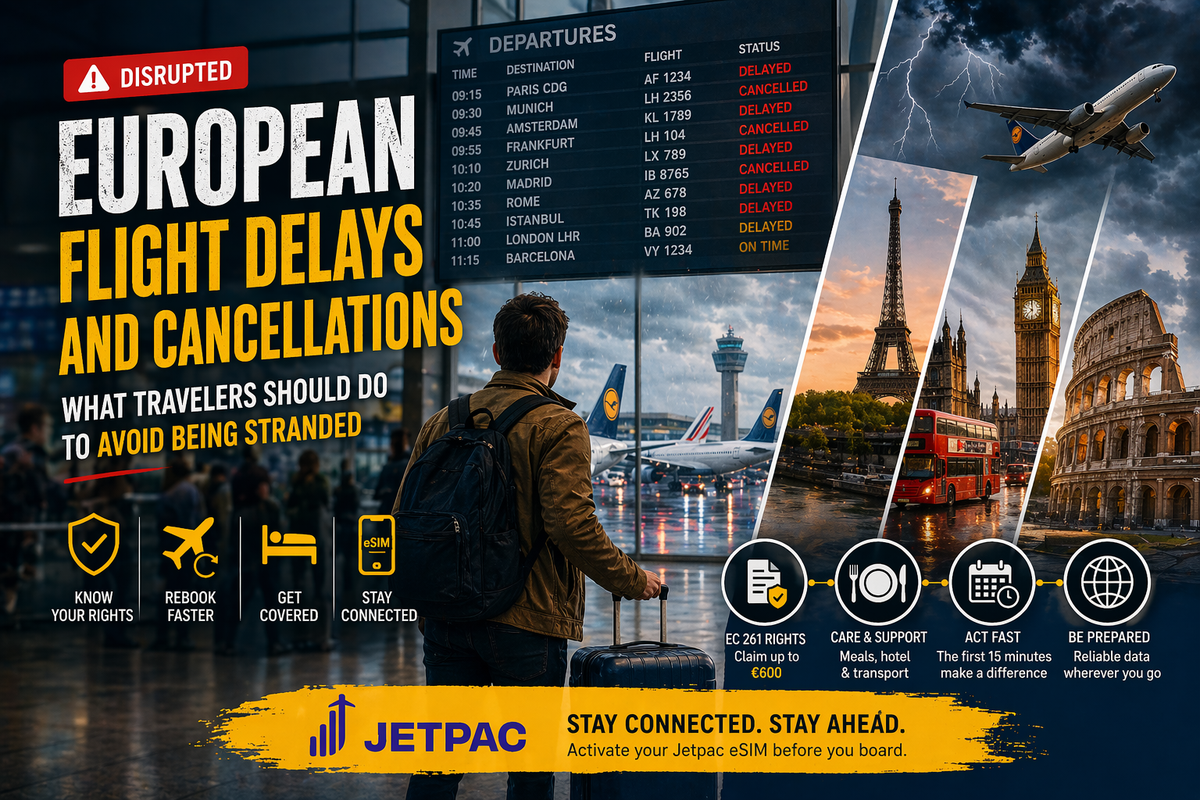
European flight cancellations and delays are at elevated levels in 2026, driven by ATC shortages, Lufthansa strikes, fuel costs, and the Strait of Hormuz closure. Know your EC 261 rights. Rebook via app, not the desk queue. Install an eSIM before departure.
The Fragility of the European Flight Network
in 2025
Impacted
(April 22)
(April 21)
A delayed flight in Europe rarely stays just one flight. One late inbound aircraft can trigger a missed connection, a last-minute gate change, a sold-out airport hotel, and hours spent trying to rebook while hundreds of other passengers do exactly the same thing. That is why European flight delays and cancellations feel more disruptive now than they did a few years ago.
Europe’s airports handled a record 2.6 billion passengers in 2025, and network reports in early 2026 continued to show pressure from air traffic control congestion, staffing shortages, weather, and knock-on delays spreading across major hubs.
The data points from April 2026 show how quickly the situation can escalate. One widely reported wave of disruption on 22 April 2026 saw 1,414 delays and 51 cancellations across 13 major European hubs. Another report published the day prior described more than 1,100 delayed flights and around 550 cancellations.
While the exact counts vary by source and time of snapshot, the direction is clear: flight cancellations and delays across Europe are not isolated incidents. They are part of a wider pattern of network fragility.
Your Action Plan If you are traveling soon, the goal is not only to understand why delays are happening. It is to know what to do fast, what rights you actually have, and how to avoid becoming stranded. This guide explains the real causes behind delays, how travelers get stuck, and the practical steps to help you recover faster.
How We Got Here: 2026 Disruption Timeline
Tap a date to view intelligence
21 January 2026
The European Parliament adopted its second-reading position on air passenger rights reform, showing that the policy debate is still active even though travelers must still rely on the current rules in force.
Why Europe is Seeing So Much Disruption
The current problem is not one single crisis. It is several stress points hitting the same system at once.
Air traffic control congestion
Airport & airline staffing shortages
Bad weather & poor visibility
Industrial action (Strikes)
Reactionary delays from earlier flights
Border-processing friction
Rising fuel costs and route rationalization
European Organisation for the Safety of Air Navigation (EUROCONTROL) 2025 review said France, Germany, and Spain accounted for two-thirds of all en-route Air Traffic Flow Management (ATFM) delays, while early 2026 network updates continued to show Air Traffic Control (ATC) staffing and capacity as major drivers of disruption. That is why small operational problems can spread quickly and become widespread flight chaos across European airlines.
The April Escalation April 2026 added more pressure. On 10 April, the first day of full Schengen Entry/Exit System operations, there were passenger disruptions and missed flights. Almost simultaneously (April 13–17), Lufthansa and Eurowings warned of unavoidable cancellations linked to overlapping pilot and cabin crew strikes.
There is also a fuel and geopolitics angle. Koninklijke Luchtvaart Maatschappij (KLM) (Royal Dutch Airlines) said on 21 April 2026 that it was cancelling flights to and from Riyadh and Dammam up to 14 June because the situation in the Middle East still created uncertainty. Separately, Lufthansa reported cutting about 20,000 short-haul flights through October to save more than 40,000 metric tons of jet fuel. That shows how broader geopolitical stress can add pressure even when the immediate cause of a specific delay is local.
The April 2026 Data Points Travelers Should Pay Attention To
The reason this story matters is that the disruption stopped being theoretical.
- Zurich 243 delays
- Madrid 189 delays
- Paris CDG 187 delays
- Amsterdam Schiphol 165 delays, 14 cancels
- Frankfurt 123 delays
- Istanbul 123 delays
- Heathrow 107 delays
- Munich 98 delays
- Lufthansa 90 delays
- Swiss 87 delays
- Turkish Airlines 87 delays
- Ryanair 86 delays
- Air France 86 delays
- KLM 84 delays, 24 cancels
- Major operational pressure recorded at Munich, Amsterdam Schiphol, and Barcelona hubs.
- Widespread reports of long queues, missed connections, overnight stays, and terminal hotel shortages for stranded travelers.
That second report is less detailed by airport and airline, but it supports the same conclusion: European flight cancellations were affecting multiple countries and multiple hub systems across back-to-back days.
How Travelers Actually Get Stranded
Most people do not get stranded because of one bad flight alone. They get stranded because the disruption creates a chain reaction that they cannot solve quickly enough.
The first flight leaves late
The connection window disappears
The next available flight is already full
Support desks get overwhelmed
Hotels near the airport sell out
Public WiFi slows down under heavy demand
The traveler loses time deciding what to do
This is how European flight cancellations stop being an inconvenience and become a real travel problem. It becomes even worse when the itinerary is built on separate tickets.
Single vs. Separate Tickets EU passenger-rights protection is much stronger when flights are on one reservation. If you book self-transfer legs yourself, flights in Europe being cancelled or delayed may leave you with weaker protection for the onward trip.
There is also a transatlantic layer. Travelers have been watching United Airlines cancellations between the US and Europe and broader fuel-related capacity cuts across the industry, because missed same-day arrivals into a European hub can destroy the rest of the itinerary inside Europe. Even when the disruption begins outside Europe, the consequences often land inside Europe’s connection system.
What To Do First When Your Flight Is Delayed Or Cancelled
The first ten to fifteen minutes matter more than most passengers realize. The people who recover best are usually the people who act before they join the longest queue.
Open the airline app or official message immediately
Confirm if delayed, cancelled, or already rebooked
Decide quickly whether rerouting or refund is better
Save screenshots of the notice and alternatives
Keep receipts for meals, transport, and hotel costs
Make sure your phone stays charged and connected
Check nearby airports and rail alternatives if the route is short haul
The Digital First Strategy A practical example from the April 22 disruption report is useful here. It explicitly advised passengers not to rely only on airport staff and to use digital channels first, especially with KLM and Lufthansa, because app-based rebooking was likely to be faster than waiting at a desk. That advice matches what actually happens during mass disruption.
Know Your Rights Before You Travel
If your trip falls under EU261 (Regulation (EC) No 261/2004), your rights depend on the route, airline, cause of disruption, and how much notice you were given.
In general, EU rules apply to:
- Flights within the EU on any airline
- Flights arriving in the EU from outside the EU on an EU airline
- Flights departing the EU to a non-EU country on any airline
What you may be entitled to:
Reimbursement or rerouting
Meals and refreshments during long delays
Hotel accommodation if overnight stays are necessary
Transport between the airport and your hotel
Compensation of €250, €400, or €600 depending on route and circumstances
This is the core of European flight cancellation compensation rules. It is also the foundation for understanding what compensation you’re entitled to in Europe when things go wrong.
The Strike Exception One point that matters a lot in practice is strikes. Internal airline staff strikes are not automatically treated as "extraordinary circumstances" under official EU guidance, which means compensation can still be due in some cases. External disruptions, such as some airport or air traffic control actions, may be treated differently if the airline can show they were outside its control. That distinction matters when trying to work out what compensation you are entitled to.
Why Staying Connected Matters During Disruption
When plans break down, the traveler who can act first usually gets the better outcome. During European flight delays and cancellations, you may need to:
Accept a rerouting option
Compare rail and air alternatives
Book a room before local hotels sell out
Open a new boarding pass
Use maps and transport apps
Message family or work
Store proof for reimbursement or compensation later
That is why disruption is not only a transport problem. It is a connectivity problem, too. This becomes even more important when you find flights cancelled or delayed across Europe, and the new route pushes you across several cities or countries in a single trip.
Smart Way to Prepare Before Departure: eSIM for Europe
An eSIM for Europe is a digital SIM you install on your phone before you leave. No physical SIM, no airport shop, no waiting after landing.
You scan a QR code before departure, and your phone connects to a local network as soon as you arrive. That helps a lot when European flight delays and cancellations force you to rebook, check updates, or message hotels without depending on airport Wi-Fi.
Most newer phones support eSIM, including iPhone XS and later, Samsung Galaxy S21 and later, and Google Pixel 3 and later. Your US number can stay active for calls and texts while the eSIM handles your data. If your flight lands in Frankfurt or gets rerouted to Brussels, the connection switches automatically.
Check if your phone supports eSIMWhy it matters during disruptions Every practical action during a European flight cancellation requires fast, reliable data. Your own mobile data connection is independent of airport Wi-Fi degradation, works across all 27 EU countries on a single plan, and activates before you clear customs at your first European airport.
Why This Helps in Europe
You can rebook quickly from the airline app
You can secure hotel rooms before they disappear
Maps and payment apps keep working
You stay connected across multiple countries
You avoid wasting time hunting for connectivity after landing
The Network Effect This becomes especially useful during travel chaos across Europe due to flight delays and cancellations, when network pressure can spread from one hub to another within a few hours.
How Jetpac Helps When Europe Travel Disruptions Start
When flight cancellations in Europe happen, the real issue is speed. You need maps, messages, ride apps, hotel details, and airline support working immediately. That is where Jetpac adds practical value.
Why Jetpac works well in those moments:
Free access to essential apps
WhatsApp, Google Maps, Uber, and Grab keep working even after your main data allowance is used. That means you can still message, navigate, and book a ride when things go wrong.
In-app voice calling in 50+ countries
Call landlines and non-WhatsApp numbers directly through the Jetpac app. Useful for airlines, hotels, insurers, and local transport. Call packs start at USD 1.99 for 5 minutes.
Hotspot sharing without limits
Use one plan across multiple devices, whether that is your laptop, your travel partner’s phone, or both, without extra sharing charges.
No roaming bill shock
Jetpac uses transparent prepaid pricing with no hidden fees and can save up to 70% compared with international roaming charges.
One eSIM, 200+ destinations
One setup works across Europe and beyond, so if you are rerouted between countries, you do not need to change SIMs or buy a new plan.
Multiple-network support
Jetpac automatically connects to the strongest available local network, which helps when you are moving between airports, train stations, and city centres.
Fast and reliable 4G/5G
Where available, Jetpac connects to 5G, with fallback to strong 4G networks for rebooking, payments, boarding passes, and hotel confirmations.
100% money-back guarantee
A hassle-free refund on your Jetpac eSIM helps if plans change before departure.
Free airport lounge access
If your flight is delayed by more than 1 hour, Jetpac includes access to 1,300+ airport lounges worldwide. You need to register yourself and one travel companion at least 24 hours before departure.
24/7/365 priority support
Help is available through WhatsApp and email at any hour, including when you are stuck late at night in an unfamiliar airport or city.
The Real Advantage During European airline flight delays and cancellations, Jetpac helps you act faster because your connection is already working when you need it most.
Practical Checklist: What to Do Before, During, and After European Flight Disruptions
- Check your flight status 48 hours before departure via your airline app or Flightradar24. Cancellations increasingly happen in advance as airlines use predictive scheduling algorithms.
- Book refundable accommodation for your first night at any European destination.
- Download airline apps and check in early so boarding passes are saved locally.
- Save your travel insurance policy number and claims phone number in your contacts before departure.
- Install your eSIM before leaving home.
- Buy travel insurance covering flight delay, cancellation, and missed connection costs.
- Arrive earlier than usual during active disruption periods. The European network historically concentrates 38% of annual delay minutes in July and August.
- Avoid the last flight of the day where possible — a delayed rotation frequently causes an evening flight to cancel.
- Allow generous connection time at high-risk hubs: Paris CDG for French ATC exposure, Frankfurt for severe delay duration when problems escalate, Amsterdam Schiphol for high volume.
- Travel carry-on only where possible. A checked bag means waiting at baggage claim when you need to sprint to a rebooking desk or alternative gate.
- Screenshot the notification immediately, including the stated reason.
- Rebook via airline app first, not the desk queue.
- Request meal vouchers (mandatory after 2 hours regardless of cause).
- Request hotel accommodation in writing if stranded overnight.
- If the airline cannot provide hotel accommodation, book your own and keep all receipts.
- Do not accept vouchers without asking whether cash compensation or a full refund applies to your situation.
- File EC 261 compensation claims within the applicable statute of limitations (typically 2 to 6 years, depending on the EU country).
- File directly with the airline or through a compensation service such as AirHelp or Flightright, which operate on a success-fee basis.
- If the airline rejects your claim, escalate to the relevant national aviation authority (Civil Aviation Authority in the UK, DGAC in France, Luftfahrt-Bundesamt in Germany).
Real Scenarios: How an eSIM Helps You Avoid Being Stranded
Flight cancelled at Frankfurt, desk queue forming fast
The Lufthansa app notification arrives: flight cancelled, reason listed as operational. You open the app immediately. Two alternative flights are visible — one this evening, one tomorrow morning. You book the evening departure in under five minutes, receive the new boarding pass, and walk past 200 people in the service desk queue. This requires a working data connection the moment the notification arrives.
Missed connection at Amsterdam, next flight not until tomorrow
KLM confirms the connection is missed and cannot reroute you until tomorrow morning. Hotel accommodation is unavailable through the airline. You open Booking.com immediately and find three available rooms within 10km of Schiphol. You book, screenshot the confirmation, and send the receipt to your travel insurance. Two of those three rooms are gone within 15 minutes.
Flight diverted from Paris CDG to Lyon
ATC congestion forces your Paris-bound flight to divert to Lyon. No onward transport information is available at the gate. You check Google Maps, confirm train connections from Lyon Part-Dieu to Paris Gare de Lyon (1 hour 55 minutes, TGV), book a ticket on the SNCF app, and navigate to the shuttle bus for the station while other passengers are still waiting for an announcement.
Overnight delay, hotel accommodation unavailable
Your flight is cancelled. An overnight stay is required. The airline's hotel partner is fully booked. You exercise your EC 261 Duty of Care self-help right, book a hotel independently, and photograph every receipt. You email the receipts to the airline claims address that evening. Three weeks later you receive reimbursement.
United Airlines connection, Lufthansa feeder cancelled
Your US to Europe itinerary routes through Frankfurt. Your Lufthansa feeder from Munich is cancelled due to the pilot strike. United's flexible rebooking waiver is active but requires you to contact United directly. You open the United app, access the rebooking waiver, select a direct service from a different German hub, and confirm your revised itinerary before the desk agent has finished with the previous passenger.
Final Thought: Preparedness Is Not Pessimism
Flight cancellations and delays across Europe are not a sign that something has permanently broken. They are a predictable consequence of a network operating at capacity with multiple concurrent stressors: geopolitical, meteorological, and structural. They will affect a meaningful percentage of US travelers flying through Europe in 2026, particularly in summer when 38% of all annual European delay minutes historically fall.
The travelers who navigate disruption well are not luckier than those who get stranded. They are faster, better informed, and able to act the moment a notification appears on their phone. They know their EC 261 rights before they need them. They have mobile data working independently of airport Wi-Fi. They rebook while others are still reading the departure board.
Before you go Before your next European trip, make sure you have reliable mobile data active from the moment your first flight lands. The disruption will not wait for you to find the Wi-Fi password.
FAQs
Why are flights delayed and cancelled in Europe right now?
European flight delays and cancellations in 2026 are being driven by several problems hitting at the same time. The biggest pressure is a long-running air traffic control capacity shortage, with delay levels now far worse than a decade ago. On top of that, airlines are dealing with staff strikes, including Lufthansa flight cancellations in Europe and walkouts at other carriers, as well as fuel disruptions linked to the closure of the Strait of Hormuz. Spring storm systems across northern and western Europe have caused further delays, and the EU Entry/Exit System, live since April 10, 2026, has increased processing times at some airports. Put together, this has created flight cancellations and delays across Europe on a scale that travellers are feeling daily.
What should I do if my flight is cancelled in Europe?
Move quickly. Take a screenshot of the cancellation notice and the reason shown by the airline. Rebook through the airline app first rather than joining the airport desk line. After two hours, ask for meal vouchers, which airlines must provide under EC 261 even when the disruption is outside their control. If you are stranded overnight, ask the airline for hotel accommodation. If they do not arrange it, book something reasonable yourself and keep every receipt, because you can usually claim those costs back. If the cancellation was the airline’s fault rather than weather, ATC disruption, or another extraordinary event, you may also qualify for compensation.
What compensation are you entitled to in Europe for a cancelled flight?
Under European flight cancellation compensation rules, EC 261/2004 gives passengers compensation based on distance. You may be entitled to €250 for flights under 1,500 km, €400 for flights between 1,500 and 3,500 km, and €600 for flights over 3,500 km. That includes some transatlantic routes. Separate from cash compensation, airlines still owe you Duty of Care, which means meals, hotel accommodation if needed, and either rerouting or a refund. The key point is what compensation you’re entitled to in Europe depends on the cause. If the disruption was due to extraordinary circumstances such as severe weather or third-party ATC strikes, cash compensation usually does not apply, but Duty of Care still does.
Is airport Wi-Fi reliable in Europe during flight disruptions?
Usually not. During major disruption events, airport Wi-Fi often slows down badly because too many passengers are trying to rebook at the same time. That is why flight delays and cancellations in Europe feel even harder in practice. The moment you need the internet most is often when the airport network performs the worst. Travelers using their own mobile data connection generally manage rebooking faster than those depending on public Wi-Fi.
Can I use an eSIM across multiple European countries?
Yes. A regional Europe eSIM can cover the EU plus nearby countries like the UK, Switzerland, and Norway on a single plan. You do not need to swap SIMs country by country. The connection switches automatically to the strongest local network, which is especially useful when flights are rerouted through another airport or country.
Does EC 261 apply to US travelers on European airlines?
Yes. EC 261 applies to all passengers, not just EU citizens. If you are flying out of an EU airport, you are covered regardless of nationality. It also applies to flights into the EU when the operating airline is EU-based. So a US traveler flying carriers like Air France, Lufthansa, KLM, or British Airways on covered routes can still claim under EC 261. This is one of the most important parts of understanding what compensation you’re entitled to in Europe during European airline flight delays and cancellations.
Disclaimer
This blog is based on verified reporting from AirHelp flight disruption data, IATA's December 2025 press release on ATC delays, EUROCONTROL network reviews (January and February 2026), Airports Council International Europe February 2026 data, Lufthansa Group press releases (April 21, 2026), KLM official travel alerts (April 21, 2026), and official EC 261/2004 regulation text confirmed via the European Commission and official reports analysis, as of April 2026. Disruption statistics reflect specific verified dates in early 2026. KLM suspension dates reflect the April 21, 2026, update at klm.com. EC 261/2004 compensation rules are confirmed by the European Commission, AirHelp, and Flightright. UK261 mirrors EC261 for UK departing flights. Compensation eligibility depends on individual flight circumstances. Always consult the relevant national aviation authority or a qualified claims service for your specific situation. Jetpac is not responsible for outcomes related to travel disruptions or decisions made based on this content.