How to Get Mobile Internet in France in 2026
A travel eSIM is the simplest way for most tourists to get mobile internet in France, while local SIMs suit longer stays, roaming suits short trips, and pocket WiFi works for groups. Compare costs, data needs, network coverage, and setup tips to stay connected across France.

The easiest way to get mobile internet in France in 2026 is a travel eSIM installed before you fly, since most tourists from outside the EU are not covered by free EU roaming. A local SIM suits longer stays, home-carrier roaming suits very short trips, and pocket WiFi suits groups.
France has four national networks (Orange, SFR, Bouygues Telecom, and Free Mobile) and strong coverage in cities and along main routes. Visitors from the US, UK, Canada, and Australia do not get the EU's "Roam Like at Home" protection, so a plan chosen in advance usually costs less than switching on roaming at the airport.
This blog explains "how to get internet in France" with each option, "how much data to buy", "what it costs", and "what to do if the connection fails".
It pairs well with our France travel tips and with fun facts about France for anyone still planning the trip.

What is the best way to get internet in France?
For most international tourists, a travel eSIM is the simplest way to get online in France. You can install it before departure, keep your home SIM active, and avoid visiting a mobile shop after arrival. However, the best option depends on your trip length, data needs, phone compatibility, route, and whether you need a French phone number. EU/EEA travelers may also find that their existing mobile plan works in France under EU roaming rules.
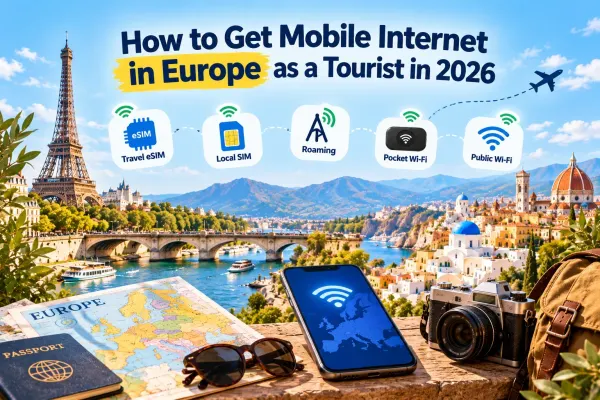
Here are the five main ways to get internet in France at a glance.
Actual prices vary by provider, plan, trip length, and data usage.
Read more: Planning your trip beyond connectivity? France Travel Guide: Costs, Routes, Safety and More covers travel budgets, transport options, safety tips, and practical essentials for exploring France.
What is mobile internet in France like?
France has extensive 4G coverage, with all four main mobile operators - Orange, SFR, Bouygues Telecom, and Free Mobile, covering more than 99% of the population. However, population coverage does not mean every area has a strong signal. Reception and speeds vary by operator, location, and terrain, particularly in rural areas and mountainous regions.

All four operators offer 5G, which launched commercially in France in 2020. In major cities such as Paris, Lyon, Marseille, and Nice, mobile internet generally performs well, although speeds and indoor reception can vary. ARCEP's 2025 network-performance tests found strong mobile internet performance in densely and moderately populated areas, with results differing by operator and activity.
Beyond major cities, coverage can become less consistent, particularly along mountain routes, in remote rural areas, and in parts of Corsica. Before traveling, check ARCEP's Mon réseau mobile coverage maps to compare operators at your destinations.
If your trip continues into Spain or Italy, remember that connectivity can change between countries. A travel eSIM may connect to different local partner networks at each destination, so check your plan's coverage across your entire itinerary.
Read more: Still deciding how long to spend in France? France Itinerary: 7, 10, 14 and 21-Day France Trip Ideas offers itinerary options for different trip lengths, helping you plan destinations and travel time.
How can tourists get internet in France?
If you're wondering how to get internet in France, you have five practical options: a travel eSIM, a local SIM card, international roaming, pocket Wi-Fi, and public Wi-Fi. The best choice depends on your budget, trip length, data needs, phone compatibility, and whether you need a French phone number. Mobile internet in France is widely available in cities, but coverage and costs vary depending on the option you choose.
#1. Travel eSIM
A travel eSIM is a convenient way to access mobile internet in France without visiting a shop or changing your physical SIM. You can purchase and install it before departure, then connect to a supported network when you arrive.
If you're comparing options to find the best eSIM for France, consider the data allowance, validity period, supported networks, hotspot rules, and whether calls or a local phone number are included. A France eSIM is particularly useful for short trips and multi-city itineraries because you can arrange connectivity before leaving home.
Read more: Choosing when to travel can make a difference to your experience. Best Time to Visit France: A Month-by-Month Travel Guide explores seasonal weather, monthly highlights, and the best times to visit different regions.
#2. Local SIM card
If you're researching how to get cell service in France with a local phone number, a prepaid French SIM is a straightforward option. It generally provides a +33 number, although plans, identification requirements, and activation procedures vary by operator.
Before purchasing, compare the available packages and choose a data plan for your France trip that matches your expected data usage and length of stay.
#3. International roaming
If you're asking, "How can I use my phone in France?" start by checking your home carrier's international roaming policy. Some plans include French data allowances, while others charge daily fees or separate roaming rates.
Roaming is convenient because you can keep using your existing number. However, compare the total cost with a local SIM or travel eSIM before deciding how to get internet in France for a longer stay.

#4. Pocket Wi-Fi
If you want to know how to get Wi-Fi in France for several devices, pocket Wi-Fi provides a shared connection for phones, tablets, and laptops. Compare rental prices, data limits, battery life, and return requirements before booking.
#5. Public Wi-Fi
Wondering how to get Wi-Fi in France without paying for a mobile plan? Free hotspots are available at many hotels, cafés, airports, libraries, and other public locations. They are useful for occasional browsing, but availability and connection quality vary, so public Wi-Fi is best treated as a backup.
Read more: Need inspiration for your route? 10 Best Places to Visit in France You’ll Love highlights standout destinations and experiences to consider when planning your French getaway.
Will My Phone Work in France?
Most recent smartphones can connect to French mobile networks, but compatibility depends on your device, whether it is carrier-unlocked, and the network bands it supports. To confirm whether your phone will work in France, check with your carrier or device manufacturer before departure. If you plan to use an eSIM, make sure your phone supports eSIM functionality as well.
Choosing a data plan for your France trip
When choosing a data plan for your France trip, estimate how much data you will need for navigation, messaging, social media, video calls, and streaming. Light users may need only a small allowance, while frequent video calls and high-resolution streaming can require significantly more data.
For more detailed recommendations, compare the best eSIM options for France travel before deciding which plan suits your itinerary.
Read more: Before finalising your travel arrangements, check Do I Need a Visa to Travel to France? Visa Requirements for entry requirements, visa rules, and the documents you may need for your trip.
eSIM vs SIM vs roaming vs pocket WiFi
There are four main ways to access mobile internet in France. Here’s how they compare in terms of convenience, flexibility, and setup.
Travel tip: EU/EEA roaming rules generally let eligible travellers use their domestic allowances in France and other covered countries, subject to fair-use limits. Other plans may charge extra.
For most tourists, a travel eSIM offers a convenient way to stay connected without swapping physical SIM cards. Before buying a France eSIM, check that your phone is unlocked and compatible, and review the plan's data, hotspot, and roaming conditions.
Does France have good mobile coverage?
France has extensive mobile coverage, especially in cities and populated areas. However, if you're deciding how to get cell service in France, remember that signal strength varies by location, network, and terrain.
Coverage in major cities
Paris, Lyon, Marseille, Nice, and Toulouse generally have good 4G and 5G coverage. All four major operators - Orange, SFR, Bouygues Telecom, and Free Mobile, serve these areas, although reception can weaken in underground stations and older buildings. Source: ARCEP's 2025 network assessment.
Coverage outside cities
Coverage can be less reliable in the Alps, Pyrenees, rural villages, and parts of Corsica. Train connections can also fluctuate: ARCEP's 2025 tests found that web pages loaded in under five seconds in around 64–65% of tests on intercity and regional trains. Check the ARCEP coverage map and download offline maps before travelling through remote areas.
4G vs 5G
Both 4G and 5G are available across France, but coverage varies by operator and location. 4G is sufficient for most tourists using maps, messaging, bookings, and browsing; 5G offers faster speeds where available. Before choosing a travel eSIM or local SIM, check which networks it supports and whether it can switch between partner networks.
Read more: Planning to travel between French cities and regions? Transportation in France: How to Get Around in France explains the main transport options and how to navigate the country efficiently.
How much mobile data do you need in France?
The right data plan for your France trip depends on how often you use maps, social media, video calls, and streaming apps. Here’s a quick guide to help you choose.
These are estimates, so your actual usage may vary. Download offline maps before travelling and use hotel Wi-Fi when available to save mobile data.
Travel tip: If you plan to stream videos or work on your laptop, choose a larger data allowance. Before buying an eSIM for France, check the hotspot limits and whether you can top up during your trip.
How much does mobile internet in France cost?
Typical prices for mobile internet in France in 2026 depend on your data needs, trip length, and provider. Use the table below to compare your options before buying.
These are indicative prices, not fixed market rates. For example, Orange Travel lists France eSIM plans from €3.99 for 1 GB over 7 days, while HippocketWifi offers France rentals from €3.95 per day for longer 4G rentals. US roaming passes and UK add-ons have different pricing and allowances, so check your carrier's current terms before travelling.
When choosing a data plan for your France trip, compare the data allowance and validity period as well as the price. A France eSIM may cost less than daily roaming for travellers whose home plans charge extra, while eligible EU/EEA customers may already have roaming included. A local SIM can suit longer stays, and pocket Wi-Fi may offer better value when several people share the cost.
What is the best internet option for your trip?
The best way to get internet in France depends on your trip length, budget, and connectivity needs.
- Short city break: A travel eSIM or roaming pass.
- Multi-country trip: A regional eSIM that covers every destination.
- Long stay: A local SIM for a French number and a suitable data allowance.
- Families and groups: Pocket Wi-Fi or an eSIM with hotspot sharing.
- Remote workers: A plan with enough high-speed data and clear hotspot rules.
- Heavy data users: A large data allowance or an unlimited plan with clear fair-use terms.
- Need a French phone number? Choose a local SIM or a plan that explicitly includes one. Jetpac in-app voice calling supports outgoing calls to phone numbers but doesn't replace a French mobile number.
- Phone without eSIM support: Use a physical SIM, pocket Wi-Fi, or your home carrier's roaming service.

How to choose an eSIM for France?
When comparing options for the best eSIM for France, check these points before buying.
Country coverage: A France-only plan works for a single-country trip. For travel across Europe, choose a plan that covers every country on your itinerary.
Data and validity: Match your allowance to your trip length and usage. Check whether you can top up if you run out.
Network coverage: Check which French networks your provider supports, where this information is available. You can also compare local coverage using ARCEP's mobile coverage map.
Hotspot and speed: Check whether tethering is allowed and whether high-speed data is capped or throttled after a certain allowance.
Activation: Confirm when your plan starts, at installation, activation, or your first connection in France.
Phone compatibility: Your phone must support eSIM and be carrier-unlocked. See our guide on Will My Phone Work in France.
How to set up mobile internet before your trip?
#1. Using an eSIM
- Check that your phone is unlocked and eSIM-compatible.
- Buy and install your eSIM over Wi-Fi before departure.
- Set the travel eSIM as your mobile data line when appropriate.
- Enable data roaming on that eSIM if your provider requires it.
- Turn off data roaming on your home SIM to avoid unexpected charges, and disable automatic data switching if your phone supports it.
- Test your connection after arrival.
#2. Using a physical SIM
Bring your passport or another accepted ID, check the seller's registration requirements, and purchase a SIM from an operator or authorized retailer. Follow the activation instructions and confirm that mobile data works before leaving the shop.
#3. Before leaving home
Download offline maps and translation packs, save your hotel address, and keep copies of your transport tickets and reservations accessible offline.
What to do if your mobile internet stops working?
If your mobile internet in France isn't working, try these quick fixes.
These steps solve many common problems. If your connection still doesn't work, contact your provider to check coverage, activation, and account settings.
Stay connected in France with Jetpac
Jetpac is a travel eSIM that you can install before your trip, with no physical SIM swap and no shop visit. Activation is simple, and your primary SIM stays active in the other slot for your usual number while the Jetpac eSIM handles data. Plans come in flexible data sizes, and Jetpac covers 200+ destinations, so one eSIM works across a multi-country route. In France, it connects to Orange and SFR and switches between them for the strongest signal. Plans include an unlimited hotspot, pricing is prepaid with no roaming bill shock, and a 100% money-back guarantee applies.
Jetpac France eSIM offers data and in-app voice calls, starting at $1.99 for 5 minutes. If you are comparing plans in detail, see our guide to the Best eSIM for France Travel.
Jetpac is a strong fit for short and medium trips, moderate data needs, multi-country routes, travelers who want to keep their home number, and anyone who needs a hotspot. It needs an eSIM-compatible, unlocked phone. A local SIM may suit a stay of a month or more, or someone who needs a French number and local texts. Jetpac is positioned on convenience, flexibility, and predictable connectivity rather than on being the cheapest option in every case.
FAQs
What is the best way to get mobile internet in France?
For most tourists, a travel eSIM installed before departure is the simplest option. A local SIM suits long stays, and roaming suits very short trips.
Can I use my phone in France without paying roaming charges?
Yes, with a travel eSIM or a local SIM. Visitors from outside the EU are not covered by Roam Like at Home, so roaming on a home plan usually costs extra. Many people searching "how can I use my phone in France" end up choosing an eSIM for this reason.
Is eSIM or a local SIM better for France?
An eSIM is easier and keeps your home number active. A local SIM often gives more data for the price on long stays and comes with a +33 number.
Does my phone need to be unlocked to use an eSIM in France?
Yes. Your phone must support eSIM and be unlocked from its original carrier.
Can I keep my regular phone number while using a travel eSIM? Yes. Keep your home SIM active in the other slot for calls and texts, and use the travel eSIM for mobile data.
Is mobile internet reliable in rural areas of France?
It is generally good along main roads and in towns, but mountains, small villages, and national parks can have weak coverage. Download offline maps before heading there.
Will my phone work in France?
Most recent smartphones work with a local SIM, and eSIM works on recent iPhone, Samsung, and Google Pixel models, as long as the phone is unlocked. If your phone does not support eSIM, a local SIM is the alternative.
Do I need to show ID to buy a SIM card in France?
Yes. French law requires identity verification, usually with a passport, and some travel eSIMs sold by French carriers also require it.
Disclaimer
This blog is for educational purposes only. The information in this article is based on publicly available data, including carrier plans, prices, coverage figures, roaming rules, and registration requirements, all of which can change without notice. Always confirm current pricing, coverage, and requirements with the provider before you travel. Jetpac is not responsible for any inaccuracies, changes, or losses arising from reliance on this information.
Get connected as soon as you land with a Jetpac travel eSIM.