How to Get Mobile Internet in Europe as a Tourist in 2026
Tourists exploring Europe in 2026 can choose from travel eSIMs, local prepaid SIMs, international roaming, and pocket Wi-Fi. Detailed comparison matrices break down cellular coverage, data requirements, and setup steps to deliver reliable, multi-country connectivity on any travel budget.
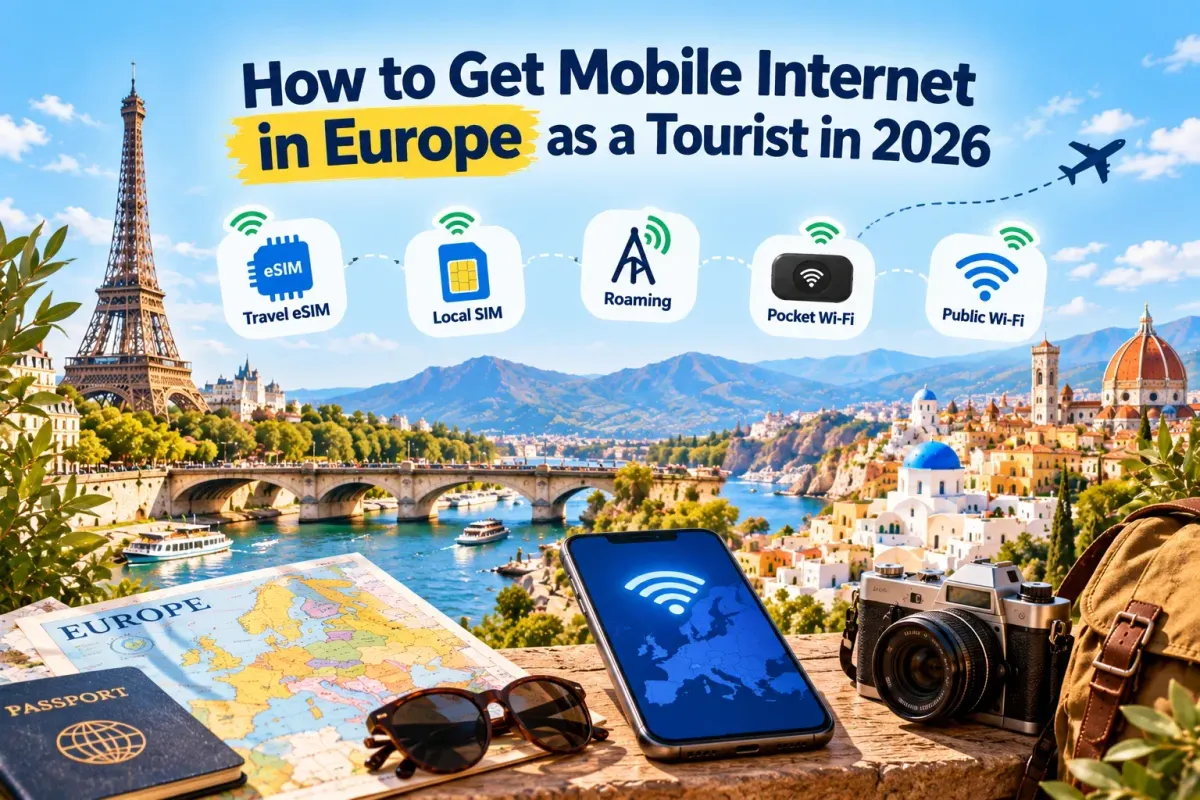
Planning a vacation to the continent involves a lot of moving parts, but figuring out your digital connectivity shouldn't be a headache. Whether you need to navigate cobblestone streets, book train tickets, or share photos, having reliable mobile internet in Europe is essential for a smooth trip.
If you are planning a data plan for Europe trip options for 2026, the landscape has evolved to offer seamless connectivity across borders.
This guide answers the critical question of “how can I use my phone in Europe” while breaking down the best ways to avoid surprise roaming fees.
What Is the Best Way to Get Internet in Europe?
There is no single best way to get mobile internet in Europe because the right choice depends on your phone compatibility, trip length, and data needs.
While a travel eSIM offers the ultimate convenience for most tourists, local SIMs work best for long stays, and a pocket Wi-Fi for Europe fits group travelers perfectly.
- Free: No financial cost required to connect.
- $ (Budget): Low cost, typical of local prepaid SIM rates or minimal regional data packages.
- $$ (Moderate): Mid-tier pricing, representative of travel eSIMs, pocket Wi-Fi rentals, or affordable short-term passes.
- $$$ (High): Premium pricing, common with daily international carrier roaming passes or long-term high-rate plans.
What Is Mobile Internet in Europe Like?
The baseline quality of mobile internet across Europe is excellent. In 2026, you can expect near-universal 4G and dense urban 5G coverage from major operators like Vodafone, Orange, and Deutsche Telekom.
Urban speeds are fast, but rural coverage varies. Transit connectivity along highways is steady, though signals often drop in remote destinations like mountains or national parks.
Network fragmentation means performance fluctuates across borders. If you are wondering “how to get cell service in Europe,” remember that EU roaming rules exclude spots like Switzerland. Checking these country policies is one of the best travel tips for Europe.
How Can Tourists Get Internet in Europe?
Travel eSIM
- What it is: A travel eSIM is an entirely digital cellular profile downloaded straight to your smartphone without a physical plastic card.
- How it works: It attaches directly to your device's network hardware to let you access web data instantly on arrival.
- When to buy: Buy your plan online a few days before departure.
- Installation: You install the profile by scanning a provided QR code or entering a manual activation code into your settings.
- Activation: It activates the moment your device connects to a local partner network in your destination.
- Phone number: Most travel packages are data-only, so learning “how to make calls in Europe with an eSIM” setup usually involves using internet-based apps like WhatsApp, FaceTime, or Skype.
- Hotspot/tethering: They fully support wireless hotspot tethering so you can share your data with tablets or laptops.
- Data limits: Plans range from smaller fixed allowances like 5GB up to completely unlimited data options.
- Coverage: They provide extensive regional coverage, allowing you to move through multiple nations seamlessly.
- Pros: They are highly convenient to buy, require zero physical shipping wait times, and allow you to keep your home SIM active.
- Cons: If you are wondering “will my phone work in Europe,” the most critical requirement is ensuring your device is completely carrier-unlocked before you buy a plan.
Local SIM Card
- Where to buy: You can purchase these physical plastic cards directly inside Europe.
- Airport vs store vs retailer: Avoid buying at expensive airport kiosks and instead purchase at official carrier stores or authorized neighborhood retail shops for the lowest rates.
- ID/passport requirements: Most European nations legally require you to present a physical passport for identity registration at the counter.
- Approximate pricing: Plans are very affordable and typically cost between ten and thirty Euros depending on the carrier.
- Data allowances: They feature highly generous data buckets that often include hundreds of gigabytes of high-speed data.
- Local phone number: Every physical card includes a real local European phone number for seamless calling and texting.
- Activation: The store clerk usually activates the network connection on the spot within a few minutes.
- Neighboring countries: Thanks to regional agreements, your card works flawlessly when traveling across neighboring borders.
- Advantages: They provide the cheapest local data rates alongside a functional native phone number for local calls.
- Disadvantages: You face the physical hassle of handling tiny plastic cards, and you risk losing your original home SIM card while it is out of your phone.
International Roaming
- What roaming is: Roaming allows your phone to stay connected abroad by accessing foreign cell towers through your home carrier network partnerships.
- How it works: Your phone automatically searches for a local signal the moment you touch down in another country.
- Carrier travel passes: Most home providers sell dedicated add-on passes to help you manage your overseas usage.
- Pay-as-you-go roaming: This default billing option charges you per individual megabyte used and should be strictly avoided.
- Daily passes: Many major carriers offer fixed daily flat rates to let you access your domestic data allocation abroad.
- Data allowances: Your high-speed data is typically limited to a small daily allotment before speeds get heavily throttled.
- Potential bill shock: Leaving data roaming active without a plan can result in thousands of dollars in accidental fees.
- Check carrier rates: You must log into your cellular account online before departure to review international pricing.
Regional rules: Knowing your operator's exact coverage zone is vital for keeping your mobile internet in Europe affordable. For instance, according to official EU digital policies, "Roam Like at Home" rules cover member states.
However, selecting a proper data plan for Europe trip packages is critical because non-EU spots like Switzerland often incur massive extra charges.
Pocket Wi-Fi
- How it works: This is a portable rental pocket router that connects to local cell towers and broadcasts a private wireless internet signal.
- Typical use case: It serves as a reliable personal hotspot for travelers who need a consistent heavy-duty data connection.
- Connected devices: You can easily link up to ten separate gadgets at the exact same time.
- Group travel: It is highly efficient for families or groups traveling together who want to split a single internet connection.
- Battery requirements: The physical device runs on an internal battery that requires regular recharging every single night.
- Pickup/return: You pick up the rental kit at your arrival airport and drop it off at a designated kiosk before flying home.
- Cost considerations: The daily rental fees are cost-effective for large groups but quickly become expensive for solo travelers.
Public Wi-Fi
- Availability: Free hotspots are easily accessible at airports, hotels, cafés, restaurants, libraries, and transport hubs.
- Security risks: These networks are unencrypted, creating major data security risks for users.
- Best practice: When researching “how to get Wi-Fi in Europe,” treat public networks strictly as a backup rather than your primary connection.
Read more: Planning the rest of your trip itinerary? From top sightseeing spots to transport tips and daily budgeting, explore our comprehensive guide. Read our blog 👉 Europe Travel Guide: Places, Costs, Transport and More
eSIM vs SIM vs Roaming vs Pocket Wi-Fi
This breakdown compares the major ways to secure mobile internet in Europe:
Does Europe Have Good Mobile Coverage?
Coverage in major cities
If you are wondering “how to get cell service in Europe” that matches your home speeds, you will be pleased with the urban infrastructure.
Metros like Paris, London, Berlin, and Rome offer highly dense, near-universal signal penetration, even extending deep into underground subway stations.
Coverage outside cities
Signal reliability changes once you venture into rural or transit areas:
- Highways & Trains: Connectivity is steady on major highways, but passing through remote train corridors, valleys, or rail cuttings often causes brief dropouts.
- Nature & Attractions: Populated tourist coastal islands maintain strong signals. However, expect complete dead zones when hiking deep into national parks or high-altitude mountains.
Read more: Taking the train across European borders? Get practical advice on popular routes, booking train passes, and keeping your connection steady during transit. Read our blog 👉 Train Travel Across Europe: Tips, Routes & Everything You Need to Know
4G vs 5G
While checking to see if “will my phone work in Europe on 5G,” remember that availability varies by network congestion and location. Fortunately, 5G is not automatically necessary for normal travel.
Standard 4G LTE remains completely sufficient for handling everyday travel tasks like map navigation, messaging, and digital bookings.
How Much Mobile Data Do You Need in Europe?
Exactly “how much mobile data do you need” depends heavily on your daily online habits. Estimating this footprint helps you select the correct data plan for Europe trip packages.
How much data for a 3-day trip?
A flexible range of 2GB to 5GB is plenty for short city breaks, giving you enough data to navigate street maps and book local restaurants on the go.
How much data for a 1-week trip?
A bucket of 5GB to 10GB easily covers your daily navigation, regular social media updates, and quick web searches for local attractions without needing to constantly look for Wi-Fi.
How much data for 2 weeks?
Aim for 10GB to 20GB if you plan to stay connected across multiple cities, share videos with friends, and handle occasional work calls during your transits.
How much data for a month?
Look for 30GB up to completely unlimited data options if you rely heavily on music streaming, regular video calls, or need a steady hotspot for your laptop.
How Much Does Mobile Internet Cost in Europe?
If you are figuring out “how can I use my phone in Europe” without overspending, this simple cost breakdown compares your main choices:
Read more: Trying to stick to a clear vacation budget? Learn how much accommodation, meals, activities, and daily expenses actually cost across different destinations. Read our blog 👉 How Much Does a Trip to Europe Cost?
What Is the Best Internet Option for Your Trip?
Best for a short city break
If you are visiting a single city for just a few days, standard home-carrier roaming or a small, inexpensive 1GB to 3GB travel eSIM is your best choice. It eliminates setup hassle, allowing you to focus entirely on your quick vacation.
Best for a multi-country trip
A regional travel eSIM is the undisputed winner for multi-country itineraries. Because of regional carrier networks, a single digital profile will seamlessly switch networks as you cross European borders without requiring any manual adjustments.
Read more: Want to make navigating new cities easier? Discover top-rated smartphone apps for booking transit, translating languages, and finding local dining spots. Read our blog 👉 12 Best Travel Apps for Europe & Multi-Country Trips
Best for a long stay
If you plan to explore Europe for a month or more, buying a local prepaid physical SIM card at your first stop offers the absolute best value. You get massive local data allowances for a fraction of the cost of travel passes.
Best for families or groups
A portable pocket Wi-Fi rental is ideal when traveling with a group. It allows everyone to share a single secure connection, saving money on individual plans while keeping multiple phones and tablets connected simultaneously.
Best for remote workers
Remote workers should pair a high-capacity travel eSIM with a pocket Wi-Fi device as a reliable backup. This combination ensures you maintain a stable, secure connection for video meetings and large file uploads.
Best for heavy data users
If you stream video daily or upload large files, look for providers offering unlimited travel eSIM data packages or a high-allowance local SIM card to avoid heavy overage fees or sudden speed throttling.
Best if you need a local phone number
A local physical SIM card from a retail carrier store is essential if you need to make traditional phone calls, text European numbers, or register for local food delivery and ride-sharing accounts.
Best if your phone doesn't support eSIM
If your device is older or carrier-locked, a local physical prepaid SIM card or a pocket Wi-Fi rental will get you online quickly without requiring digital eSIM capabilities.
How to Choose an eSIM for Europe
Selecting the right digital profile involves more than just finding the lowest price. Platforms like the Jetpac eSIM for Europe have made connecting overseas incredibly simple, but evaluating a few specific plan details ensures you get reliable internet in Europe for your trip in 2026.
Check country coverage
Always verify that your specific destinations are listed on the provider package. This step is especially critical if your itinerary includes regional or non-EU spots like Switzerland or the United Kingdom, which are often left out of basic regional bundles.
Check how much data you need
Do not automatically assume you need an unlimited data plan. Evaluate your typical consumption habits beforehand, as a fixed-data allowance of 10GB or 20GB is often more than enough and far more cost-effective.
Check network partners
A cheap travel package is useless if its local partner network has poor coverage along your specific route. Opt for providers that partner with Tier-1 European networks, such as Orange or Vodafone, to ensure fast and steady signals.
Check hotspot rules
If you are a remote worker or need to tether a laptop, review the hotspot permissions before buying. Some providers allow unlimited data on your phone but block you from sharing that connection with secondary devices.
Check speed/fair-use limits
Understand exactly what you are paying for by distinguishing between these standard data structures:
- Unlimited High-Speed Data: Unrestricted, maximum speeds for the entire duration of your plan.
- Daily High-Speed Allowance: A specific amount of fast data per day, which resets every 24 hours.
- Throttled Data: Connection speeds that drop significantly after you hit a certain data limit, making the internet slow.
Check activation rules
Validity timelines vary by company. Determine whether your plan days start counting the moment you install the profile, when you manually click activate, or only when your device physically connects to a network in Europe.
Make sure your phone is compatible and unlocked
This is the most critical pre-purchase step. Your smartphone must be entirely carrier-unlocked by your home provider, and it must possess built-in hardware compatibility for digital eSIM profiles.
How to Set Up Mobile Internet Before Your Trip
If using an eSIM
- Confirm your phone supports eSIM and is carrier-unlocked.
- Purchase your plan online.
- Install the eSIM profile while connected to home Wi-Fi.
- Keep your primary SIM active if you need your usual number.
- Set the new travel eSIM as your primary mobile data line.
- Enable data roaming exclusively for the travel eSIM.
- Disable data roaming on your home SIM to prevent accidental fees.
- Test your internet connection immediately after arrival.
If using a physical SIM
Order the card online before leaving or purchase it at a carrier store immediately after arrival, then swap the plastic chips.
Before leaving home
Download offline maps, translation packs, carrier apps, and digital tickets while saving your hotel address and emergency numbers.
Read more: Feeling overwhelmed by pre-trip logistics? Walk through a step-by-step itinerary planning guide to organize flights, stays, and activities effortlessly. Read our blog 👉 How to Plan a Trip to Europe: Step-by-Step Guide
What to Do If Your Mobile Internet Isn't Working
No signal
Toggle airplane mode on and off or restart your phone to force a fresh network connection.
Data isn't working
Verify that cellular data is turned on and that your travel profile is active.
SIM won't connect
Make sure you have turned on the data roaming switch specifically for your travel eSIM.
Internet is very slow
Go into your mobile settings and manually select a different local network operator.
5G isn't working
Switch your cellular data settings down to 4G LTE for a more stable connection.
You ran out of data
Log into your eSIM provider app or dashboard to purchase an immediate data top-up.
Your phone keeps using your home SIM
Go to your cellular settings and manually select your travel line as the primary data source.
Stay Connected in Europe with Jetpac
Getting reliable mobile internet upon arrival in a new country can feel like a stressful race against time, but setting up data before landing removes that travel friction completely.
Why Jetpac can be useful for travelers
- Simple digital setup with instant pre-trip installation.
- No physical SIM swap, keeping your primary number active for home calls.
- Flexible data plans across 40+ destinations with automatic activation upon arrival.
Is Jetpac right for your trip?
Selecting the best eSIM for Europe travel depends on your specific trip length, data demands, number of countries, device compatibility, tethering needs, and local calling. Setting up a Jetpac Europe eSIM in 2026 delivers predictable connectivity with unrestricted hotspot sharing and multi-network reliability.
Read more: Heading to North America for your next getaway? Learn how to secure fast data, choose top providers, and avoid steep roaming fees in Mexico. Read our blog 👉 Internet in Mexico: Best Providers and Avoid Roaming Fees
FAQs
What is the best way to get mobile internet in Europe?
A travel eSIM is the best option for most tourists visiting in 2026. It offers flexible data packages, easy setup, and seamless connectivity across borders.
Can I use my phone in Europe without paying roaming charges?
Yes, you can avoid extra charges by using a regional travel eSIM or buying a local prepaid physical SIM card instead of using home-carrier roaming.
Is eSIM or a local SIM better for Europe?
A digital eSIM is better for multi-country vacations and quick setup. A local physical SIM works better for long stays needing maximum data and a native phone number.
Does my phone need to be unlocked to use an eSIM in Europe?
Yes, your smartphone must be completely carrier-unlocked by your home provider to install and run a travel eSIM or foreign network profile.
Can I keep my regular phone number while using a travel eSIM?
Yes, modern dual-SIM phones let you keep your primary home SIM active for incoming calls and texts while using the eSIM strictly for cellular data.
Is mobile internet reliable in rural areas of Europe?
Mobile internet is very reliable in cities and on major transit routes, but coverage can become spotty or drop entirely in remote hiking spots or high mountains.
Disclaimer
The information provided in this guide is based on travel data, technical specifications, and network availability estimates at the time of writing in 2026. Specific details including mobile package pricing, network speeds, coverage areas, and regional roaming policies are subject to change without notice. We recommend verifying current plan terms, device compatibility, and regional guidelines directly with network providers before your trip. Jetpac is not responsible for any connectivity changes or travel outcomes following publication.