Summer in Germany 2026 – Weather, Temperature, Climate, and Top Tourist Places
Summer in Germany is the best time to visit, with warm temperatures, long days, and packed festival calendars across every region. This guide covers weather, climate, and the top tourist places in Munich, Berlin, Hamburg, Heidelberg, the Black Forest, the Rhine Valley, Rothenburg, and Dresden.
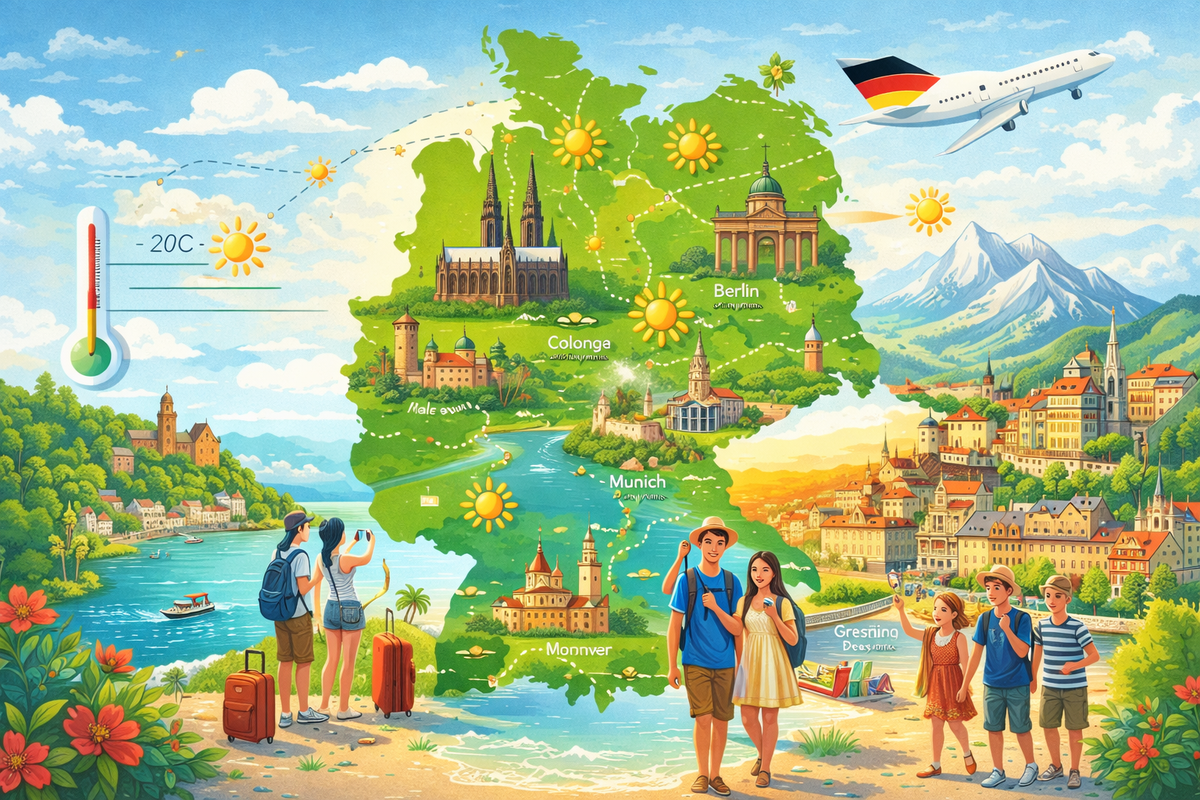
Summer in Germany is Europe at its most welcoming. From Bavaria's beer gardens to the Rhine Valley's castle-lined riverbanks, it transforms between June and August into a destination that rewards every traveler. Whether you are chasing Germany's most popular tourist attractions or looking for the best places to visit in summer in Germany, long evenings and a packed festival calendar await. This is an excellent time for Americans traveling to Germany, with all major attractions at full capacity.
Is summer a good time to visit Germany? With warm temperatures, long daylight hours, and every major attraction running at full capacity, the answer is a clear yes.
Before you fly from the USA, installing a Jetpac eSIM means you land connected to Germany's networks instantly, with maps, transit apps, and travel alerts live from arrivals.
Summer in Germany 2026 brings record visitor numbers to all major destinations, so booking attractions and accommodation ahead of arrival is more important than ever.

Here is your complete guide to weather, temperature, climate, and top tourist places across Germany this summer.
1. Munich, Bavaria
Munich anchors Germany's southern summer scene, combining Bavarian culture, world-class museums, and easy Alpine day trips.
- Weather: Warm and sunny with afternoon thunderstorms common in July and August.
- Temperature: 18°C to 25°C (64°F to 77°F) June through August. July is the warmest month.
- Climate: Continental, with warm, humid days and cooler evenings. Germany's south gets more summer rain than the north.
- Top Tourist Places: English Garden, Marienplatz, Nymphenburg Palace, Deutsches Museum, Viktualienmarkt.
Tip: Book Neuschwanstein Castle tickets online at least two weeks ahead. Summer in Germany brings three-hour queues without pre-booking.
2. Berlin
Berlin's summer is defined by open-air culture, with Germany's capital turning parks, canals, and rooftops into the social center of Europe during summer in Germany.
- Weather: Warm with a mix of sunshine and brief showers. July averages 232 hours of sunshine, one of the sunniest summer months in the country.
- Temperature: 18°C to 26°C (64°F to 79°F) across the summer months.
- Climate: Oceanic-continental mix. Berlin is one of Germany's drier cities in summer, averaging around 500mm annual rainfall.
- Top Tourist Places: Brandenburg Gate, Museum Island, East Side Gallery, Tiergarten, Reichstag dome.
Tip: Book the Reichstag dome visit for free at bundestag.de well in advance. Walk-in entry is not permitted.
3. Hamburg
Hamburg gives visitors a summer experience unlike any other German city, with the massive Alster lakes, the historic Speicherstadt warehouse district, and a maritime culture that sets it apart from the rest of the country.
- Weather: Cooler and cloudier than southern Germany. Pack a light jacket even in July.
- Temperature: 15°C to 22°C (59°F to 72°F) June through August.
- Climate: Maritime, influenced by the North Sea. The northwest receives more rain than any other region, with Hamburg averaging 700-750mm annually.
- Top Tourist Places: Speicherstadt UNESCO warehouse district, Miniatur Wunderland, Elbphilharmonie, Blankenese.
Tip: Download the Deutsche Wetterdienst app before arriving. The most variable summer weather is in the north.
Read More: Before your Germany trip, the 15 Fun Facts About Germany You Didn't Know covers Fun Facts About Germany that put its history, culture, and character into context. Two minutes of reading that make every German destination on this list significantly more interesting to explore.
4. Heidelberg
Heidelberg sits in one of Germany's warmest summer corridors, along the Neckar River beneath a ruined Renaissance castle.
- Weather: Warm, reliably sunny, and relatively dry. One of the most consistently pleasant summer cities in the country.
- Temperature: 20°C to 27°C (68°F to 81°F), among the highest summer averages in Germany.
- Climate: Mild continental with a sheltered river valley microclimate that keeps southwestern cities warmer than the national average.
- Top Tourist Places: Heidelberg Castle, Old Bridge (Alte Brücke), Philosopher's Walk, and the Old Town.
Tip: Take the funicular up, walk Philosopher's Walk back down. Views across the Neckar Valley at golden hour are exceptional.
5. Black Forest, Baden-Württemberg
The Black Forest is one of Germany's great summer escapes, combining dense pine forests, thermal spa towns, and a slow-travel atmosphere increasingly rare in Western Europe.
- Weather: Cooler and greener than the Rhine plain below, with higher rainfall keeping the landscape lush through summer.
- Temperature: 16°C to 23°C (61°F to 75°F) across the region. Higher elevations run significantly cooler.
- Climate: Humid continental with local variation by altitude. The Black Forest region gets some of the highest summer rainfall in elevated areas.
- Top Tourist Places: Baden-Baden thermal baths, Triberg Waterfalls, Titisee Lake, Freiburg im Breisgau old town.
Tip: Baden-Baden's Caracalla Spa requires booking in peak summer. The spa culture here is worth building half a day around.
6. Rhine Valley
The Rhine Valley between Bingen and Koblenz is a UNESCO World Heritage landscape, a stretch of river lined with medieval castles, vineyard terraces, and riverside towns unchanged for centuries.
- Weather: Warm and reliably sunny in summer. The sheltered valley microclimate makes this one of the warmest and most reliably dry summer regions.
- Temperature: 20°C to 26°C (68°F to 79°F) in peak summer. The Rhine corridor is consistently warmer than the national average.
- Climate: Wine-growing microclimate with low summer rainfall. The Rhine region produces Riesling under the same reliable summer sun that makes it a travel destination.
- Top Tourist Places: Lorelei Rock, Marksburg Castle, Bacharach, Rüdesheim, Rhine River cruise between Bingen and Koblenz in Germany.
Tip: KD Rhine cruises run daily from May through October. A Germany eSIM keeps navigation live between river stops where WiFi is unreliable.
7. Rothenburg ob der Tauber
Rothenburg ob der Tauber is one of the best-preserved medieval towns in the country, a fully walled city on the Romantic Road delivering an authentic experience beyond the major cities.
- Weather: Warm and pleasant. Slightly cooler than Munich due to the higher elevation on the Franconian plateau.
- Temperature: 17°C to 23°C (63°F to 73°F) from June to August. The central plateau stays a few degrees below the Rhine corridor.
- Climate: Continental, with warm days and noticeably cooler evenings. Layers are useful in smaller inland towns after sunset.
- Top Tourist Places: Town walls circuit, Plönlein junction, Medieval Crime Museum, Christmas Museum.
Tip: Arrive before 9 am or after 5 pm. Germany's best-preserved small towns draw peak crowds between 10 am and 5 pm.
Read More: Planning travel beyond summer? The Top 12 Best Places to Visit in September Around the World covers the best places to go in September, including Germany destinations that offer quieter conditions and lower prices right after peak season ends.
8. Dresden
Dresden delivers one of the most rewarding summer experiences in Germany, a reconstructed Baroque city on the Elbe whose historic core was methodically rebuilt after wartime destruction.
- Weather: Warm and sunny. July is Dresden's warmest and driest summer month, making it one of the most reliably pleasant eastern cities in summer.
- Temperature: 18°C to 25°C (64°F to 77°F) across June through August.
- Climate: Continental, with warm summers and cool evenings. Eastern cities are drier than the west, with Dresden averaging around 500-550mm annual rainfall.
- Top Tourist Places: Frauenkirche, Zwinger Palace, Semperoper, Brühl's Terrace, and Elbe River walks.
Tip: For USA travelers, the Dresden Card covers all public transport and museum entry. Families flying from the USA into Dresden Airport will find the card available at the airport information desk on arrival. It is important to have your Jetpac eSIM so that navigation apps work from the moment you land.
Staying connected this summer: Jetpac for Germany
Germany runs on apps. The DB Navigator for train times, the Bundesliga stadium app for match tickets, the Deutsche Wetterdienst for that afternoon thunderstorm heading toward Munich, the queue management system at Neuschwanstein that tells you when your slot opens.
Germany eSIM plans from Jetpac are the simplest way to stay connected across all eight destinations on this list without touching your carrier settings at any border.
Summer in Germany is not a destination where you wing it without data. Every missed connection, every sold-out castle ticket, every wrong tram in Dresden happens faster when your phone is not connected.
For USA travelers, the choice is either $10 to $15 per device per day in carrier roaming or one Germany eSIM plan from Jetpac installed before you board. The eSIM activates the moment your flight lands at Frankfurt or Munich, connects automatically to Germany's strongest available carrier across every city and rural stretch on your itinerary, and costs a fraction of what daily roaming charges accumulate across a ten-day trip.
Germany's rail network is among the best in Europe, but also among the most disrupted in 2026. Strike schedules, platform changes, and last-minute reroutes are announced on DB Navigator in real time. Having data between cities is not a convenience in Germany this summer. It is the difference between catching your connection and missing it.
📡 No Hotspot Limits Across Every Device: One Jetpac plan shares data freely across every phone and laptop in your travel group, from Berlin's Museum Island to the Rhine Valley cruise deck.
🗺️ Google Maps and WhatsApp Stay On After Data Runs Out: Jetpac ensures that even with a zero balance, Google Maps keeps routing and WhatsApp keeps messaging, so no one gets stranded in Rothenburg or loses contact mid-itinerary.
⚡ Switches Carriers Automatically: From Hamburg's port district to the Black Forest's elevated valleys, a Jetpac eSIM locks onto the strongest available German network at every point without any manual setting change.
💸 One Flat Cost Instead of Daily Roaming: Jetpac ensures that the connectivity stays affordable and seamless with plans up to 70% cheaper than roaming.
📞 Call your loved ones in the USA for $1.99 per 5 Minutes: Directly inside the Jetpac app, no separate international plan, no hotel phone surcharges.
✅ Full Refund If It Does Not Connect: Every Jetpac plan carries a 100% money-back guarantee with round-the-clock support via WhatsApp and email for the duration of your Germany trip.
FAQs
Is Germany worth visiting in the summer?
Absolutely. Summer in Germany offers the longest days, warmest temperatures, and the most active festival calendar, with every region peaking between June and August, from Bavaria's open-air beer gardens and the Rhine Valley's vineyard festivals to Berlin's rooftop culture and the Black Forest's hiking trails at their greenest.
Which are the best cities to visit in Germany during the Summer?
Munich, Berlin, Heidelberg, and the Rhine Valley are the most rewarding. For fewer crowds, the best summer destinations around Germany include Rothenburg ob der Tauber and Dresden.
What is the weather like in Germany in the summer?
The weather in Germany in summer ranges from 15°C to 27°C (59°F to 81°F) depending on the region. Southern regions and the Rhine Valley run warmest. Hamburg and the northwest run cooler with more frequent rain. July is the peak warmth month. The weather in Germany is more variable by region than most visitors expect, so pack accordingly.
Is Germany too hot in July and August?
No. Average summer temperatures range from 20°C to 26°C across most cities. Heat waves occasionally push above 30°C, but extreme heat is the exception.
Is Germany expensive to visit in the summer?
Germany sits in the middle by Western European standards. Budget travelers manage on $80 to $120 per day. Americans traveling to Germany during peak summer should book accommodation at least 6 weeks in advance. For U.S. travelers, mid-range trips cost $150 to $250 per day, including accommodation, meals, and transportation.
How many days do you need for a summer vacation in Germany?
Seven to ten days covers two to three major cities. Summer in Germany 2026 offers slower travel, and two weeks allow comfortable visits to the Rhine Valley, the Black Forest, and smaller towns.
Do I need a SIM Card or eSIM when traveling to Germany?
Yes. For USA travelers, a travel eSIM from Jetpac is the most practical solution. It is activated before departure, activates on landing in Germany, and covers the entire country without a physical SIM; no phone shop on arrival. An eSIM for Germany helps you reduce your roaming bills, too.
Disclaimer
Temperature ranges are based on historical climate averages. Entry prices subject to change. Jetpac is not responsible for changes after publication.