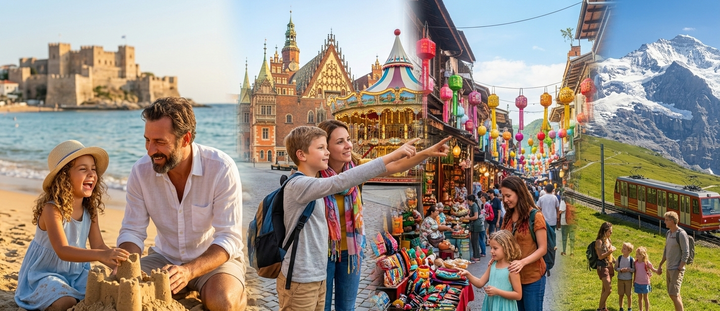
5, 7 & 14-Day Switzerland Travel Itinerary You’ll Actually Enjoy
A well-built Switzerland travel itinerary balances mountains, lakes, and cities without rushing. Whether you have five days, a week, or two weeks in Switzerland, moving with intention allows the country’s layers to unfold naturally.
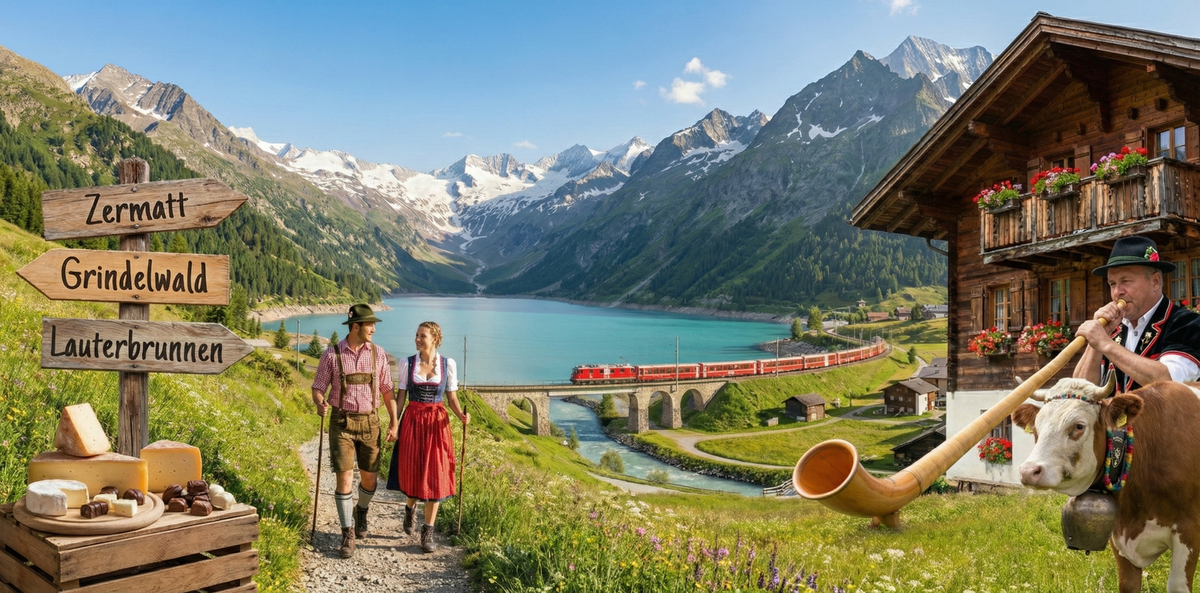
Switzerland does not reveal itself all at once. You arrive expecting mountains, chocolate, and punctual trains, and those things are all there. But the country layers quietly. A lake shifts colour through the morning. Cowbells echo across a valley you didn’t plan to find. A medieval village appears around a bend and looks untouched.
Planning a Switzerland travel itinerary requires real choices. The country packs more into a small geography than most travelers expect. A week here feels full in a way that’s hard to explain. The infrastructure is efficient, which means you actually reach the places you plan to see. But the landscapes ask you to slow down.
This Switzerland itinerary guide gives you three standalone routes:
- A focused 5-day itinerary for Switzerland
- A balanced Switzerland itinerary for 7 days
- A full 2 weeks in Switzerland
Pick the one that matches your time and follow it as written, or use it as a base to adjust.
Before you land, sort your connectivity. An eSIM Switzerland option like Jetpac activates before arrival and keeps maps and transport apps working across mountain valleys and city centres alike. More on that below.
Best Time to Visit Switzerland
There is no wrong season, only different versions of the same country.
The best time to visit Switzerland depends entirely on your focus: hiking, skiing, lakes, or culture.
Before finalizing your dates, know the best time to visit Switzerland to match your itinerary with the right season and weather.
5-Day Itinerary for Switzerland
This 5-day itinerary for Switzerland gives you cities, lakes, and mountains without rushing. It moves logically and still leaves space to sit with a view.
Day 1 – Zurich
Start in Altstadt, where medieval streets sit beside sleek boutiques. Walk along the Limmat River, then climb Lindenhof Hill for a quiet view over church spires and rooftops. Have lunch at a riverside café, try Zürcher Geschnetzeltes if you want something local. In the evening, head to Langstrasse or Zurich West for relaxed dining and a first taste of Swiss city life.
Day 2 – Lucerne
An hour by train takes you to postcard Switzerland. Chapel Bridge and the Musegg Wall are early morning magic before the crowds gather. Take a boat across Lake Lucerne and watch the mountains rise directly from the water. Stay overnight and enjoy a lakeside dinner, fresh lake fish, or rösti is a good start.
If you want to go beyond the classic stops, explore these most beautiful places in Switzerland for quieter alpine scenery and hidden lakes.
Day 3 – Interlaken
The train ride itself is part of the experience. Lakes narrow into valleys and peaks appear suddenly outside the window. Take the Harder Kulm funicular for a view that makes the geography make sense. In the evening, walk between Lakes Thun and Brienz and let the air cool around you.
Day 4 – Grindelwald
Grindelwald feels smaller, more intimate. Ride the gondola to First or simply walk beneath the Eiger’s north face. Alpine trails here don’t demand speed; they reward stillness. Stop for coffee in a wooden chalet café before returning to Interlaken.
Day 5 – Bern
Bern is calm and deeply livable. Walk under six kilometres of arcades, visit the Rose Garden for the famous river-bend view, and sit with a coffee where Einstein once lived. It’s a fitting close to a compact but complete Switzerland travel itinerary.
Switzerland Itinerary 7 Days
This 7-day Switzerland itinerary builds on the 5-day version but adds breathing room and a shift into French-speaking Switzerland.
Days 1–2 – Zurich
Follow the 5-day outline, but give yourself time to linger. Take a boat across Lake Zurich or a short train to Rapperswil, where medieval towers overlook the water. Zurich works best when you let it unfold slowly rather than checking off sites.
Not sure what to bring? Check out the practical Switzerland packing list to prepare for changing mountain weather and long train days.
Day 3 – Lucerne
As mentioned earlier, Lucerne’s beauty lies in its balance of lake and stone. With extra time, take the cogwheel railway up Mount Rigi or Pilatus. From the summit, Switzerland spreads out in lakes and ridgelines in every direction.
Days 4–5 – Interlaken & Mürren
Base yourself in Interlaken but stay one night in Mürren or Wengen. Waking up in a car-free alpine village changes the pace entirely. Walk Lauterbrunnen Valley, feel the mist from waterfalls, and eat something simple and hearty, maybe raclette after a long day outdoors.
Day 6 – Montreux & Lavaux
The train west softens the scenery. Vineyards terrace down toward Lake Geneva, and French replaces German on the signs. Visit Chillon Castle, then walk through Lavaux’s vineyards with a glass of local white wine. The landscape here is less dramatic than the Alps, but quietly powerful.
Day 7 – Geneva
Geneva feels international but grounded. Walk through Vieille Ville, climb Saint-Pierre Cathedral, and sit by the lake watching sailboats pass the Jet d’Eau. The transition from alpine peaks to lakeside diplomacy makes this Switzerland itinerary feel complete.
Traveling in colder months? Read our guide to Switzerland in winter to plan around snow conditions, ski regions, and Christmas markets.
2 Weeks in Switzerland
Two weeks in Switzerland lets you go deeper rather than just further. It’s not about adding more stops; it’s about letting each region settle.
Days 1–4 – Zurich & Lucerne
Follow the earlier structure but expand gently. Visit Rhine Falls from Zurich or take a longer lake cruise in Lucerne. Spend an extra hour in cafés rather than trains. The country rewards time.
Days 5–7 – Bernese Oberland
Stay in Mürren or Wengen instead of just Interlaken. Hike to Bachalpsee, where mountains reflect in still water. Let Lauterbrunnen’s waterfalls set the rhythm of your days. This is Alpine, Switzerland, at its purest.
Looking for more activity ideas? Discover additional things to do in Switzerland beyond the standard tourist route.
Days 8–9 – Zermatt
Arrive in car-free Zermatt and let the Matterhorn dominate the skyline. Ride the Gornergrat railway one day, hike the Five Lakes trail the next. Evenings here are quiet, wooden chalets, soft light, and fondue shared slowly.
Day 10–11 – Lugano (Ticino)
Cross into Italian-speaking Switzerland and feel the change instantly. Palm trees line the lake, risotto replaces rösti, and the atmosphere softens. Walk the promenade in Lugano and ride Monte Brè for sunset. It feels Mediterranean without leaving Switzerland.
Day 12 – Engadine Valley
Travel north to St. Moritz and the Engadine. The light is sharper, the lakes calmer, the crowds thinner. Walk between Sils and St. Moritz and let the silence do its work.
Considering a longer stay? Check the cost of living in Switzerland to understand accommodation and daily expenses before booking.
Days 13–14 – Montreux & Geneva
Return west for vineyards and lake views. Add Vevey or Chaplin’s World if you want a cultural stop before departure. End in Geneva slowly, not with urgency, but with a final lakeside evening.
Two weeks in Switzerland show you how different each corner feels, Alpine, Mediterranean, French-speaking, high-altitude quiet, all within one small country.
Switzerland Travel Budget
Food is the most controllable expense. Coop and Migros supermarkets make picnic lunches easy. Tap water is safe everywhere.
The Swiss Travel Pass often pays off for trips of five days or longer.
Staying Connected in Switzerland
Switzerland may look compact on a map, but your days move fast, with early trains, last cable cars, shifting weather, and mountain routes that change by the hour. Reliable data isn’t optional here. It keeps your Switzerland travel itinerary flexible instead of stressful.
An eSIM Switzerland plan lets you activate your connection before departure. Scan a QR code, switch it on when you land, and your data works immediately, from Zurich’s old town to remote alpine villages.
If you’re researching the best eSIM for Switzerland, reliability and cross-border flexibility matter, especially if your trip continues into France or Italy.
Why Jetpac Works Well for Switzerland Travelers
Jetpac eSIM is built for multi-stop European trips and mountain-heavy routes like Switzerland.
For a Switzerland itinerary that moves between cities, lakes, and mountains, a dependable eSIM Switzerland tourist option removes one logistical variable. Set it up before departure, and your focus stays on the view, not the signal.
FAQs
What is the best Switzerland travel itinerary for first-timers?
The Switzerland itinerary, 7 days covering Zurich, Lucerne, Interlaken, Montreux, and Geneva, offers the strongest balance.
Is 5 days enough for Switzerland?
A 5-day itinerary for Switzerland covers highlights but focuses mainly on the German-speaking north and Bernese Oberland.
Is 2 weeks in Switzerland too long?
No. Two weeks in Switzerland allows exposure to all major regions without rushing.
What are the best places to visit in Switzerland on a short trip?
Lucerne, Interlaken, Grindelwald, and Bern are essential.
Is an eSIM Switzerland tourist option worth it?
Yes, especially for multi-city routes. It simplifies transport apps and navigation across alpine regions.
How much does it cost to travel to Switzerland?
The cost of a Switzerland travel itinerary depends on your style and season. Budget travelers can manage on USD 120–160 per day with hostels and supermarket meals. Mid-range trips average USD 200–300 per day, while luxury itineraries can exceed USD 350 daily, especially in places like Zermatt or St. Moritz.
Disclaimer
This guide is for educational purposes only. Information is based on publicly available data at the time of writing. Costs, schedules, rail passes, and connectivity services may change. Switzerland’s official currency is the Swiss Franc (CHF). Any USD references are approximate conversions. Jetpac is not responsible for network coverage, speed, or service interruptions.