Can Americans Travel to Russia Right Now?
The US State Department maintains a Level 4 Do Not Travel advisory for Russia, the highest level it issues. Americans currently in Russia are advised to leave immediately. Wrongful detention, drone strikes, and suspended consular services are the core risks.
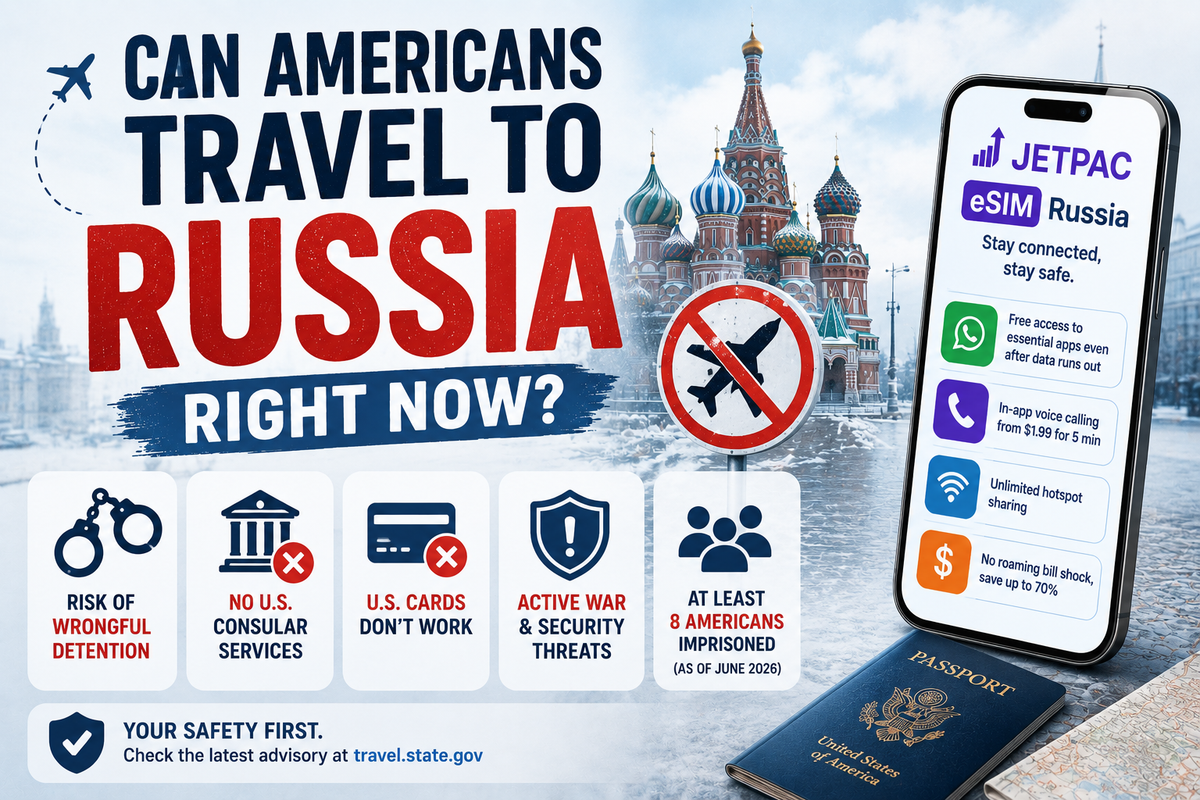
The US government has placed Russia at Level 4: Do Not Travel, the highest advisory level it issues, and Americans currently there are instructed to leave immediately.
The US State Department issues the highest level travel warning to Russia because of the continuing war with Ukraine, the risk of wrongful detention by Russian security services, the arbitrary enforcement of local laws, and the threat of terrorism. This advisory has been in place since February 2022 and was most recently reissued on December 29, 2025.
So, can Americans travel to Russia? Technically, yes. There is no federal law that automatically bans it. But legal permission and real-world safety are very different things, and in Russia’s case, that gap is unusually wide.
This blog explains whether Americans can travel to Russia right now, whether US citizens can travel to Russia, and whether it is safe to travel to Russia as an American under the current Russia travel warning update. The short answer is no, not safely.
There are no direct flights from the US. American bank cards do not work in Russia, all US consulates have suspended operations, and the US government continues to warn citizens against all travel.
What the US Government Actually Says
Do Not Travel
"Do not travel to Russia for any reason due to terrorism, unrest, wrongful detention, and other risks. U.S. citizens in Russia should leave immediately."
The US government advises citizens against all travel to Russia without any qualification. There is no carve-out for tourists, no exception for business travel, and no region within Russia rated at a lower level. The entire country is Level 4.
What Changed in the December 2025 Update?
Two sharpened warnings
"U.S. citizens may serve their entire prison sentence without release."
"The risk of wrongful detention of U.S. citizens remains high."
The Smart Traveler Enrollment Program registers your presence with the US Embassy and ensures you receive emergency notifications. Enroll at:
step.state.govCan Americans Legally Go to Russia Right Now?
Advisory, not a ban
Americans can travel to Russia without breaking US law. The advisory is a formal government warning, not a legal ban. In practice, several barriers make travel from the USA to Russia significantly more difficult and significantly more dangerous than the legal status alone suggests.
What actually stops you
Why the Advisory Exists: Real Cases
The Level 4 advisory is not bureaucratic caution. It reflects a documented pattern of Americans imprisoned on charges ranging from fabricated to grossly disproportionate. These are not people with government connections. They include a teacher, a ballerina, a musician, a soldier, a sailor, and a retired English teacher in his seventies.
Americans in Russian custody
A "wrongfully detained" designation is a formal State Department classification that triggers diplomatic advocacy through the Special Presidential Envoy for Hostage Affairs. It does not guarantee release.
Is It Safe to Travel to Russia as an American Right Now?
Is it safe?
This is a risk that cannot be managed through careful behaviour alone. The combination of factors below places Americans in Russia beyond the reach of normal travel risk mitigation.
"Is it safe to travel to Russia in 2026?" is a question the State Department answers with a single instruction: do not go.
Also Read
Is It Safe to Travel to Israel in 2026?
Planning a trip to Israel? Stay informed about the current travel situation, safety considerations, government advisories, and practical tips before you travel.
Is It Safe to Travel to Turkey Right Now?
Heading to Turkey soon? Learn about the latest travel conditions, regional considerations, safety guidance, and tips for a smoother trip.
Is It Safe to Travel to Iran?
Considering a trip to Iran? Understand current travel advisories, entry considerations, safety concerns, and important information for travelers.
Is It Safe to Travel to Iraq?
Planning travel to Iraq? Review the latest safety information, regional travel considerations, and key precautions to help you make informed decisions.
What Is the Security Situation Inside Russia Right Now?
One of Ukraine's largest drone strikes on Russia
Debris fell on Sheremetyevo Airport. Drone strikes have repeatedly forced Moscow-region airports to suspend operations and strand passengers for hours.
Recent security events
Three Myths Worth Addressing Directly
Avoiding politics lowers your risk
Karelina made a $52 donation from the US before she even traveled. Fogel was carrying medication. Zimmerman was sailing. Prior social media history, donation records, and past associations are all usable by Russian authorities. Fabricated or exaggerated charges appeared in every documented American detention case.
Releases mean things are improving
Releases demonstrate that swaps are possible, not that detention risk has decreased. Zimmerman was intercepted in June 2025, after the release of Fogel and Karelina. An unnamed American was sentenced in February 2026. The pattern has not changed.
The Embassy will help if something goes wrong
The Embassy is operating with severely reduced staff under Russian-imposed restrictions. All consulates have suspended operations. Consular access to detained Americans is not guaranteed. The advisory states this explicitly.
What About Dual Nationals?
The risk is compounded
For Those Who Must Travel
Who travels despite the advisory
Staying Connected in Russia: If Travel Is Unavoidable
For the narrow category of people who travel to Russia for unavoidable reasons, a working data connection is one of the few practical safety tools available. It keeps maps, emergency contacts, and exit logistics accessible when other systems fail.
A Jetpac eSIM Russia plan activates before departure through a QR code, so connectivity is in place before you land. No physical SIM swap at a Russian airport, no reliance on local carrier infrastructure that may be restricted or monitored.
Why it works for unavoidable Russia travel
FAQs
Can Americans travel to Russia in 2026?
Technically, yes, there is no US law banning it. In practice, the US State Department maintains Level 4: Do Not Travel for Russia, the highest level it issues, and instructs all Americans currently in Russia to leave immediately. No direct flights operate between the US and Russia. US cards do not work due to financial sanctions. All US consulates have suspended operations. At least eight Americans remain imprisoned in Russia as of June 2026.
Can US citizens travel to Russia safely?
No. The documented risk includes wrongful detention on fabricated or disproportionate charges, drone strikes reaching major Russian cities, no functioning US consular support, non-operational US banking cards, and most travel insurance policies refusing coverage in Do Not Travel zones. The State Department's position is unambiguous: do not travel to Russia for any reason.
What is the current Russia travel warning update?
The most recent Russia travel warning update was issued on December 29, 2025. It maintains Level 4: Do Not Travel and, for the first time, adds specific drone-strike language. It sharpened language on wrongful detention, explicitly warning that Americans may serve their entire sentence without release and that the risk of wrongful detention remains high.
What has happened to Americans who traveled to Russia?
At least eight Americans remain imprisoned as of June 2026. Marc Fogel received 14 years for carrying prescribed medication. Ksenia Karelina received 12 years for donating $52 to a Ukrainian charity. Chuck Zimmerman received 5 years for allegedly transporting weapons on his sailing boat. An unnamed American received 4 years for failing to declare rifle stocks in checked luggage. All were ordinary civilians with no government connections.
Is it safe to travel to Russia as an American if I avoid politics?
No. Karelina donated before she traveled. Fogel was carrying medication. Zimmerman was sailing. Russian authorities fabricated or grossly exaggerated charges in every documented American detention case. Your nationality and its value as a diplomatic bargaining chip is the primary risk factor, not your behaviour inside Russia.
What is the best eSIM for Russia for people who must travel there?
Look for the best eSIM for Russia that activates before departure via QR code, covers Russian networks reliably, keeps essential apps active after the data cap, and works across transit countries on the same plan. Verify current coverage in your specific routing before departure.
Disclaimer
This blog is for informational and educational purposes only and does not constitute legal, security, or travel advice. The US State Department Russia travel advisory cited is based on the official advisory issued on December 29, 2025, and reissued on May 8, 2025, after periodic review; always verify the current advisory status at travel.state.gov before making any travel decisions. Advisory levels are subject to change; information reflects status as of June 2026. Detention cases and release dates are based on publicly available reporting from CBS News, CNN, NPR, AP, Axios, Al Jazeera, The Hill, and Radio Free Europe/Radio Liberty and are accurate as of those sources' publication dates; individual case statuses may have changed. Detainee counts vary by source; the total of eight or more reflects the most conservative confirmed figure as of June 2026. The US government's ability to provide consular assistance in Russia is severely limited; verify current consular status at the US Embassy Moscow website before any travel. Russia's e-visa availability for American citizens is subject to change without notice; verify directly with Russian consular authorities. Travel insurance exclusions in Do Not Travel zones vary by policy; verify coverage explicitly with your insurer before any travel to Russia. Individuals considering travel to Russia for professional reasons should consult qualified legal and security professionals with Russia-specific expertise. Jetpac eSIM availability and network coverage in Russia are subject to change; verify current coverage before purchase. Jetpac is not responsible for network variations, third-party data accuracy, or decisions made based on this content. No endorsement of travel to Russia or any destination under a Do Not Travel advisory is implied.
Read next

Is It Safe to Travel to France Right Now: France Travel Advisory 2026

Anak Krakatau Eruption Disrupts Air Travel Across Indonesia