Does AT&T Work in Canada? Latest Plans and Prices for 2026
Canadian cell towers automatically route AT&T signals, giving unlimited subscribers fee-free service. Still, prepaid lines and older tiers face $12 daily fees or severe speed drops. Checking your tier beforehand and toggling data roaming ensures steady GPS and data throughout your trip.

Yes, your phone will work seamlessly north of the border. “Does AT&T work in Canada” without extra charges? Most domestic unlimited tiers include AT&T roaming in Canada automatically, giving you talk, text, and data access at no added cost. However, off-net speed throttling remains the main caveat.
This guide breaks down AT&T coverage in Canada, plan eligibility, and whether an international pass or secondary travel eSIM makes sense for your trip in 2026.
AT&T Roaming in Canada: What to Expect
Before heading north, checking your plan features ensures seamless mobile access. Modern AT&T service in Canada connects automatically through local partner networks like Rogers, Bell, and Telus.
The table below breaks down default plan allowances, speed caps, and roaming expectations across the border.

Is Canada Included in AT&T's Plan?
Plans that include Canada
Does AT&T work in Canada? Checking whether your AT&T unlimited plan in Canada covers your trip comes down to your current account line.
Modern options like Unlimited Premium PL, Unlimited Extra EL, Unlimited Starter SL, and Value Plus VL include talk, text, and data access in Canada at no extra charge.
Tiered options like the 4GB plan also share domestic data allowances seamlessly across the border.
Read more: Traveling to Mexico next? Learn how major U.S. carriers handle cross-border coverage, data speed caps, and included talk and text allowances. Read our blog 👉 Does AT&T Work in Mexico? Latest Plans, Cost and Roaming Guide
Plans that require an international pass/add-on
If you carry a plan without built-in North American features or want to prevent pay-per-use rates, adding a travel pass secures reliable access.
Alternatively, purchasing an affordable standalone solution like a Jetpac Canada eSIM allows you to skip carrier-based daily fees entirely.
- Pass name: AT&T International Day Pass
- Cost: $12 per day for the primary line ($6 per day for additional lines on the same account)
- Validity: 24 hours per daily fee, capped at 10 daily charges per billing cycle
- Data allowance: Uses your domestic plan data allowance (includes high-speed data matching your home account)
- Calling: Unlimited calls back to the U.S. and to over 210 included destinations
- Texting: Unlimited standard texting included
Plans that don't include international roaming
Legacy meter-based accounts and basic AT&T Prepaid plans do not include roaming across Canadian networks by default.
If you travel on an ineligible prepaid tier without adding a feature pass, your device will not connect to cellular networks or will trigger costly pay-per-use fees.
Evaluating eSIM vs roaming helps prepaid users set up an affordable digital data profile before heading north. Confirming your setup beforehand ensures AT&T service in Canada stays active without unexpected account suspensions.
How Much Does AT&T Cost in Canada?
Your total expenses depend on your base account tier and whether you carry an active add-on. Reviewing the primary pricing breakdown helps you plan your travel budget accurately before crossing the border in 2026.
Read more: Heading to Europe soon? Understand how daily travel passes, destination tiers, and network access rules impact your final mobile bill abroad. Read our blog 👉 iD Mobile Roaming Guide: Prices, Passes, and Destinations
What Coverage Can You Expect From AT&T in Canada?
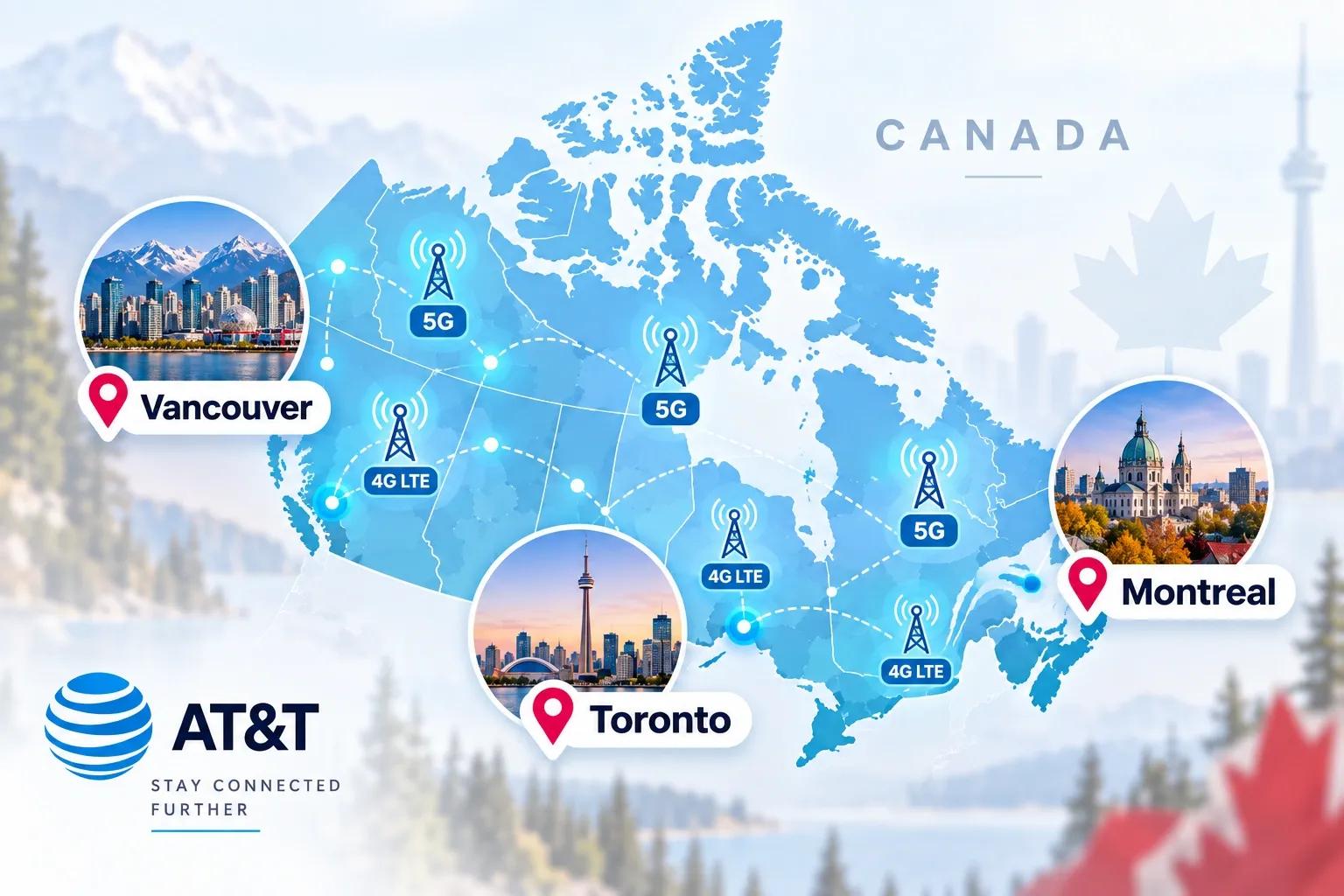
AT&T uses local partner networks like Rogers, Bell, and Telus rather than operating its own cell towers. Evaluating overall AT&T coverage in Canada before departing ensures you know what to expect across different provinces.
- Strong 4G LTE spans roughly 99% of populated areas, primary highways, and border crossings.
- High-speed 5G connects automatically in major urban hubs via local roaming agreements.
- Popular destinations like Banff, Niagara Falls, and Whistler maintain solid cell signals.
- Remote wilderness, northern territories, and deep mountain passes experience weak or absent service.
- Coastal regions and islands like Vancouver Island keep steady coverage near towns and ferry routes.
AT&T coverage in major cities
Verifying AT&T service in Canada across major urban centers confirms reliable performance in high-density regions:
- Toronto: Fast, reliable connections span downtown, Pearson Airport, and surrounding suburbs.
- Vancouver: Solid signals cover downtown, coastal harbor areas, and transit routes.
- Montreal: Network performance stays fast across historic quarters and underground shopping areas.
Reviewing your coverage details ahead of time ensures that asking “will my AT&T phone work in Canada” ends with steady navigation throughout your journey.
Read more: Comparing major carrier roaming features across North America? Discover how another top network manages speed limits, hotspot sharing, and partner connections. Read our blog 👉 Does T-Mobile Work in Mexico? Latest Plans, Data & Roaming Guide
How to Use AT&T in Canada
Setting up your device properly before heading north guarantees that AT&T data roaming in Canada connects seamlessly as soon as you cross the border.
Before you leave
- Log in to your myAT&T account to confirm your plan tier includes native Canadian roaming features.
- Verify that your account line has no international roaming blocks or restrictions active.
- Confirm your phone supports HD Voice, VoLTE, and local Canadian frequency bands.
- Download the myAT&T mobile app to monitor real-time data usage and account add-ons on the go.
- Save AT&T international customer support (+1-314-925-6925) in your contacts for free toll-free assistance while abroad.
Read more: Planning a European vacation this year? Explore post-Brexit travel rules, daily roaming charges, and fair usage caps across popular destinations. Read our blog 👉 EE EU Roaming Charges Explained: What You'll Pay in 2026
When you arrive
- Open your cellular settings menu and turn data roaming ON so your device can attach to Canadian towers.
- Keep network selection set to automatic so your phone registers with partner networks like Rogers, Bell, or Telus.
- Restart your phone after crossing the border to force a clean connection with local cell towers.
- Read the automated welcome text message from AT&T outlining active rates and data terms.
- Check your status bar to confirm which partner network displays beside your signal bars.
If your phone doesn't connect
If your device displays no service or data fails to load after landing or crossing the border, you might wonder, "Can I use my AT&T phone in Canada?" Follow these official troubleshooting steps to get back online:
- Toggle Airplane mode on for ten seconds and turn it back off to reset your phone's wireless radios.
- Turn off your phone completely, wait 30 seconds, and power it back on to force a fresh network handshake.
- Open cellular settings and verify that data roaming is explicitly toggled on for your active AT&T line.
- Reset network settings under system options to clear corrupted network configurations and saved caches.
- Contact AT&T international support at +1-314-925-6925 for account-level troubleshooting if connection issues persist.
Taking these precautions ensures AT&T's roaming for Canada functions as expected, so you can maintain uninterrupted connectivity throughout your trip.
What Happens to Your AT&T Number Abroad?
Your primary U.S. mobile line stays active so family and accounts can reach you without interruption. Asking “does AT&T work in Canada” comes down to how your line handles calls, texts, and data across the border.
- Your mobile number remains live on partner networks without needing account reconfiguration.
- Incoming and outgoing calls are included at no extra charge on eligible unlimited tiers.
- SMS and 2FA authentication texts work natively so you can receive bank verification codes seamlessly.
- WhatsApp and iMessage remain linked to your primary number automatically.
- Wi-Fi Calling lets you place free voice calls back to U.S. numbers over local wireless networks.
- Dual-SIM usage allows you to keep your main line active for texts while running data on a secondary travel profile.
Learning “how does eSIM work” alongside a physical SIM gives you complete flexibility during your trip.
Understanding these daily functions ensures your AT&T coverage in Canada supports your communication needs without billing surprises.
Read more: Wondering how mobile payments work while traveling? Discover how contactless checkout works overseas, terminal requirements, and how to avoid hidden bank fees. Read our blog 👉 Does Apple Pay Work Internationally Without Fees?
AT&T Roaming vs Travel eSIM in Canada
Choosing between carrier roaming and a digital SIM card comes down to your current account tier, device status, and data demands. Both methods provide solid connectivity, but one may suit your budget better than the other.
When AT&T is the better choice
- You already hold an AT&T unlimited plan in Canada that includes native North American roaming at no extra charge.
- Maintaining standard voice calling and direct SMS text messaging on your regular phone number is essential.
- You prefer instant connectivity without installing digital profiles or adjusting network settings.
When a travel eSIM is the better choice
- Your base tier lacks native roaming features, making daily add-on passes too expensive for longer trips.
- Asking “will my phone work in Canada” is backed by an unlocked device ready for a digital data package.
- You want fixed upfront pricing to avoid unexpected account fees from AT&T data roaming in Canada.
Read more: Using a budget carrier for North American travel? Check out exact roaming add-on fees, coverage limits, and alternative data options. Read our blog 👉 Does Mint Mobile Work in Mexico 2026? Coverage, Costs & Data
What Is the Best Option for Your Trip?
Evaluating your travel length and data habits ensures that asking “does AT&T work in Canada” ends with seamless service on a budget.
Use AT&T Roaming If…
- Your existing plan includes native North American talk, text, and data.
- You want immediate connectivity without changing device settings.
- You only need light data for basic messaging, email, and maps.
Choose a Jetpac eSIM If…
- Your base plan lacks built-in roaming and relies on $12 daily passes.
- You need heavy high-speed data for streaming or hotspotting.
- You carry an unlocked phone and want a budget eSIM for Canada.
Use Both for Added Flexibility
- Keep your primary SIM active for calls, SMS, and bank verification texts.
- Assign mobile data to Jetpac on dual-SIM phones to prevent carrier fees.
- Maintain full home accessibility while using dedicated high-speed local data.
Consider Your Trip Length and Data Needs
- Short weekend trips: Stick with carrier roaming if your plan includes native coverage.
- Longer stays and digital nomads: A travel eSIM provides better long-term value than daily passes.
- Heavy data users: A secondary profile prevents speed throttling during peak usage.
- Multi-country itineraries: Regional packages keep you connected across North American borders while keeping your primary line active for essential calls and texts.
How to Avoid Unexpected AT&T Roaming Charges
Unexpected billing happens when background device settings run quietly across the border. Taking a few action steps helps keep your monthly bill predictable:
- Turn off data roaming in your phone settings if your base plan lacks included Canadian coverage.
- Disable background app refresh and automatic app updates over cellular to block silent data consumption.
- Pause cloud backups and lower video streaming resolution to conserve your high-speed allowance.
- Use Wi-Fi Calling over secure local networks to call back to the U.S. without using cellular minutes.
- Watch out for accidental border roaming near northern U.S. towns where signal bands cross state lines.
- Consider getting a secondary travel eSIM to lock in a fixed data pool without risking pay-per-use carrier rates.
Checking these settings ahead of time ensures “will my AT&T phone work in Canada” ends with steady connectivity rather than an unexpected billing surprise.
Should You Use a Jetpac eSIM in Canada Instead?
If you are wondering "does AT&T cover Canada" efficiently without extra fees, carrier roaming can often surprise you with hidden costs.
Standard daily passes stack up quickly, and off-network roaming subjects travelers to slow, throttled data speeds. Buying a Jetpac Canada eSIM offers predictable costs starting from $4, providing fast local connections on top Canadian networks.
Dual SIM support lets you keep your primary SIM active for home texts while using digital data for maps.
Comparing data allowances and network speeds helps you find the best eSIM for Canada. It is best for travelers wanting multi-network coverage without high daily roaming fees. Check out our Jetpac eSIM for Canada plans in 2026 to stay connected!
FAQ
Is AT&T roaming free in Canada?
Yes, AT&T roaming in Canada is included at no extra charge on most modern unlimited plans. However, legacy and prepaid accounts require a paid travel pass or pay-per-use rates.
Do I need to activate international roaming before traveling?
Most unlimited accounts have international roaming enabled automatically. You should still check your myAT&T app before leaving to confirm no account blocks or restrictions are active on your line.
Will AT&T work automatically when I arrive?
Yes, your phone connects automatically to partner networks like Rogers, Bell, or Telus upon arrival. Just make sure you turn data roaming ON in your device settings.
How much high-speed data do I get abroad?
You share your domestic plan’s high-speed allowance across the border. Once you hit your limit, data speeds are throttled to 2G, or off-net roaming caps apply until your next cycle.
Can I keep my AT&T phone number while using an eSIM?
Yes, dual-SIM devices let you keep your primary AT&T number active for calls and 2FA texts while using a secondary eSIM exclusively for affordable cellular data.
Will AT&T work in rural areas of Canada?
Coverage is strong in cities and along major highways, but rural wilderness areas and mountain passes often have weak or absent signals. Reliable AT&T service in Canada depends on partner towers.
Can I Use AT&T on a Cruise?
Standard cellular plans do not cover maritime networks at sea. Connecting on a cruise ship requires a specialized cruise package to avoid high pay-per-use maritime rates in 2026.
Can I Use AT&T on a Ferry/Flight?
In-flight and ferry networks are not included in regular land roaming plans. You must connect to onboard Wi-Fi or pay separate airline and maritime access charges in 2026.
Disclaimer
The information in this blog is for general informational purposes only and is based on plan details, carrier terms, and data allowances available to the Jetpac team at the time of writing in 2026. AT&T rates, international pass pricing, data limits, and partner network features are subject to change by the carrier at any time. We recommend verifying all current plan details directly on the official AT&T website before traveling. Jetpac is not responsible for any changes or travel outcomes based on this content.