Is It Safe to Travel to Costa Rica Right Now? 2026 Guide
Yes, travel to Costa Rica in 2026 is broadly safe when you understand how the country actually works on the ground. From San Jose streets to Guanacaste beaches and Arenal trails, managing petty theft, currents, and roads is what keeps the trip smooth and steady.
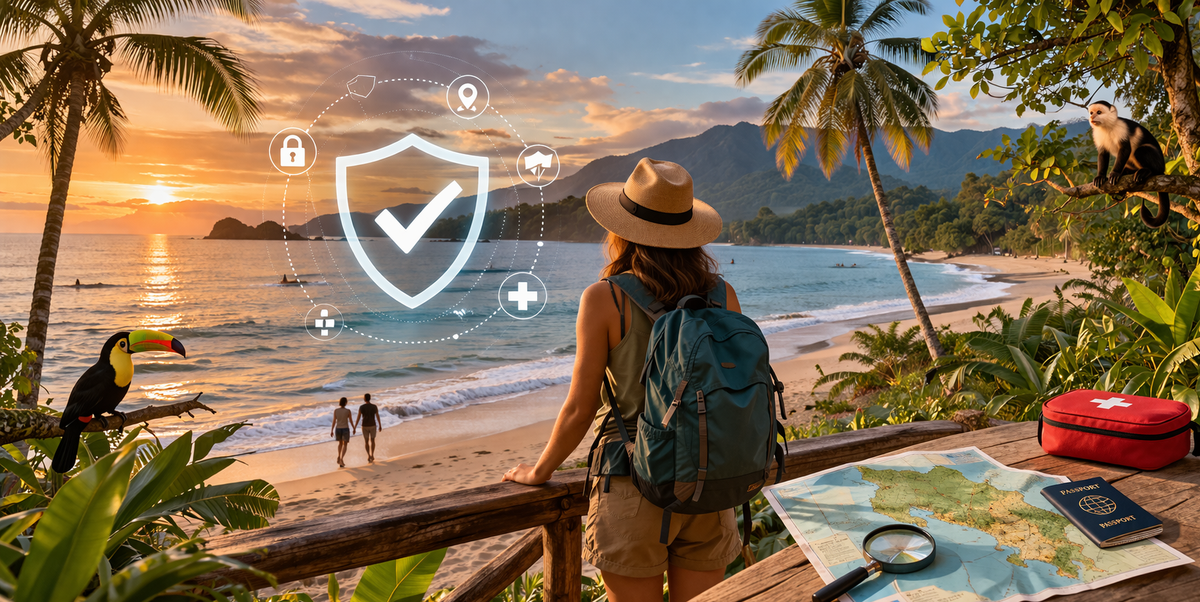
Over 1.6 million Americans travel to Costa Rica annually. The Pacific surf, Arenal volcano, Monteverde cloud forests, and wildlife found nowhere else on earth make it one of the most sought-after destinations in the Western Hemisphere. For travelers heading from the US, the topic of " Is it safe to travel to Costa Rica?” is at the forefront of mind for most first-time visitors, and the full answer goes well beyond a single advisory rating.
Before you fly, setting up a Jetpac eSIM for Costa Rica ensures navigation, embassy contacts, and transport apps are live the moment you clear immigration at Juan Santamaria Airport in San Jose, with no SIM card queue and no dead window between landing and connecting.
Costa Rica holds the top Central American ranking in the 2025 Global Peace Index, and no zone within the country carries a Level 3 or Level 4 designation.
The circuits tourists actually travel, from Guanacaste's Gold Coast to Arenal's lava fields to Manuel Antonio's national park, are all accessible.
The security picture in 2026
The Costa Rica travel advisory, last updated April 2, 2026, sits at Level 2: Exercise Increased Caution due to crime.
The same rating applies to France, Italy, and Germany. Understanding what the Costa Rica travel advisory actually covers is what separates a well-prepared visit from an anxious one.
The Level 2 rating reflects two crime categories. Property crime, including rental vehicle break-ins, beach theft, pickpocketing at bus terminals, and vacation rental burglaries, is the most common category affecting tourists.
Violent crime, including armed robbery and criminals forcing tourists to make ATM withdrawals under duress, is documented but concentrates in specific downtown San Jose neighborhoods rather than in resort zones and national parks.
If targeted, do not resist. Enroll in STEP at step.state.gov so the US Embassy can contact you directly.
Travelers researching whether it is safe to travel to Costa Rica right now will find that the Level 2 rating carries a precise, practical meaning that requires understanding which areas concentrate risk and how to move through them confidently.
Where is it safe, and where should one be careful
How safe is Costa Rica across the tourist zones Americans actually use? The risk profile shifts significantly by region.
San Jose has the highest tourist incident concentration, particularly downtown around Avenida Central and the main bus terminals. Escazu and Santa Ana, where most international visitors base themselves, carry considerably lower risk.
Guanacaste, covering Tamarindo, Nosara, Liberia, and the Papagayo Peninsula, is the most popular region for American visitors in 2026 and one of the most straightforward for first-time travelers.
The documented concern here is car break-ins at beach parking areas, not violent confrontations.
Manuel Antonio draws first-time visitors to its national park beaches, where beach theft is the primary risk.
Keep someone with belongings whenever any member of your group enters the water. Arenal and Monteverde record the lowest tourist crime rates in the country.
The Caribbean side, particularly Puerto Viejo and around Limon, carries higher crime than the Pacific coast.
Use reputable shuttle services and avoid isolated beach areas after dark on the Caribbean side.
Anyone researching whether Costa Rica is safe will find that the standard itinerary built around Guanacaste, Arenal, and Manuel Antonio remains entirely accessible when regional differences are respected, and valuables are not left unattended at any point.
What every American needs to know before arrival
For US citizens visiting Costa Rica for the first time, the entry process is more straightforward than in most international destinations.
No visa is required for tourism, with immigration typically granting up to 180 days, though the actual permitted duration is stamped at the border and is not guaranteed.
Carry a valid passport, proof of a return or onward ticket, and evidence of funds at the official minimum of $100 per month of your planned stay.
Your passport must be valid for the full duration of your stay and in good physical condition, as a damaged passport can result in denied entry.
Yellow fever vaccination is not required for travelers arriving directly from the US. It applies only to those arriving from Bolivia, Brazil, Colombia, Ecuador, Peru, French Guiana, or Venezuela.
A $29 airport tax applies on departure by air, typically included in ticket prices by major carriers.
Two rules that consistently surprise American visitors: marijuana and marijuana-related products are illegal in Costa Rica regardless of home-state laws, and foreigners are prohibited from participating in public demonstrations or protests, which can result in detention or deportation under Costa Rican law.
For US citizens traveling with minors born in Costa Rica, all Costa Rican minor children require a formal exit permit from immigration to leave the country, enforced without exception.
Consult the nearest Costa Rican consulate well before travel if this applies to your family.
The safety steps that separate smooth trips from difficult ones
The data behind is Costa Rica's safety for Americans is confirmed by the millions of annual visitors who travel the main tourist circuit safely each year, and it points to a consistent set of preparation habits that apply regardless of region.
Transport decisions carry the highest impact. Never approach or accept a ride from an unmarked vehicle. Use official orange taxis with a visible roof light, or book through Uber or InDriver for every journey.
At Juan Santamaria Airport and Daniel Oduber Airport in Liberia, the only legitimate pickup is the official licensed taxi desk inside the terminal.
Criminals posing as plainclothes police officers and asking to inspect documents or foreign currency are documented across the country.
Walk to the nearest official police station if approached. The Tourist Police operate a dedicated 24-hour English-language line at 2511-9260 for visitor incidents.
Rental vehicle security is the most-reported tourist crime category in Costa Rica. Never leave anything visible through a car window, and physically verify doors are locked before walking away, as thieves use signal-blocking technology to prevent remote locking.
Use ATMs inside bank branches or shopping malls only, never street-level machines after dark. Driving in Costa Rica carries specific challenges: rural and beach-town roads are often unpaved, poorly lit, and unmarked. Shuttle services between major destinations are recommended where possible.
Health hazards that deserve equal attention
The topic of whether it is safe in Costa Rica extends beyond crime to a set of health and natural hazards that require equal preparation before departure.
Dengue fever is a year-round risk in coastal and jungle areas below 6,500 feet in elevation, with all four dengue serotypes currently circulating in Costa Rica simultaneously.
Use DEET or picaridin-based repellent consistently, wear long sleeves and pants after dusk, and consult a travel health clinic about the QDENGA dengue vaccine before departure.
Rip currents are responsible for multiple US citizen drownings annually, making the ocean statistically more dangerous than crime.
Most Costa Rican beaches have no lifeguards. Always ask your accommodation specifically about beach conditions before entering the water, swim only in designated areas, follow flag systems, and never swim alone or after consuming alcohol.
Three volcanoes, Rincon de la Vieja, Turrialba, and Poas, are currently in elevated activity states. Check national park alerts before visiting any volcanic zone. Wildfires burn through Guanacaste between January and May.
The rainy season from April through October brings flooding and landslides to rural roads throughout the country.
Addressing the full picture of whether it is safe in Costa Rica means preparing for all of these hazards with the same attention given to urban crime awareness, since natural incidents account for a significant share of US tourist emergencies in the country.
Also Read
Is It Safe to Travel to Mexico Right Now?
Wondering if Mexico is safe to visit right now? Get the latest travel guidance, regional safety insights, crime trends, and practical tips to help you plan a secure and enjoyable trip.
Read More ↗Is It Safe to Travel to Brazil?
Is it safe to travel to Brazil now? Learn about current safety conditions, common risks, safer regions, and practical travel tips to help you plan a secure and enjoyable trip.
Read More ↗Is It Safe to Travel to Colombia?
Is it safe to travel to Colombia now? Learn about current safety conditions, common risks, safer regions, and practical travel tips to help you plan a secure and enjoyable trip.
Read More ↗Costa Rica Travel Tips
Planning a trip to Costa Rica? Discover essential travel tips, from best times to visit to local insights that make your trip smoother.
Read More ↗Will My Phone Work in Costa Rica?
Heading to Costa Rica? Check if your phone will work, understand network compatibility, and avoid connectivity issues on arrival.
Read More ↗Your connection across Costa Rica with Jetpac
A Costa Rica itinerary puts your phone to serious work. You might navigate San Jose traffic to a morning shuttle, check road conditions after overnight rain before driving toward Arenal, pull up trail maps on the Nicoya Peninsula with no nearby Wi-Fi, message your group's location from a Manuel Antonio beach, or locate the Tourist Police number after a car break-in at a trailhead. Every one of those moments requires consistent data, not just hotel lobby Wi-Fi.
eSIM plans for Costa Rica from Jetpac before you leave, activate automatically the moment your flight lands at Juan Santamaria.
No counter at the airport. No delay. No scramble for Wi-Fi to find your transfer confirmation. Standard International Roaming from US carriers typically costs $10 to $15 per device per day.
One Jetpac plan replaces that with a single flat prepaid rate covering every device in your group from first arrival to final departure.
The question of whether it is safe to travel to Costa Rica right now has a clearer practical answer when your tools work from the moment you land.
Rip current warnings, emergency shuttle updates, road closure alerts, and the Tourist Police line at 2511-9260 all require consistent connectivity to be useful.
An eSIM for Costa Rica through Jetpac means those tools remain live throughout every destination on your itinerary, from volcanoes to coastlines to jungle lodges.
The data consistently shows that it is safe to travel to Costa Rica right now for the millions of Americans who visit each year, and Jetpac ensures the connectivity that makes all of that possible from the moment you touch down.
📡 One plan, every destination: From San Jose's urban grid to Monteverde's cloud forest to a Pacific beach in Guanacaste, one Jetpac plan keeps every device connected with no per-device charges
🗺️ Maps and messages stay on at zero balance: Trail navigation near Corcovado, Uber booking in San Jose, and WhatsApp check-ins from Arenal all keep working even after data hits zero
⚡ Strongest available signal, always: Jetpac connects to whichever Costa Rican carrier has the best signal at your location, from 5G in the capital to remote areas along the Osa Peninsula
💸 Up to 70% less than daily US carrier roaming: One flat prepaid cost replaces a per-day, per-device charge that compounds across a week-long trip
📞 Calls at $1.99 per 5 minutes: Reach the Tourist Police at 2511-9260, the US Embassy, your tour operator, or accommodation directly through the Jetpac app
✅ 24/7 WhatsApp and email support: Jetpac ensures that you are never stuck in between with its dedicated customer support on WhatsApp and email.
FAQs
What is the current Costa Rica travel advisory level?
Level 2: Exercise Increased Caution, last updated April 2, 2026. Crime is the sole basis, and no regions carry higher designations. Enroll in STEP at step.state.gov for live embassy updates throughout your trip.
Is Costa Rica safe for families traveling in 2026?
Yes. Guanacaste, Arenal, and Manuel Antonio are well established for family travel. Supervise children at all beaches, follow guidance near volcanic zones, and use DEET repellent consistently in jungle and coastal areas.
Is Costa Rica a safe place to visit for solo travelers?
Yes. Solo travel on the main tourist circuit is well established. Use app-based transport for every journey, avoid solo beach walks after dark, and save both 911 and the Tourist Police line at 2511-9260 before you land.
Is Costa Rica safe for Americans visiting major cities?
Yes, in established tourist districts with standard precautions applied. San Jose's neighborhoods of Escazu and Santa Ana carry considerably lower risk than the downtown area, particularly after dark.
What should I do in an emergency in Costa Rica?
Call 911 for all emergencies. Contact the Tourist Police English-language line at 2511-9260 for tourist-specific incidents. Reach the US Embassy in San Jose at +506 2519-2000. Always file a police report for any incident.
Is it safe to travel to Costa Rica during the rainy season?
Yes, with flexible planning. The rainy season runs from April through October and brings flooding and landslides on rural roads. Check road conditions daily and build flexibility into your itinerary when moving between regions.
Disclaimer
This information is based on publicly available data at the time of writing and is for general reference only. Safety conditions, travel advisories, and local risks may change. Jetpac is not responsible for network performance or third-party data accuracy. No destination or service is endorsed. Travelers, especially those from the US, should verify current Costa Rica travel advisory updates, entry requirements, and local conditions before travel. Connectivity and eSIM performance may vary by device, carrier, and coverage area.