
18 Travel Tips for Senior Citizens: Health, Safety, and Savings
Senior citizens can travel with greater confidence by following these travel tips for senior citizens on health, safety, accessibility, comfort, and savings.
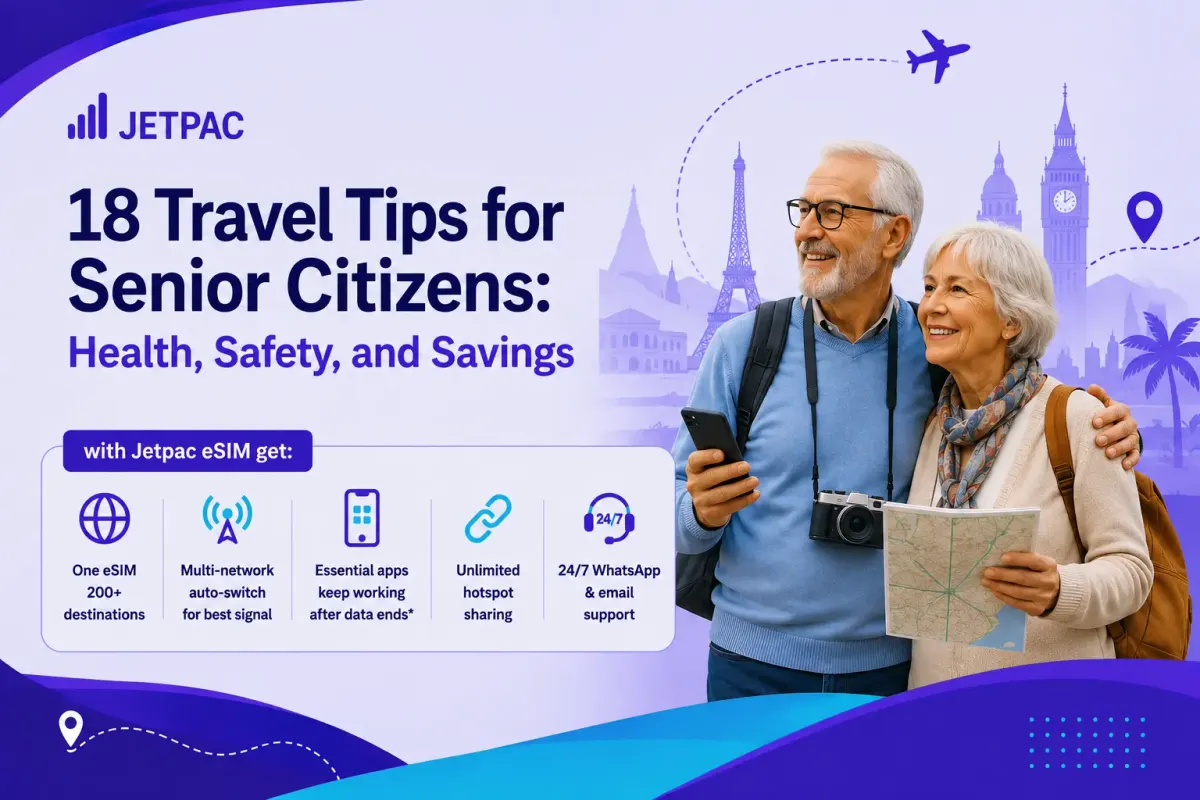
Travel does more than fill a passport with stamps — research consistently links it to improved mood, sharper cognitive engagement, and stronger social connection in later life. Age doesn't have to shrink the map; thoughtful preparation just makes sure the trip matches your comfort and pace.
Older Americans are traveling more than ever, a 2025 AARP study found senior travel at a record high, with more retirees taking multiple trips a year than at any point in the last decade. Age is no barrier to exploring the world, but thoughtful preparation still makes the biggest difference to comfort, health, and confidence when traveling later in life.
This guide covers 18 travel tips for senior citizens in 2026, from health preparation and flight comfort to safety, budgeting, and staying connected — reviewed against current CDC, TSA, and travel-insurance guidance so you're planning with up-to-date information, not outdated advice.
This guide was researched and fact-checked against current CDC, TSA, State Department, and travel-insurance guidance for 2026, so you're planning with up-to-date rules rather than outdated advice that's since changed.
Key Takeaways
- Senior travel is at a record high — but preparation still matters more than age.
- A pre-travel health review, correctly packed medication, and the right insurance prevent most common travel disruptions.
- Small, often-missed rules — REAL ID, TSA PreCheck eligibility, medication import limits — can derail a trip if checked too late.
- Staying connected with a reliable eSIM and a VPN removes one of the biggest sources of arrival-day stress.
| Before Travelling | What to Confirm |
|---|---|
| Health review | Fitness for the trip, recommended vaccines, prescriptions, and destination-specific health risks. |
| Medication | Carry enough medication, keep it in original packaging, bring prescription copies, and pack it in your carry-on bag. |
| Insurance | Check cover for medical treatment, pre-existing conditions, trip cancellation, and emergency evacuation. |
| Mobility support | Arrange airport wheelchair assistance, boarding support, accessible transfers, and suitable accommodation if needed. |
| Travel documents | Verify passport validity, visas, insurance documents, prescriptions, and emergency contact details. |
| Transport | Confirm direct routes where possible, connection times, seating preferences, and baggage assistance. |
| Accommodation | Check for lifts, step-free access, bathroom accessibility, bed height, and proximity to attractions. |
| Communication | Ensure your phone works abroad, save emergency contacts, arrange roaming or a travel eSIM, and keep offline copies of important documents. |
| Budget | Look for senior discounts, travel on flexible dates, estimate local transport costs, and keep contingency funds. |
| Emergency plan | Know the nearest medical facility, keep your insurer's contact details handy, schedule family check-ins, and have a backup transport plan. |
Health and medical preparation
1. Arrange a pre-travel health review
Speak with a healthcare professional before a major international, high-altitude, cruise, or long-haul trip, particularly when managing chronic conditions or a recent health change. The consultation may cover destination risks, vaccines, medication timing across time zones, and long-flight concerns.
The CDC recommends checking destination pages for vaccines and current health risks before international travel. This is one of the most foundational travel tips for senior citizens before any significant departure.
Routine vaccines — including MMR, seasonal flu, and tetanus — should be current before departure. More than half of tetanus cases in the US occur in adults over 65, making a booster worth checking on before a trip.
Some destination-specific vaccines, such as yellow fever, carry age-related precautions for travelers over 60, so this is worth discussing directly with a doctor rather than assuming standard dosing applies.
2. Choose a trip that matches your health and mobility
The strongest travel tips for seniors start with matching the destination to current abilities rather than what was manageable years ago. Evaluate walking distances, heat, altitude, toilet access, and local healthcare before booking.
A destination may be technically safe while still being unsuitable for someone managing steep paths, long transfers, or extreme temperatures. The distinction between possible and comfortably enjoyable matters enormously at the planning stage.
3. Carry medication in your hand luggage
Never place essential medication in checked luggage. Carry enough for the trip plus a delay allowance, keep a current medication list, and bring prescription copies for controlled substances.
The National Council on Aging recommends keeping a list of medications, doctors, and nearby pharmacies at the destination. Check destination rules for restricted medicines before departure, retain original packaging, and keep medical devices in a separate accessible bag.
Counterfeit medications are common in some destinations. Only carry medicine brought from home rather than purchasing replacements abroad, even from a pharmacy.
A few extra precautions make prescription travel smoother:
Carry a letter from your doctor describing your medical conditions, allergies, and current medications — this can prevent delays or questions at customs and immigration.
Know your medication's generic name, not just the brand name. Pharmacies abroad often recognize generic names more reliably than U.S. brand names if you ever need a refill.
If a medication requires refrigeration, pack it in an insulated bag for transit and request a hotel room with a small refrigerator on arrival.
4. Check medical and travel insurance coverage carefully
Standard cancellation insurance may not cover adequate overseas medical care. Verify pre-existing condition cover, emergency treatment, hospital stays, evacuation, and trip cancellation terms before purchasing any policy.
For US seniors, Original Medicare generally offers limited overseas medical coverage. Some Medicare Advantage or Medigap plans may provide additional benefits. Confirm your own plan rather than assuming coverage abroad.
Original Medicare and Medicaid do not cover medical costs outside the United States. Some Medicare Advantage or Medigap plans offer limited overseas benefits, but coverage varies significantly — confirm directly with your plan provider rather than assuming any coverage carries over. This is precisely why standalone travel medical insurance matters more for seniors than for younger travelers.
5. Prepare a medical and emergency information pack
Carry paper and digital copies of emergency contacts, doctor's details, medical conditions, allergies, medication list, and insurance policy number. A traveling companion should know exactly where this pack is stored.
Among the best travel safety tips for seniors, preparing an emergency information pack is the one most often overlooked until it is urgently needed.
📖 Read more: Managing travel costs carefully makes a real difference on longer trips and fixed budgets. This guide covers 20 practical money-saving strategies that work across all trip types and destinations. 👉 How to Travel on a Budget: 20 Smart Money-Saving Travel Tips
Flights, transport, and comfort
6. Book the simplest route, not just the cheapest flight
The lowest airfare often involves long walks, short connections, overnight layovers, or exhausting departure times. These are among the most important travel tips for seniors who find busy hub airports physically demanding.
Prioritize direct flights, longer connection windows, daytime arrivals, and shorter ground transfers. Avoid self-transfer itineraries where possible.
7. Request airport and airline assistance early
Wheelchair assistance suits anyone who cannot comfortably manage long airport distances or tight connections, not only travelers who use one daily. US airlines are legally required under the Air Carrier Access Act to provide mobility assistance at no charge to eligible passengers.
TSA Cares provides dedicated assistance for passengers with medical conditions and disabilities through US security screening. These airport traveling tips reduce physical strain considerably and apply equally to travel tips for first-time flyers navigating large hub terminals for the first time.
Know the REAL ID and TSA PreCheck rules
Since May 2025, a REAL ID-compliant driver's license or ID card is required to fly domestically within the US — a standard passport also works. Check your license for the star marking in the corner before booking; a non-compliant ID can mean being turned away at security.
Travelers aged 75 and older are generally allowed to use TSA's PreCheck lane even without PreCheck membership — shoes, laptops, and liquids can stay in your carry-on. Travelers under 75 who want the same benefit can apply for TSA PreCheck (US domestic flights) or Global Entry (which includes PreCheck plus expedited international arrivals). Both require a non-refundable application fee and processing time of several weeks, but membership lasts five years.
8. Senior travel hacks for comfortable seating
Senior travel hacks for comfortable seating begin with reviewing the aircraft seat map before booking rather than accepting a default assignment. Aisle seats allow easier toilet access and room to stand without climbing past other passengers.
Bulkhead and legroom seats offer more space but may require overhead bag storage and carry exit-row eligibility restrictions on some aircraft. Check the seat map carefully since configurations differ across plane types.
Applying senior travel hacks for comfortable seating in advance avoids avoidable discomfort on departure day.
9. Move, hydrate, and pace yourself on long journeys
Sitting still for long periods increases the risk of deep vein thrombosis (DVT) — blood clots that form in the legs during long flights. This risk is higher for travelers who've had recent surgery, hospitalization, or a family history of clotting, or who are managing certain chronic conditions.
Standing and walking the aisle every hour, wearing compression socks, and staying hydrated all help reduce this risk; anyone in a higher-risk group should ask a doctor about additional precautions before flying.
Drink water regularly, limit alcohol, stand and move when safe, and perform gentle seated exercises on long flights. Wear comfortable, non-restrictive clothing and keep medicine accessible throughout the journey.
Travelers with circulation concerns should seek personalised medical advice from a doctor before flying.
10. Pack light and use manageable luggage
Heavy luggage increases fatigue and fall risk. Use a lightweight wheeled case and pack outfits that can be mixed and re-worn. Traveling light is among the simplest travel tips for seniors to implement and one of the most impactful for comfort across any journey.
The practical rule: never pack more than you or your companion can safely manage at every point in the journey.

📖 Read more: Smart travel hacks save considerable time and reduce costs at every stage of a trip. This guide covers 18 of the most effective strategies for travelers looking to move smarter and spend less. 👉 18 Best Travel Hacks That Will Save You Money & Time in 2026
Accommodation and itinerary planning
11. Confirm accessibility directly with the accommodation
Never assume a hotel is accessible based on its listing alone. Ask specifically about step-free entrance, lift access, walk-in shower, grab rails, shower seat, bed height, and door width before confirming a booking.
Accessibility standards vary significantly across countries, particularly in older European buildings and historic districts. Request written confirmation when a feature is essential to your comfort or mobility on the trip.
12. Build rest into the itinerary
The biggest mistake older travelers make is scheduling each day according to what looks achievable on paper rather than what remains enjoyable in practice.
Plan one main activity per half-day, allow time between attractions, and keep at least one flexible day per week. Staying longer in fewer places consistently protects energy for the experiences that matter most.
13. Plan around food, hydration, toilets, and daily routines
Plan for regular meal times, dietary needs, accessible toilets, medication schedules, shade, and seating throughout each day. These practical details quietly determine whether a day feels comfortable or draining.
This is especially important when traveling with elderly parents, because family members often underestimate how disrupted routines affect comfort, mood, and stamina across a full day of activity.
📖 Read more: The right travel apps simplify navigation, translation, and real-time bookings from any destination. This guide covers the 26 best travel apps for planning trips like a pro in 2026. 👉 26 Best Travel Apps for Planning Trips Like a Pro in 2026
Safety and family travel
14. Protect documents, money, and personal information
Carry only daily-use cash, use a secure cross-body bag, and keep backup cards in a separate location from your main wallet. Avoid public discussion of room numbers and use only licensed transport.
The best travel safety tips for seniors include checking common local scams before arrival and avoiding unprotected public Wi-Fi for sensitive account access. Completing an international travel checklist before departure reduces the risk of arriving without essential documents. These are among the key travel tips for senior citizens that apply equally on domestic and international trips.
For extra peace of mind in tourist-heavy destinations, favor cash over cards for smaller purchases — it reduces exposure to card-skimming and fraud, which are especially common in high-traffic tourist areas. Check with your home bank about fee-free ATM withdrawals abroad before you go, and always call your card issuer ahead of the trip so legitimate purchases aren't mistaken for fraud and blocked.
15. Stay connected without depending on public Wi-Fi
A working phone supports maps, translation, airline updates, hotel communication, emergency contacts, and family check-ins. Relying solely on public Wi-Fi creates security risks and connectivity gaps at critical moments.
Not every phone or plan works seamlessly once you leave the country — checking compatibility before departure, rather than discovering a dead phone at the arrivals gate, is one of the simplest planning steps a senior traveler can take.
An international eSIM provides mobile data without removing a physical SIM from the device. A travel eSIM installs digitally before departure, removing the need to find or configure a local SIM after a long journey. When selecting the best eSIM for international travel, confirm phone compatibility, destination coverage, plan duration, and support availability.
A solo travel tips guide consistently recommends securing reliable data access before departure rather than sourcing connectivity at the destination airport.
16. Agree on roles when traveling with elderly parents
Tips for traveling with elderly parents begin with a clear agreement before departure. Decide who manages insurance details, medication, transport timings, and emergency decisions before leaving home.
When traveling with elderly parents, involve the older traveler fully in destination and itinerary decisions. These tips for traveling with elderly parents work best when the goal is practical support without removing independence.
📖 Read more: Women traveling independently benefit from targeted safety advice covering accommodation, transport, and personal security. This guide covers expert guidance for navigating unfamiliar destinations safely and with confidence. 👉 20 Travel Safety Tips for Women: Expert Advice
Savings and common mistakes
17. Use flexible dates, senior discounts, and slower travel to save
Older travelers often have more date flexibility than families tied to school schedules. Travel during shoulder season, compare midweek departures, and ask about senior rates at rail networks, museums, and public transport. Eligibility ages and conditions vary by provider.
Stay longer in fewer destinations, choose accommodation with kitchen facilities, and book refundable rates where health uncertainty exists. Setting up a mobile data plan before departure avoids one of the most preventable travel costs in 2026.
18. Avoid the most common senior travel mistakes
Senior travel mistakes to avoid include overloading the itinerary, hiding medical conditions from an insurer, packing medicine in checked luggage, booking tight connections, and assuming all hotels have accessible facilities.
The biggest mistake older travelers make is overestimating stamina at the planning stage, which then creates several of these problems simultaneously.
Ignoring insurance age exclusions and medication import rules are also among the travel tips for seniors most commonly missed before departure.
Enroll in the State Department's free traveler alert program
Before an international trip, enroll in the Smart Traveler Enrollment Program (STEP) — a free U.S. State Department service that sends safety and security alerts for your destination directly from the local embassy or consulate. STEP also makes it significantly easier for family to reach you, or for the embassy to reach your emergency contact, if something goes wrong while you're abroad.
Alongside STEP, notify both your bank and your credit card companies of your travel dates before departure. Unexpected overseas charges are one of the most common reasons accounts get frozen mid-trip — a quick call or app notification beforehand avoids being locked out of your funds far from home.
Protect against the leading cause of preventable harm while traveling
Injury, not illness, is the most common cause of preventable harm for international travelers, and road accidents are a major contributor. A few precautions lower the risk significantly:
- Always wear a seatbelt, including in taxis and rideshares
- Avoid riding in vehicles at night in destinations with less-regulated roads
- Skip motorcycles where possible; wear a helmet if riding is unavoidable
- Use only licensed, marked taxis
- Avoid overcrowded or overloaded buses and vans
- Learn local traffic patterns before crossing streets, especially in countries that drive on the opposite side to home
Are there international travel restrictions for senior citizens?
There is no single worldwide age limit that prevents senior citizens from traveling internationally. International travel restrictions for senior citizens typically relate to the destination, transport provider, insurance policy, medication, or planned activity rather than age alone.
Check destination health and vaccine requirements, medication-import rules, airline medical forms, and travel-insurance age bands before booking. Among the best travel safety tips for seniors, reviewing insurance restrictions well in advance is the step most frequently skipped.
International travel restrictions for senior citizens at the insurance level often include age limits or pre-existing condition exclusions that appear only in the fine print. Senior travel mistakes to avoid at this stage include assuming standard domestic policies apply internationally without reading the full terms.
Verify rules directly with official destination authorities, your airline, insurer, and any cruise or rental provider before committing to a booking.
📖 Read more: Knowing which destinations have the most stable safety environments helps senior travelers and families plan international trips with greater confidence. 👉 Top 15 Safest Countries in the World to Visit
Staying connected as a senior traveler
One of the most practical travel tips for senior citizens in 2026 is arriving at the destination with mobile data already active on your phone. A connected phone from the moment you land removes the stress of searching for airport Wi-Fi while tired from a long journey.
Jetpac's international eSIM covers 200+ destinations on a single plan and installs digitally before departure, connecting automatically on landing without requiring a SIM card swap or a visit to a local phone shop.
For senior travelers managing multi-country itineraries, the best eSIM for international travel set up in advance removes a significant source of arrival-day stress. A reliable travel eSIM is one of the most practical pre-departure decisions any senior traveler can make.
Jetpac travel eSIM provides 24/7 WhatsApp support, unrestricted hotspot sharing for travel companions, and a 100% money-back guarantee. On data packs of 3 GB and above, essential apps including Google Maps stay active even after the high-speed allowance is used.
Final thoughts on travelling safely and comfortably as a senior
These travel tips for seniors consistently point to the same foundations: preparation, realistic pacing, suitable insurance, accessible arrangements, and dependable communication throughout the trip.
These travel tips for senior citizens apply whether planning a first overseas trip or returning to a long-loved destination. Choose a trip that matches current ability, carry medication and documents correctly, use available assistance, build rest into the schedule, and stay connected throughout.
Thoughtful planning expands what is possible rather than narrowing it.

Sources
- AARP. "Older Americans Are Traveling More Than Ever, Says 2025 AARP Study." March 6, 2025.
- Centers for Disease Control and Prevention. Travel Health Guidance for Senior Citizens. cdc.gov/travel
- Transportation Security Administration. TSA Cares and PreCheck Eligibility. tsa.gov
- National Council on Aging. Prescription Medication Use Among Adults 65+. National Health Statistics Report No. 209, Sept 2024.
- U.S. Department of Homeland Security. REAL ID Requirements.
FAQs
Is there an age limit for international travel?
There is no single worldwide age limit for international travel. Restrictions depend on the destination, transport provider, insurance policy, or medical condition rather than age alone.
Should senior citizens get medical clearance before flying?
Not always. A pre-travel consultation is recommended before major international, long-haul, or high-altitude trips, particularly when managing a chronic or recently changed health condition.
How should older adults carry prescription medication abroad?
Carry all essential medication in hand luggage with original packaging, a current medication list, and prescription copies for controlled substances. Check destination medication import rules before departure.
Can senior travellers request free wheelchair assistance at airports?
Yes. US airlines are required under the Air Carrier Access Act to provide wheelchair and mobility assistance at no charge to eligible passengers. Contact the airline directly before travel to arrange this.
What type of travel insurance is best for seniors with pre-existing conditions?
Look for a policy explicitly covering pre-existing conditions, emergency treatment abroad, evacuation, and trip cancellation. Check age limits and exclusions carefully before purchasing any plan.
How can older travellers stay comfortable on a long-haul flight?
Choose an aisle seat, drink water regularly, limit alcohol, move periodically, and keep medicine accessible. Travelers with circulation concerns should consult a doctor before flying.
What should I consider when travelling with an elderly parent?
Agree on roles before departure, involve the parent in planning decisions, confirm accommodation accessibility, build rest into each day, and prepare a clear emergency information pack.
Do airlines or attractions offer senior-citizen discounts?
Many do, but eligibility ages and conditions vary significantly by provider. Ask directly when booking and check rail networks, museums, and public transport for available senior rates at each destination.
Disclaimer
All information in this guide reflects general travel advice based on data available in 2026. Entry requirements, insurance policies, airline rules, and health recommendations change frequently. Verify all details directly with official authorities, insurers, airlines, and accommodation providers before booking.