What Does SOS Mean and When Should You Use It?
SOS is not an acronym. It is a Morse code distress signal chosen for its simplicity: three dots, three dashes, three dots. The SOS meaning covers maritime emergencies, phone emergency features, and any life-threatening situation where immediate rescue is needed.
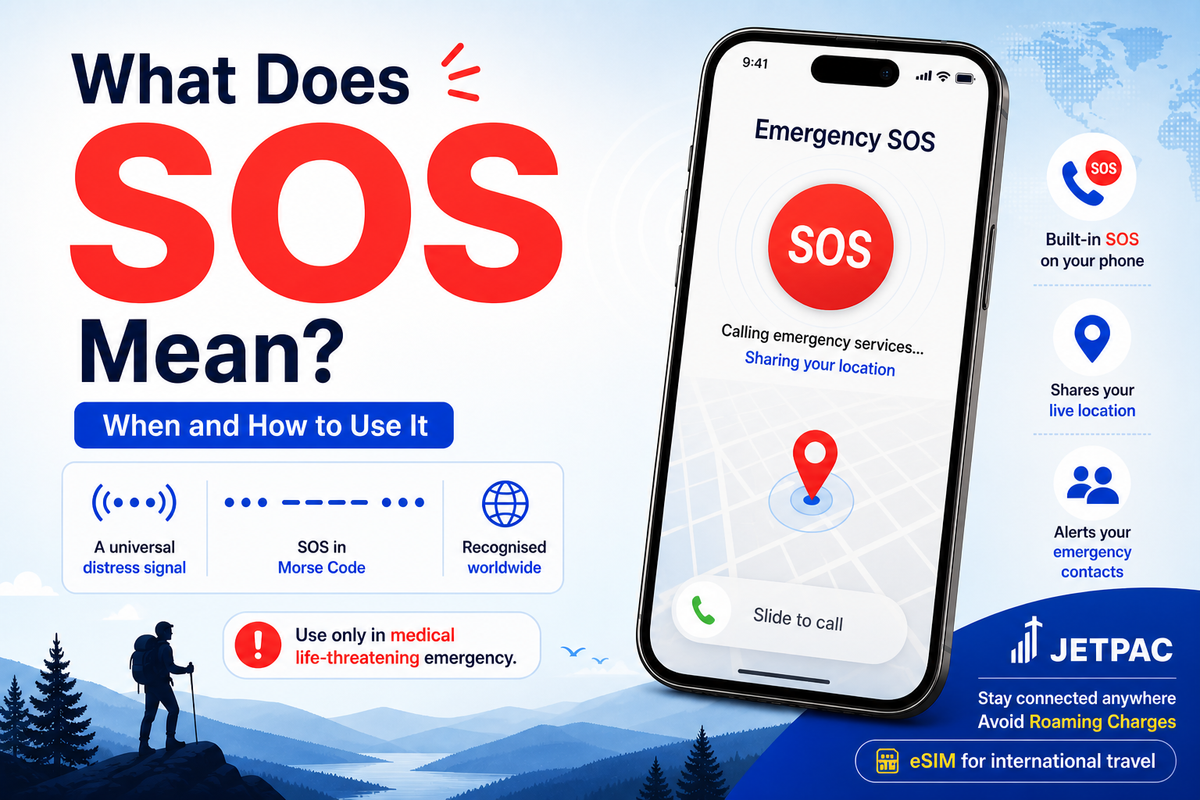
SOS is an internationally recognised distress signal used when life is in immediate danger, and help is urgently needed. Most people assume it stands for something. It does not. The SOS meaning has no connection to words or phrases. "Save Our Souls" and "Save Our Ship" were invented after the signal was already in use. SOS was chosen for one reason: how it works in Morse code. Three dots, three dashes, three dots. Simple enough to tap out under pressure. Unmistakable enough that no one could confuse it with anything else.
What Does SOS Stand For?
That is the factual answer, and it surprises most people.
Is SOS Really an Acronym?
SOS is not an acronym and was never meant to be one. The 1918 Marconi Yearbook of Wireless Telegraphy and Telephony puts it plainly:
"This signal was adopted simply on account of its easy radiation and its unmistakable character. There is no special significance in the letters themselves."
Then, Where Did "Save Our Souls" Come From?
"Save Our Souls" and "Save Our Ship" are backronyms: phrases invented after the fact to make sense of letters that had no original meaning. During the British government inquiry into the Titanic disaster in 1912, the Attorney General himself believed SOS stood for "save our souls." That version stuck and has been repeated ever since.
What does SOS stand for in practice today is simply this: someone needs rescue right now. Beyond its technical meaning, SOS has also become everyday shorthand for any desperate appeal for help, a figurative use documented as far back as 1918 and now common in texting, social media, and everyday speech.
When someone says "I need an SOS," they mean they are overwhelmed and need help fast. The signal earned that meaning honestly.
SOS in Morse Code
What Is the SOS Pattern and Why Was It Chosen?
SOS in Morse code is three dots, three dashes, three dots, sent as one unbroken sequence with no gaps between the letters.
In Morse code, a dot is the shortest signal possible, and a dash is three times longer. The letter S is three dots, and the letter O is three dashes. Put them together without spaces, and you get one of the most rhythmically distinct patterns in the entire alphabet. It cannot be confused with anything else. A trained operator can send it in seconds. An untrained person can tap it out on a rock.
When Was SOS Officially Adopted?
Three dates define the history of the signal. Each one changed how the world communicates in a crisis.
SOS first appeared in German maritime radio regulations. It was a national standard before the world caught up.
The International Radiotelegraph Convention in Berlin made SOS the universal distress signal. Before this, different countries used different codes. British Marconi operators preferred CQD.
The Titanic used both CQD and SOS alternately after striking an iceberg. It became one of the most documented distress transmissions in history.
The Global Maritime Distress and Safety System (GMDSS) became the primary maritime protocol, replacing SOS as the official standard.
How Can You Signal SOS Without a Radio?
The practical beauty of the signal is that it does not need a radio. Three short, three long, three short works across any medium.
Scratched into sand or packed snow, SOS reads identically upside down, which makes it unusually practical as a ground signal for rescue aircraft overhead.
Is SOS Still Used Today?
SOS is still internationally recognised as a valid backup distress signal when all other systems have failed, even after GMDSS took over as the primary protocol in 1999.
SOS remained the official maritime radio distress signal until February 1, 1999, when the Global Maritime Distress and Safety System took over. More than a century after its adoption, the pattern endures.
SOS Emergency Meaning: When to Use It and When Not To
What Are the Three Levels of Distress Signals?
SOS emergency's meaning is precise: immediate risk to life. It helps to know where it sits among the three internationally recognised distress levels.
Life is at risk and rescue is needed right now. Brings helicopters and a coast guard response.
Serious situation needing attention, but not immediately life-threatening. A developing medical issue or engine failure in a shipping lane. Brings a vessel check.
A navigational safety warning, such as debris in the water ahead. Informational, not a call for rescue.
Knowing which level applies matters. Using the wrong signal sends the wrong response.
When Should You Send an SOS?
These situations share one thing: normal channels are not fast enough.
- A hiker has a broken leg on a remote trail with no way out and no signal for a standard call
- A boat is taking on water
- A medical emergency on a mountain road with no passing traffic and no other way to get help in time
- A car has broken down, but everyone is safe
- A trail is harder than expected, but no one is hurt
- A flight has been cancelled
What Should You Do After Sending SOS?
Stay where you are unless your current position creates additional danger.
Keep signalling at intervals so rescuers can track your position.
Save your phone battery by lowering screen brightness and closing everything you do not need.
If you moved to send the signal and got a response, return to your last safe position and wait there.
Also Read
How to Make International Calls
Need to call abroad without high charges? Learn how to make international calls using the most cost-effective methods while traveling.
What Is International Roaming?
Confused about roaming? Understand what international roaming means, how it works, and why it can impact your travel costs.
Data Roaming in the USA
Traveling within the US? Learn how data roaming works in the USA and how to manage your usage to avoid extra charges.
Current Period Roaming Mean on iPhone
Seeing “current period roaming” on your iPhone? Understand what it means, how to track your data usage, and avoid unexpected charges.
What Does SOS Mean on Your Phone?
Your phone has an emergency feature built in that most people have never tested. What does SOS mean on your phone in practical terms: a single action that calls local emergency services, shares your GPS coordinates, and messages your emergency contacts — all at once, without unlocking your screen or opening a single app.
Emergency SOS on your phone dials the local emergency number of whatever country you are in, not a fixed number. Your phone handles the routing automatically based on your location.
How Does iPhone Emergency SOS Work?
Press and hold the side button and either volume button at the same time.
Keep holding until the Emergency SOS slider appears, then drag it.
If you keep holding past the slider, a countdown starts and the call connects automatically when it ends.
When Emergency SOS is triggered, your Medical ID is automatically shared with emergency services. Add blood type, allergies, and medications now.
Does iPhone Work Without Signal in an Emergency?
On iPhone 14 or later running iOS 16.1 or later, Emergency SOS via Satellite texts emergency services when you have no cellular signal and no Wi-Fi. Point the phone toward the sky and follow the on-screen guidance. The message routes through Apple's satellite network.
iPhone 14 or later, iOS 16.1 or later. No cellular or Wi-Fi needed. Free for eligible devices. Availability varies by country.
Press and hold the side button, then drag the Emergency Call slider. Works independently, even without your iPhone nearby. Critical in falls or sudden medical events.
How Does Android Emergency SOS Work?
Android Emergency SOS is not universal. The activation method varies by manufacturer.
There is no single method that works across all Android devices. Confirm yours is enabled before your trip, not during an emergency.
Once inside, set up your personal information, confirm your activation method is on, and save your emergency contacts.
What If You Are in a Truly Remote Area?
Phone Emergency SOS needs cellular signal, Wi-Fi, or satellite coverage to work. Where none of those exist, dedicated satellite communicators are significantly more reliable.
Garmin inReach and ACR ResQLink Personal Locator Beacons (PLBs) broadcast on the 406 MHz distress frequency monitored by the COSPAS-SARSAT international satellite rescue network. This operates independently of any phone carrier.
For serious hiking, offshore sailing, or any trip into genuinely remote terrain, knowing these options exist is part of responsible preparation.
Staying Connected in an Emergency Abroad
Why Does Data Matter in an Emergency?
An emergency abroad hits differently from one at home. You are in an unfamiliar place, possibly without a working local number, and your US carrier is running up $10 to $15 in roaming charges every single day. If your data runs out mid-trip, maps, messaging, and your emergency contacts all go dark at the same moment. That is not just an inconvenience. In the wrong situation, it is a serious problem.
How Does a Travel eSIM Help?
An eSIM for international travel from Jetpac solves this before it starts. It activates via QR code before you leave home, so the moment you land at a foreign airport, your connection is live. No SIM swap at the airport. No store to find. No gap in coverage at the worst possible time.
WhatsApp, Google Maps, and Uber stay fully active after your allowance is used. A traveler who burns through their data on a remote hike still has location sharing and messaging to reach their emergency contact.
Activates via QR code before departure. Switches automatically to the strongest available local carrier wherever you are.
No roaming bill waiting when you return. Plans start from $1, transparent pricing, no hidden fees.
One plan covers every device in your group. Share across phones, tablets, and laptops without extra charges.
Calls landlines and non-WhatsApp numbers in 50+ countries. Call a local emergency line or local guide directly from the Jetpac app without a local SIM.
24/7 support via WhatsApp and email. The best eSIM for international travel is the one that keeps working when everything else stops.
If your flight is delayed by more than 1 hour, Jetpac includes access to 1,300+ airport lounges worldwide. Register yourself and one travel companion at least 24 hours before departure.
FAQs
What does SOS mean?
SOS is an internationally recognised distress signal for life-threatening emergencies. The SOS meaning is not connected to any words or acronyms. "Save Our Souls" and "Save Our Ship" are backronyms invented after the fact. SOS was adopted in 1905 because of its simplicity and clarity in Morse code, nothing more.
What does SOS stand for?
Nothing. The 1918 Marconi Yearbook confirms this directly. SOS was chosen for how it transmits in Morse code, not for what the letters might spell. Every phrase attached to it, including "Save Our Souls" and "Save Our Ship," was invented after the signal was already in global use.
What is SOS in Morse code?
SOS in Morse code is three dots, three dashes, three dots (··· - - - ···) sent as one continuous sequence. Three short, three long, three short again. It can be sent by radio, flashlight, whistle, or any repeatable method. The pattern was chosen because it is simple under stress and impossible to confuse with any other code.
What does SOS mean on your phone?
It triggers a call to local emergency services, shares your GPS location, and alerts your emergency contacts simultaneously. The number it dials is the local emergency number wherever you are: 911 in the US, 999 in the UK, 112 across Europe.
On iPhone, press and hold the side button and a volume button together, or enable the five-press method via Settings → Emergency SOS → Call with 5 Button Presses.
On Android, the method depends on your manufacturer; go to Settings → Emergency SOS on your specific device and confirm it is enabled before you travel.
When should you use an SOS signal?
Only when life is immediately at risk: a serious injury in a remote location, a vessel taking on water, a medical emergency where standard help cannot reach you in time. For serious but non-life-threatening situations, Pan-pan is the right signal. Sending an SOS when it is not warranted diverts rescue resources and is a criminal offence in several countries.
What is the difference between SOS and Mayday?
SOS is a Morse code distress signal sent as dots and dashes. Mayday is its spoken equivalent, adopted at the 1927 International Radio Convention for voice communication. Mayday comes from the French m'aider, meaning "to help me." Both signal the same thing: an immediate threat to life. SOS is for coded or written transmission. Mayday is for speaking directly over radio.
Disclaimer
This blog is for informational and educational purposes only. Historical facts about SOS and Morse code are sourced from Online data and official convention records. Emergency SOS phone features are based on Apple Support documentation and publicly available device information as of May 2026 and are subject to change with software updates. Verify your specific device's activation method in Settings before travel. Apple Emergency SOS via Satellite availability varies by country and device; verify current coverage at apple.com. Android Emergency SOS activation varies by manufacturer and software version; check your specific device settings. Medical ID features described are based on Apple's publicly available documentation; verify current functionality on your device. Dedicated satellite communicator devices operate independently of phone networks; verify coverage and registration requirements before purchase. Emergency procedures, local emergency numbers, and distress signal laws vary by country; always verify local emergency numbers before travel. Jetpac is not responsible for network variations, third-party data accuracy, or decisions made based on this content. No endorsement of any service or third-party device is implied.